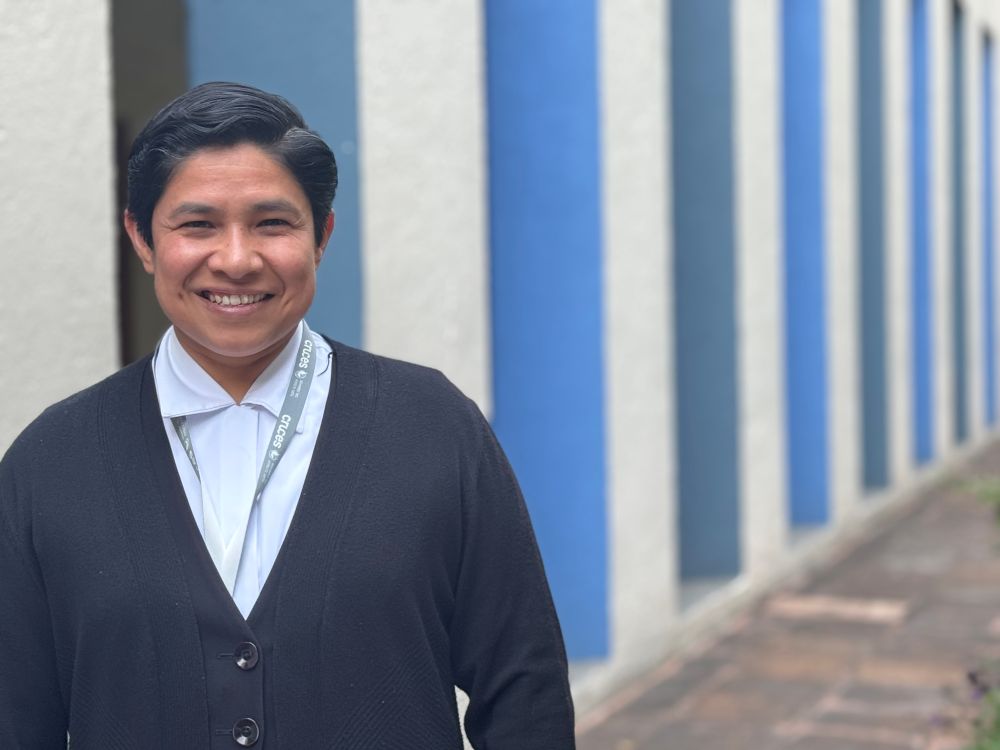
Sr. Brenda Hernández, of the Daughters of Immaculate Mary of Guadalupe, is the new head of the Office of Development and Holistic Health for Women Religious in Mexico. (GSR photo/Rhina Guidos)

by Rhina Guidos
Editor's note: Global Sisters Report's Monday Starter is a feature from GSR staff writers that rounds up news from or about women religious that you may otherwise have missed.

The Office of Development and Holistic Health for Women Religious in Mexico announced the appointment of Sr. Brenda Hernández, of the Daughters of Mary Immaculate of Guadalupe, as its new general coordinator. The office focuses on sisters' health and includes mapping information on female consecrated life in the country.
"I'm excited about being able to help the congregations, especially with decision-making, figuring out what steps to take and what to do," Hernández told Global Sisters Report. "Through my work in collaboration with Fr. Luis Fernando Falcó [who left the leadership post in summer for missionary work in Brazil], we conducted five investigations to help consecrated life."
One investigation led the office to the finding that younger sisters are showing signs of degeneration of bones and joints earlier in life, she said. Another discovered that more than 90% of sisters only went to the doctor when they already showed symptoms of illness, and another showed that about half the congregations spend a significant chunk of their annual budget — 25 to 60% — on medical care for sisters.
"If we investigate concrete happenings, we can help consecrated life with statistics, with data. We can investigate and take action," she said.
The information has helped members of consecrated life apply for funds to care for sisters and also to take preventive action, she said.
The center began its work in 2023 with instruction from the Center for Applied Research in the Apostolate at Georgetown University and funding from the Hilton Foundation (a major funder of GSR).
NY archdiocese join nuns' lawsuit against assisted suicide
The Becket Fund for Religious Liberty announced Oct. 30 that Archbishop Ronald Hicks of New York has joined a lawsuit initiated by four orders of nuns against New York's Medical Aid in Dying act. The law, which went into effect in August, allows terminally ill patients who are residents of the state, are 18 or older, and have less than six months to live, access to "prescription for medication which they can choose to self-administer to end their life." Facilities must counsel patients on physician-assisted suicide and help them transfer to another facility if necessary. Patients must have the ability to understand the consequences of the law and be able to "self-administer the medication," says a state website on the law.
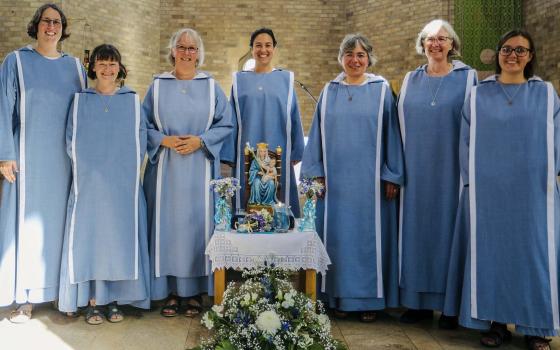
The Carmelite Sisters for the Aged and Infirm, the Dominican Sisters of Hawthorne, the Missionary Sisters of St. Benedict and the Little Sisters of the Poor have sued the state, saying that because of religious beliefs against suicide they cannot comply with the law at their facilities.
In early August, a federal court ruled that the sisters' facilities don't have to comply with the law while the case proceeds.
The Diocese of Rockville Centre, also in New York, joined the archdiocese, as well as other Catholic healthcare providers in the state, saying they cannot "facilitate a patient's suicide in any way" because of religious beliefs, says Becket on its website.
"Assisted suicide is completely incompatible with the compassionate care that the sisters and ArchCare [a Catholic healthcare ministry] offer. We are urging the court to protect these Catholic ministries as they continue their life-saving work, rather than forcing them to help end lives like New York wants," said Adéle Keim, senior counsel at Becket.
Advertisement
Sisters of Charity of New York 'troubled' by bishops' photo-op with Trump
U.S. bishops who met for a photo-op with President Donald Trump Oct. 22 received swift criticism from their flocks after the White House publicized video and photos of their gathering on social media less than two weeks ahead of the Nov. 3 election.
While one expressed sadness that a prayer over the president, in which all 12 bishops present participated, was "manipulated," another bishop blamed "the media," and another said he'd wished he'd been shrewd "like those who exploited our meeting for partisan political purposes." But the majority of bishops who participated were silent.
"Images carry messages. Silence carries messages, too," said the Sisters of Charity of New York in an Oct. 26 statement titled "Authority" about the bishops' gathering with the president.
The church, the sisters told the bishops, does not need more photographs standing with those in power, but needs more witnesses standing with those who have none. Women religious, with little institutional power in the church, have founded schools and hospitals, worked with immigrants, cared for the sick, dying and abandoned, because the Gospel demands it, they said. The Gospel doesn't demand standing with the powerful, the statement said.
"The hierarchy gave women religious little institutional authority. History gave us something greater: moral authority. And that authority comes with a responsibility: To speak when silence would be easier, to stand where love demands, and to remember that our first allegiance is not to a president, a political party, or even an institution. It is to the Gospel of Jesus Christ," they wrote.