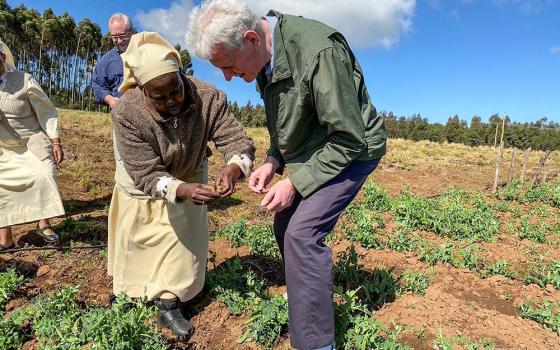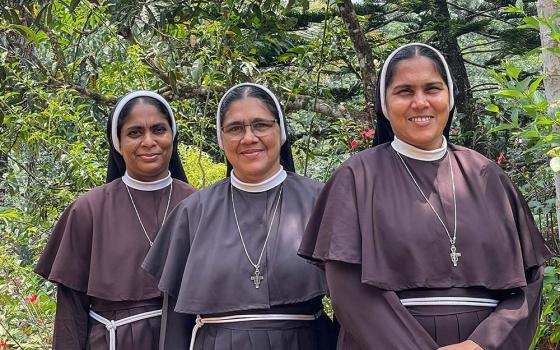
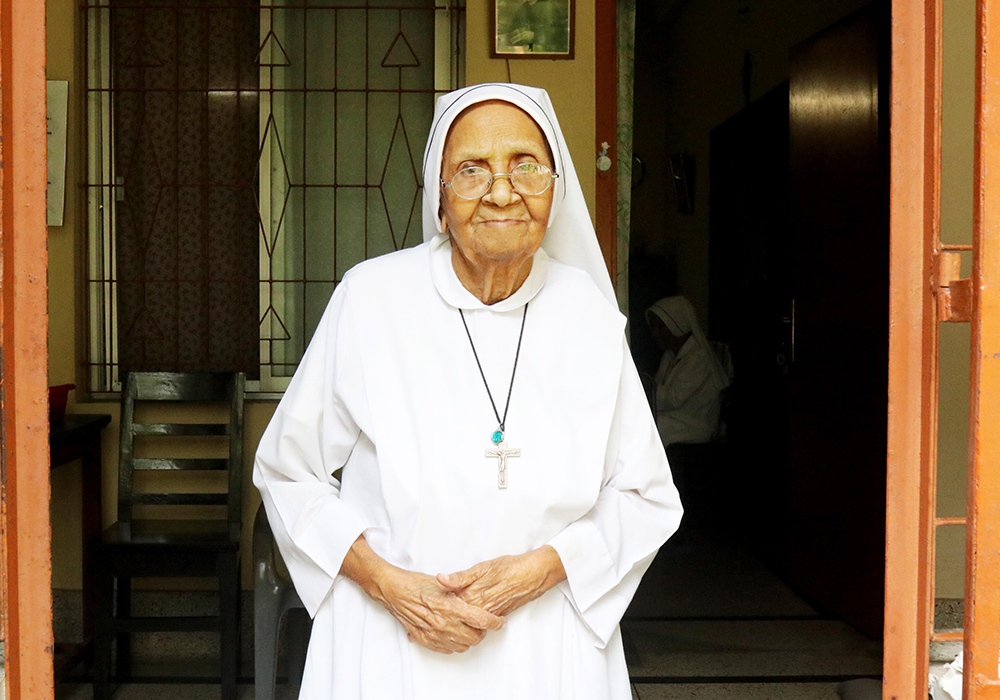
Sr. Albina Gomes, 94, a member of the Sisters of Maria Bambina, has worked as an evangelizer and teacher in northern Bangladesh's rural areas for most of her life. (Stephan Uttom Rozario)

by Stephan Uttom Rozario
Maria Bambina Sr. Albina Gomes, 94, has worked most of her life as an evangelizer and teacher in northern Bangladesh's rural areas, spreading God’s word and educating children, traveling to non-Christian villages and families, and spreading the message of Christ.
Gomes told Global Sisters Report that her good fortune began when she was born on Christmas night in 1931. She took her first vows in 1955 and professed her final vows in 1960. She is now a "praying apostle" and living in the northern Diocese of Rajshahi, spending time with girls and women.
In a recent interview with Global Sisters Report, Gomes shared her journey as an evangelizer and teacher in rural areas.
GSR: Why did you choose to preach the word of God?
Gomes: From a young age, there was prayer in our house, and I saw sisters around us. I saw them serving people, and I knew I would also like to serve the people. Moreover, my four elder siblings dedicated me to God.
In 1951, I entered the Sisters of Maria Bambina. There, I was a direct student of Mother Teresa. She was another inspiration for me. I saw Mother Teresa, learned from her and tried to follow the path she showed me. Then I thought to bring the word of Christ to those who had not heard the word in Bangladesh and to teach for the development of society.
I not only preached the word, but also taught in schools. Society at that time was immersed in superstitions, and I wanted to introduce them to modernity by giving them the light of education. I spent almost my entire clergy life in the Indigenous areas, and they were very poor and uneducated. I wanted to work for them, and I think I did well.
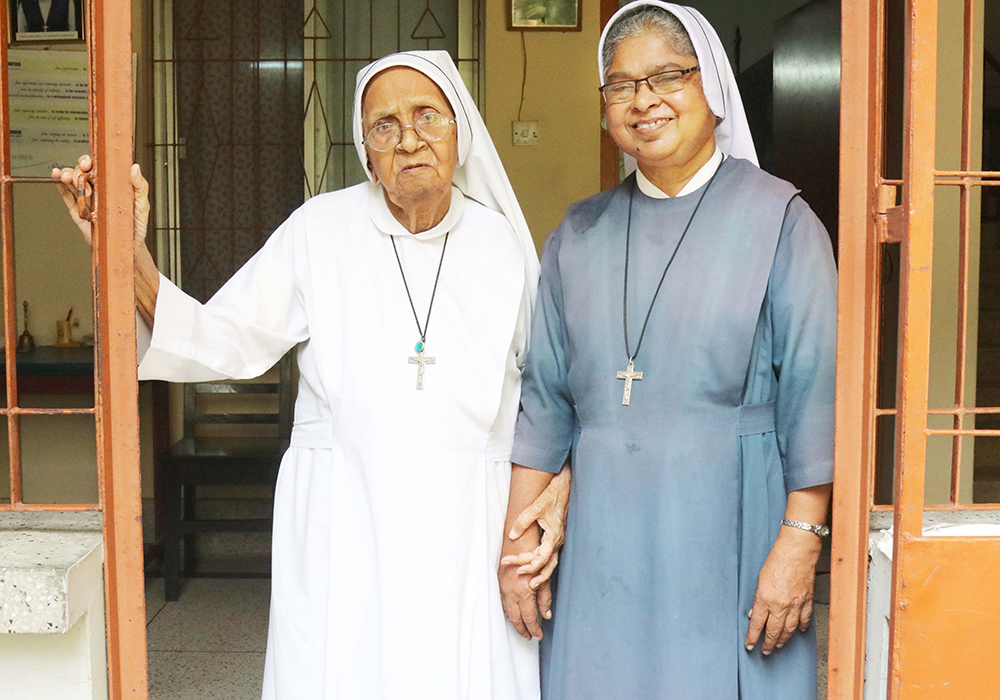
Sr. Albina Gomes, left, with Sr. Tressie Chacko, at the Casa Gaia convent in Rajshahi, Bangladesh, an Indigenous majority Catholic diocese (Stephan Uttom Rozario)
What was that work like?
I did not face any obstacles when I was teaching. The challenge was not knowing the native language of the Indigenous communities. However, I was able to learn and teach them.
There were quite a few challenges in spreading the word of Christ. I was forbidden to enter many villages, and they threatened that if I went to those villages, bad things would happen to me. However, I went there and told them that I did not come to spread any religion.
Those who were traditional or pagans worshiped trees. I explained that trees did not create us, and that a creator created us. So, the creator should be worshiped instead. Although they worshiped the Tulsi tree by arranging it beautifully, I respected this and spoke to them about God. One day, someone caught me doing this, but later, others came and rescued me.
Advertisement
How did you overcome these challenges?
I overcame these challenges with love, with the name of the almighty God. I went to them again and again, preached the word of Christ and explained the Bible to them.
If someone showed me love, I would bring them along with me to other places and preach the word of God. There were many poor people in the villages, so I used to carry my own food. When transportation was difficult, I brought a three-wheeler. I fell many times and I still feel that pain.
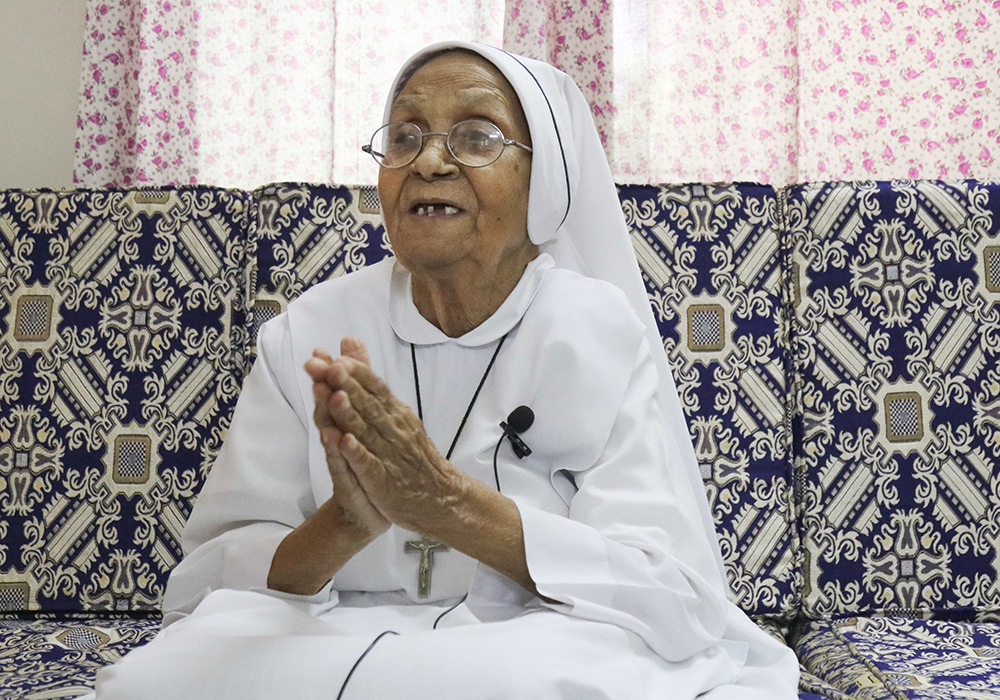
Sr. Albina Gomes, 94, speaks with Global Sisters Report in the Casa Gaia convent at Rajshahi, Bangladesh, an Indigenous majority Catholic diocese. (Stephan Uttom Rozario)
Do you think you were successful in your work?
I am proud that at least three people who learned from me became fathers [priests] and later bishops. I don't know how many more went on to become fathers and sisters.
I prepared about 5,000 people for baptism and am happy that people who once wouldn't let me into their homes have gradually accepted Christ. However, the harvest is abundant, and the number of workers is not sufficient.
Is there a difference between the way you preached the word of Christ then and now?
Earlier, we used to go from village to village, from one family to another, to preach the word. But now, many fathers and sisters go to those villages and conduct prayers or do routine apostolic work. Family visits are not like before, and families now also come to fathers [priests] or sisters for their needs.