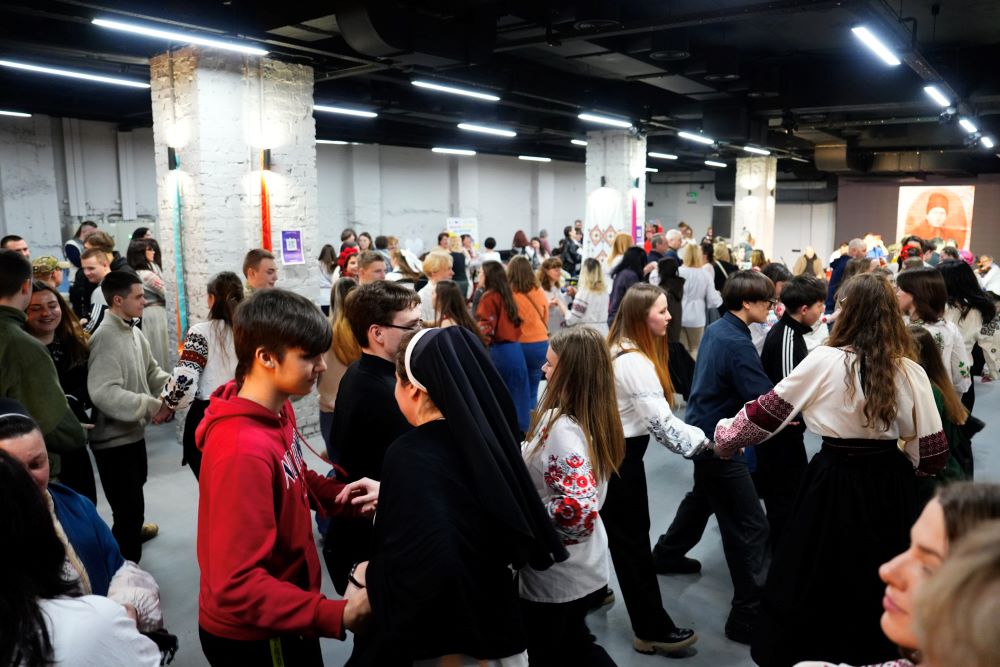
Ukrainian youth participate on Feb. 8 in a national dance during a vechornytsi social gathering in Zaporizhzhia, Ukraine. (Courtesy of Anhelina Yaroshenko)
by Sr. Yeremiya Steblyna
Have you ever wondered how Ukrainians live and what they dream about just 20 kilometers from the war zone, from the front line unfolding in their country? How does the war affect them? And can they not just survive, but continue to truly live? And what do the consecrated persons who did not leave their monasteries and stayed with these people think about? What are their prayers about and what is their daily life like?
Ukrainian writer Serhiy Zhadan put this difficult reality into words at the Munich Security Conference on Feb. 12.
"Human beings are not born for missile strikes, for hours-long air raid alerts, for tracking the routes of attack drones that are coming to kill them," he said. "To be killed in one's own home, in the building where one was born, grew up, and has lived all one's life. Death from hypothermia in one's own bed in a city of over a million in Eastern Europe should not be part of a person's life plans."
I spent a week in Zaporizhzhia, a city in Ukraine that is now only 20 kilometers from the front line. And not because I wanted to find answers to all these questions. It was much more mundane than that. My sisters who remained in this monastery and did not leave needed helping hands.
The community of Basilian sisters in Zaporizhzhia consists of three sisters. They needed help sorting humanitarian aid and medicines, so the three of us responded to this invitation. The time I spent in Zaporizhzhia was extremely valuable. And although I understood all the risks associated with being in the front line zone, God's grace was greater: With his help, I was able to overcome my fears and reach out to people who needed my hands and my presence.
To remain consecrated in a place of danger, pressure, poverty and despair is to show people that God has not abandoned his people. That there is hope.
To be honest, people are leaving Zaporizhzhia, not coming to it. Daily shelling with rockets, drones and artillery, and the constant threat of death make life in this city unbearable and difficult. Before our arrival, the railway and the maternity hospital were shelled. So, you simply cannot get to the city itself. In Dnipro, they organized a transfer to Zaporizhzhia. This is the only way you can get to Zaporizhzhia, the glorious capital of the Ukrainian Cossacks, in the current war conditions.
The wailing of sirens is interrupted from time to time by explosions, sometimes distant, sometimes closer. We have learned to distinguish between when the air defense is firing and when a drone is hitting its target. Thus, the sisters also live under daily shelling. In these conditions, they pray, work and serve people. And this is their choice. Each of them had the opportunity to leave Zaporizhzhia at one time or another. And each of them responded "yes" to the need of the people to be there.
It is strange, perhaps even a coincidence, but this year the Dicastery for Institutes of Consecrated Life published a document entitled "The Prophecy of Presence" on the occasion of the World Day of Consecrated Life. In particular, it notes "how strong the prophetic dimension of consecrated life is as a 'presence that remains': alongside wounded peoples and individuals, in places where the Gospel is often lived in conditions of fragility and trial."
To remain consecrated in a place of danger, pressure, poverty and despair is to show people that God has not abandoned his people. That there is hope. And it lies in people who open their hearts and monasteries so that light may enter the lives of others.
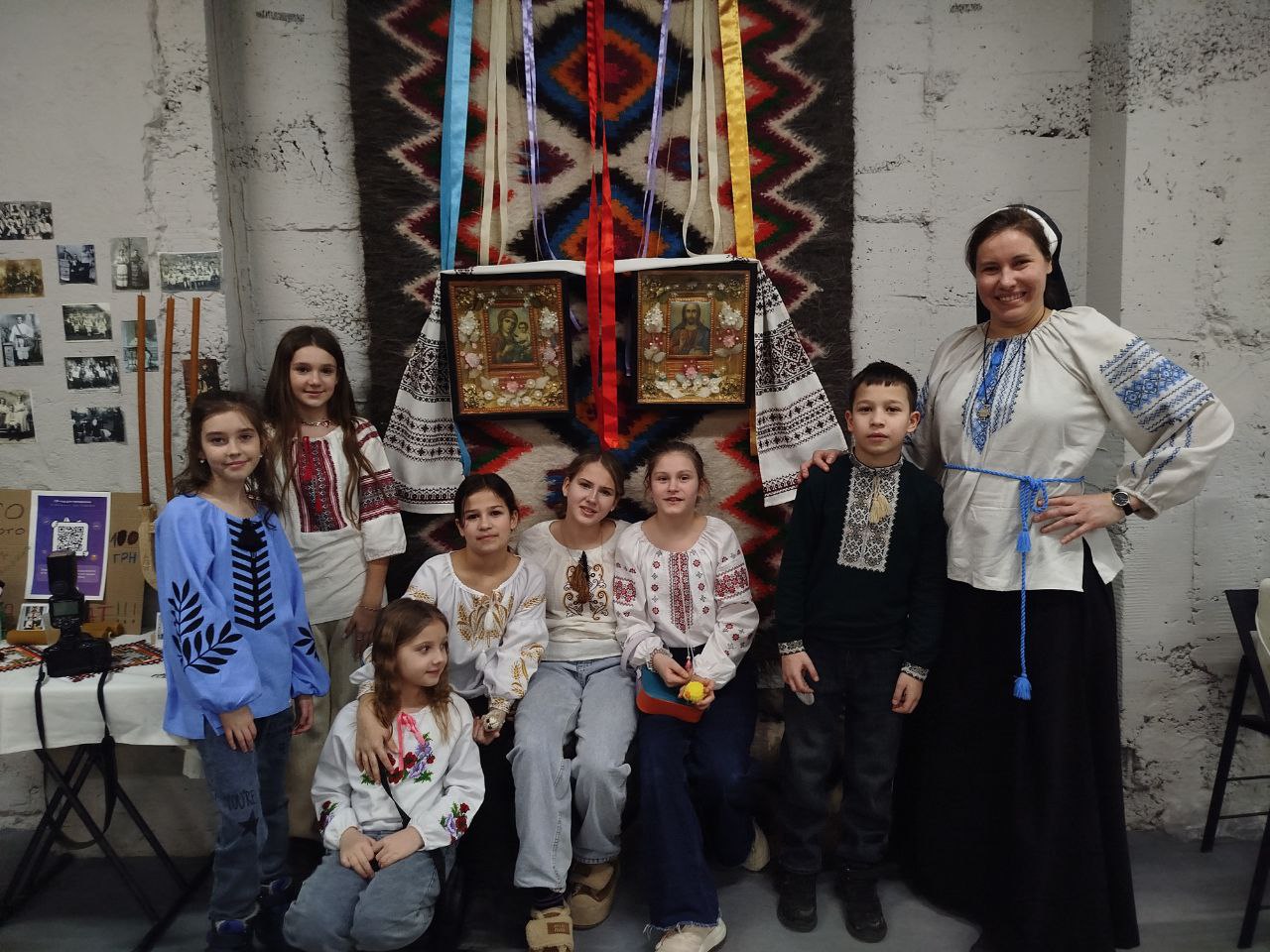
Basilian Sr. Yelysaveta Varnitska poses with children from the catechetical school at a vechornytsi evening gathering in Zaporizhzhia, Ukraine. (Courtesy of Anhelina Yaroshenko)
Sr. Lucia Murashko, the superior of the monastery, says with tears in her eyes that before the war, there were never so many people, children and young people in this monastery and chapel.
"Our house is simply bursting at the seams," she said. "On Sundays, we can't all fit in here. There are so many young people who come to us to pray and learn catechism that there is simply not enough space."
The sisters shared everything — the chapel, the kitchen, the dining room — so that young people could grow in faith and draw fullness of life. The nuns not only pray together, but also feed the young people so that they can study well and be together all Sunday, supporting one another. Twice a week, these young people visit our monastery. On Thursdays, they gather for the liturgy and the reading of the word of God, and on Sundays, for the liturgy, catechesis and preparation for summer Christian camps for children.
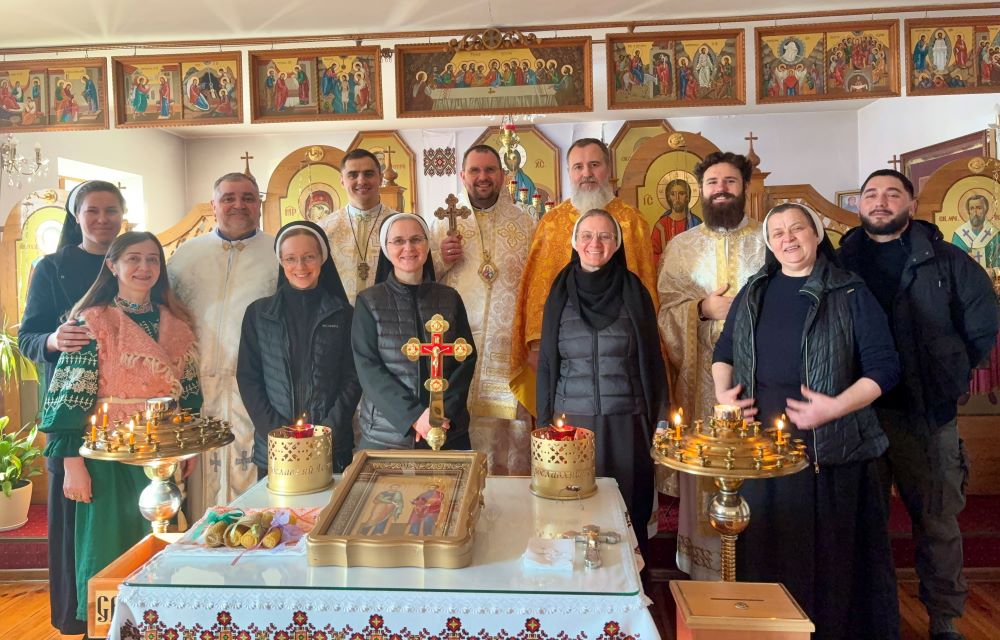
Bishop Maksym Ryabukha of Donetsk Exarchate, center, is pictured with sisters and priests after the divine liturgy at the Basilian Sisters monastery in Zaporizhzhia, Ukraine. (Courtesy of Anhelina Yaroshenko)
Is it not because, as the above-mentioned document states, "this remaining is not only a personal or communal choice, but becomes a prophetic word for the entire Church and for the world. In this act of remaining like a seed that accepts death so that life may flourish, in diverse and complementary forms, the prophecy of all consecrated life is expressed." Is it not a prophetic testimony to nurture the seeds of young Christians in the midst of war? They will become the hope of the church and the world tomorrow. They will build a new Ukraine with their faith and preserved Christian values.
These young people surprised me the most when, on Sunday, together with priests and Basilian sisters, they organized Stritenski evening gatherings (Stritenski vechornytsi). To the sounds of drones and rockets, they lived life to the fullest — dancing, singing Ukrainian songs, cherishing their language and supporting their own culture. These young people showed me how to appreciate life and live mindfully.
And isn't the writing of icons under the guidance of a nun, accompanied by the incessant humming of drones, a testimony to God's life? And often with the lights turned off.
Of course, "all things work together for good for those who love God" (Romans 8:28). The war has plunged each of us into constant pain. But the war has also helped people ask themselves existential questions about good, evil, eternity and life. That is why the sisters now have many times more work. There are many more people who thirst for the Word of life.
As it turns out, here in Zaporizhzhia, the harvest is truly great (Matthew 9:37). And God calls us to be his witnesses in this place. The task for each of us during wartime is particularly simple: to introduce another person — a soldier, a volunteer, a young person, or a child — to Jesus Christ. Realizing that the last word does not belong to war. The last word belongs to God. And that word is life.
"God has not forsaken Ukraine," said Major Archbishop Sviatoslav Shevchuk, head of the Ukrainian Greek Catholic Church, in a book-length interview with Krzysztof Tomasik about God, the church and humanity during this terrible war. The consecrated sons and daughters in Ukraine have not abandoned her in these difficult times. The north, south and east of Ukraine are our hot spots today. This is where the war is being fought. And this is also where people who have consecrated themselves to God and service stand and remain before God in prayer.
Advertisement
Many ask us, "Why are you still there? What for?" Because in the lives of consecrated persons, the ability to be there, to remain, not to leave, is a support for many. It is a gesture that is greatly appreciated. But above all, it is proof of God's faithfulness, who gives the grace to be faithful to him even when explosions and missiles are loud. Is it easy for them to be in these circumstances? Not at all. I personally know two sisters who developed PTSD after staying in places close to the fighting. They are now successfully undergoing rehabilitation. And some are still holding on. Because they support those around them with their presence and their prayers — soldiers, volunteers, families, students, young people.
"Sometimes it becomes so incredibly difficult, so extreme. And then suddenly the thought occurs to me that I am in the most right place on the entire planet. For all of created time and space. And I must be only here right now." This is how deeply and touchingly Ukrainian soldier Artur Dron wrote about his time in the trenches in his book of short prose, Hemingway Knows Nothing. However, this truth is not only about the military. Many people who wear a cassock, a robe or a collar could unquestionably agree with Artur's words.
For their greatest prayer, and ours, in times of war is the one Moses prayed to God: "Rise up, Lord! Let your enemies be scattered! Let those who hate you flee before you" (Numbers 10:35). And may the faithfulness and steadfastness of each sister be a quiet invitation to him: "Rest, Lord, among the countless thousands of Israel" (Numbers 10:36). For we can endure all things only in him who strengthens us (Philippians 4:13).