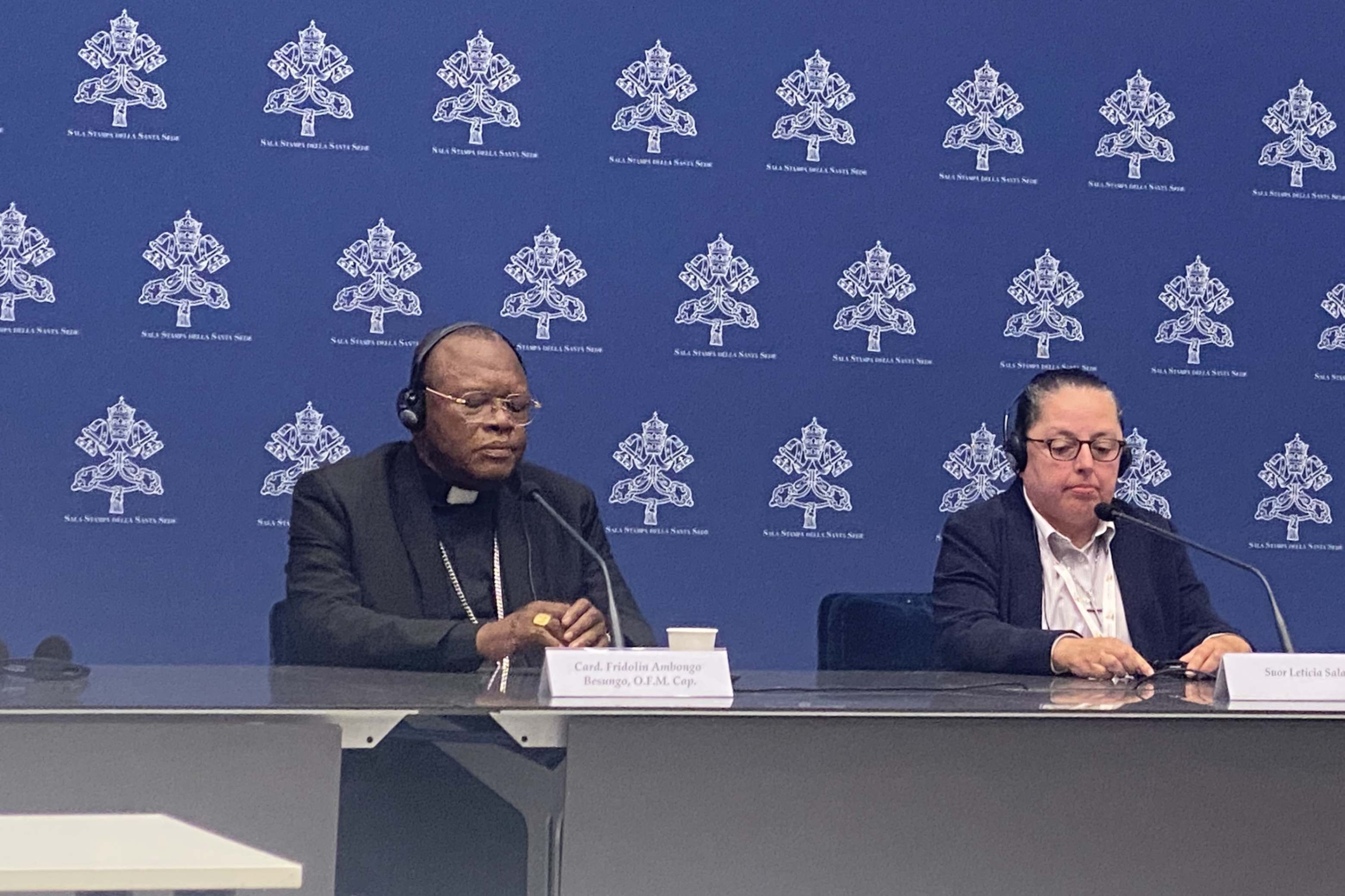
Sr. Leticia Salazar, right, a U.S. delegate to the Synod on Synodality, listens to questions from the press alongside Cardinal Fridolin Ambongo of Kinshasa, Congo, during a press conference at the Vatican on October 7, 2023. The Synod invites us to listen to one another, but also to accompany one another during difficult times, Salazar said. (GSR photo/Rhina Guidos)
by Rhina Guidos
In 2023, Sr. Leticia Salazar made Catholic Church history by becoming one of a small contingent of women allowed to participate and vote in the consultation process known as the synod on synodality, a type of gathering that — until then — only men of the church could attend.
Salazar, of the Company of Mary Our Lady, has said that although the synod has been difficult for some to understand, synodality is simply about listening and inclusion. Salazar holds a master's degree in bioethics and spirituality from Loyola Marymount University in Los Angeles, is chancellor of the Diocese of San Bernardino, California, and has extensive experience in Latino ministry in the United States.
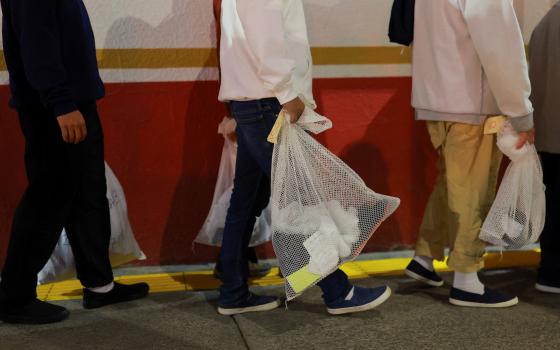
Dealing with Latino ministry these days means dealing with immigration issues such as the notable case faced by Martin Rascon in July 2025. The U.S. citizen from San Bernardino managed to escape gunfire from the Border Patrol, whose agents attacked the vehicle he was traveling in. Rascon testified before the U.S. Congress in February about the attack. In July 2025, immigration agents also detained, close to church grounds, members of two parishes in her diocese.
'There are many missing people; there are many deaths.'
—Sr. Leticia Salazar
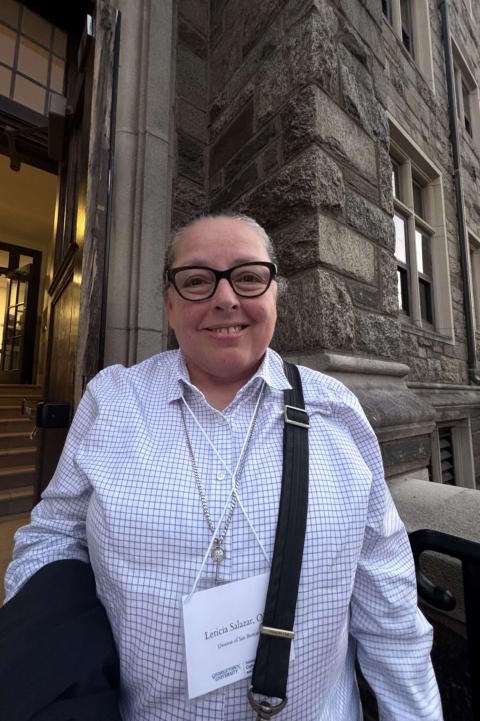
Sr. Leticia Salazar smiles following a leadership gathering for Catholic women and the common good at Georgetown University in Washington on March 9, 2026. (GSR photo/Rhina Guidos)
At a leadership gathering for Catholic women and the common good at Georgetown University in Washington in March, Salazar spoke with Global Sisters Report about the difficulties Latinos face in her diocese due to treatment by immigration officials.
GSR: What's it like in your region of California?
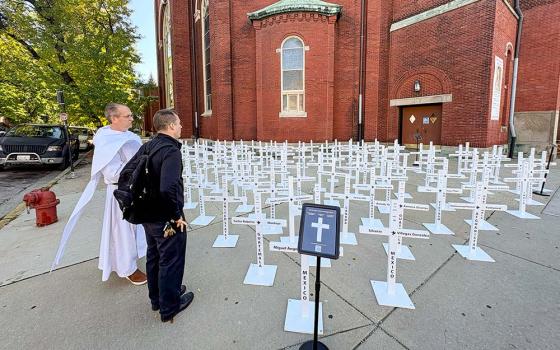
Salazar: It is such inhumane and dehumanizing treatment. It is intolerable. A small group of religious sisters began calling on other congregations to directly help all those who are being victimized by this treatment. There are many people who have gone missing, there are many deaths — and I say "many, many deaths" because the missing are counted among the dead, right? But there also is a group and a passion that has been unleashed in the community — a passion for mercy, for encounter, for help, and for the fact that we are brothers and sisters. And this critical situation affects us all.
How does the situation look now?
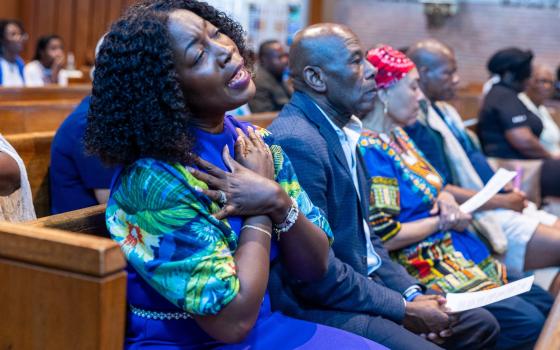
In our diocese, the Diocese of San Bernardino, there is a lot of fear, and the bishop has allowed families who are afraid to go to Mass to not attend [in person], but to follow along via Facebook or YouTube, so they can celebrate their faith online.
Do you see that as a type of persecution?
Yes. It's persecution of human beings, isn't it? Because it's not just against a single culture. It's a war declared against humanity and against what makes us human. It is a violation of human dignity. It is an abuse of power over others, of domination over others. And it is truly sad because it is dehumanization happening right before our eyes.
'Yes, we can do something concrete: Open the doors of our homes, our schools, and our hospitals to the people who need the most help right now."
—Sr. Leticia Salazar
Advertisement
You have been part of the synod. How do you view the synod's work in light of everything that is happening right now?
Our work is to humanize and collaborate in everything that humanizes. That is the church's mission in society. The church's mission to heal, to accompany, to forgive. But the church's mission is to be present with the brothers and sisters who suffer the most. And I believe that they — people and families — need to feel accompanied and need to feel that the church is not just an institution: the church is brothers and sisters walking alongside.
So, I believe the synod invites us to listen to their stories, but also to walk alongside them. And yes, we can do something concrete: open the doors of our homes, open our schools and hospitals to people who need help right now. I have been in conversation with people who have been separated: a father who has been taken away, and a family who cannot afford to pay rent.
When these kinds of things happen, what does that mean?
It means that society is not supporting the family, that society is an individualistic society with very self-serving interests, economic interests. Not interests that benefit the community, but self-serving interests to enrich the most powerful. So that is something that is not Christian. It is not humane for people to have an interest in destroying others to increase their wealth.
If you could say something to President Donald Trump about everything you're seeing, have seen, and your fears, what would you say?
I would ask that he look inside his heart, and ask himself — and that we all ask ourselves: What legacy do we want to leave on this earth? Because we know that our life here on this earth is not everything; it is fleeting. And if we do not spend our time doing good, then we have not lived life for the gift that God gave us: for others.
Life is not for oneself. Life came into the world to be a gift for others. And if I do not live that gift, the gift of life does not belong to me. It [life] does not belong to us. The gift of life is a gift to others.
This story was originally published in Spanish May 21, 2026.