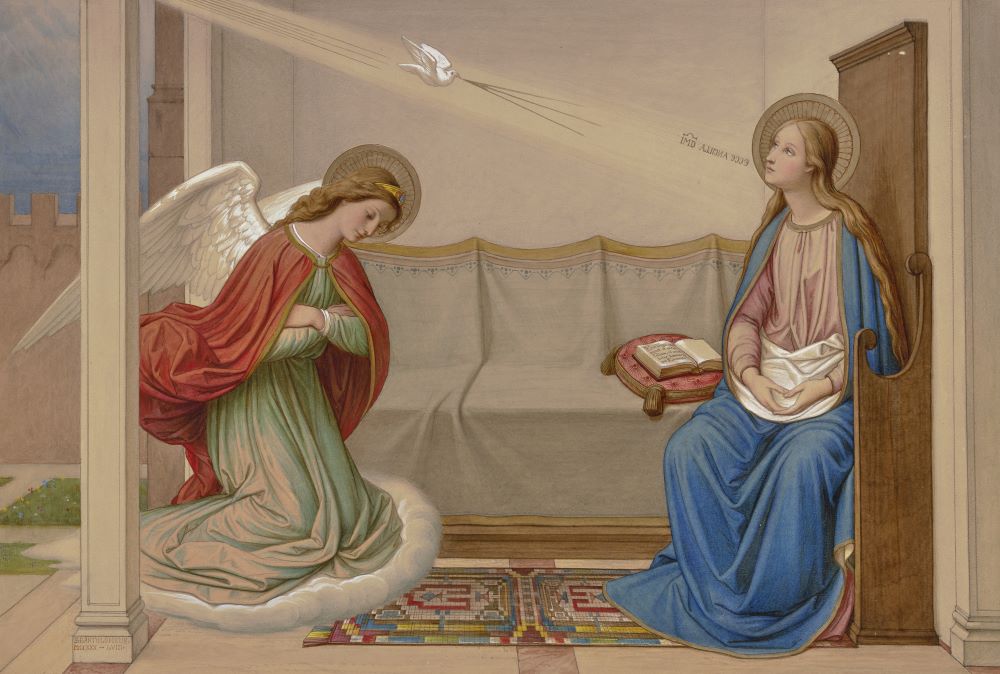
"The Annunciation" (1858) by Eduard von Steinle (Artvee)
by The Life Panelists
There are moments in life when we sense God calling us and that invitation is not always easy to understand or follow. Listening to that call means pausing, looking within ourselves, and choosing to respond, even without having all the answers.
This month, the panelists reflect on their experiences of that invitation to say "yes" to God, guided by the question:
Do you remember a moment in your life when you felt called to say yes to God, even when it was difficult or uncertain? How did that decision shape your path?
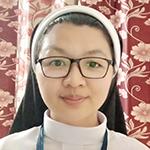
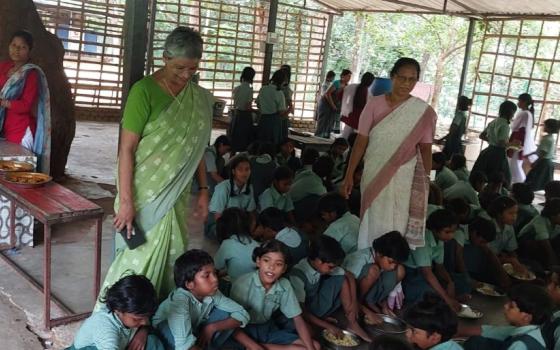
Sr. Agnes Rungsung, a member of the Sisters of the Adoration of the Blessed Sacrament, hails from a remote village in Manipur, northeastern India, where Catholics are a minority. Despite facing humiliation from peers and teachers for her faith, these trials deepened her love for the Catholic Church and led her to seek its truth more fervently. Now holding a licentiate in Biblical theology, she teaches in formation houses and preaches retreats to laypeople, clergy and religious. An emerging writer and theologian, she is currently preparing for her doctoral studies abroad, continuing her mission to evangelize through intellect and faith.
In late 2018, my then provincial superior, Mother Catherine Elavumkal, asked me to assist the ministry team at Holy Redeemer Retreat Centre in Umroi, a town near Shillong, the capital of the northeastern Indian state of Meghalaya. My first reaction was sheer panic. I have always been expressive and talkative, and in my mind, a retreat center was a place for those who were naturally quiet and contemplative. I felt so inadequate that I tried to make an excuse to avoid the assignment. However, the decision remained unchanged.
What made it even more challenging was that people who knew me well also questioned whether I was suited for such a role. Their doubts fed my own imposter syndrome. Their comments echoed my deepest fears: "I don't belong here. I have nothing to offer." Yet, beneath all that turmoil, I accepted the assignment, not because I felt capable, but because I realized that God and my superiors trusted me more than I trusted myself.
Mary did not have everything figured out; she just trusted God.
When I began the ministry, the people who came to the center changed my perspective. All my worries melted away. Many people came in broken, grieving and weighed down by life, yet they carried a deep, childlike faith. Watching them pray with tears in their eyes as they walked the Way of the Cross barefoot moved me deeply. It taught me that spirituality has nothing to do with one's personality, but more with allowing God to enter and saying, like Mary, "Behold the handmaid of the Lord" (Luke 1:38).
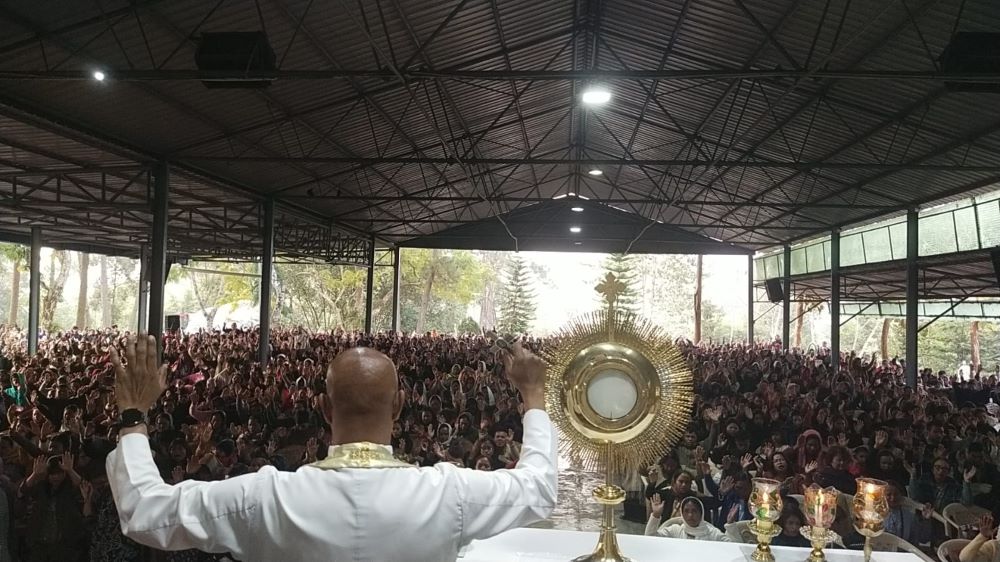
Retreat participants pray in adoration before the Blessed Sacrament at Holy Redeemer Retreat Centre in Umroi, Shillong, India, Feb. 14, 2025. In late 2018 Sr. Agnes Rungsung's then provincial superior asked her to assist in ministry there. (Courtesy of Agnes Rungsang)
I gradually came to see that accepting this mission, even though I was scared, was my own way of saying yes to God. Mary did not have everything figured out; she just trusted God. In the same way, my acceptance, though imperfect and hesitant, became an act of trust.
As the ministry continued, I once shared my doubts and struggles with my spiritual director. I explained how hard it had been to say yes in obedience to my superiors. He smiled and said: "Obedience is like soil in the hands of a farmer. The soil does not get to choose what is planted; it just lets the farmer do his work. In the same way, we are the field, and our superiors are the farmers. Let us just trust the one doing the planting. This is our yes to God as well."
That image has stayed with me. What began as a scary and unwanted assignment became the exact place where I needed to grow. It was an invitation to trust more deeply and to continue saying yes to God. That yes continues to shape my life today.
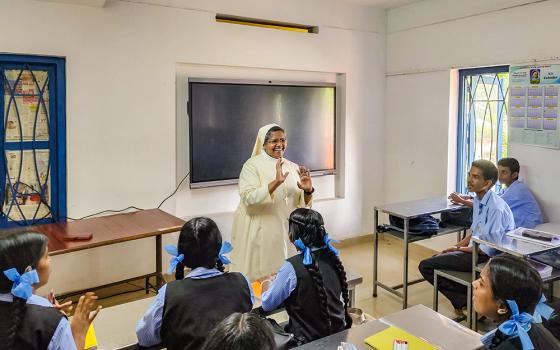
Sr. Alice Nyazungu is a Carmelite Sister, known as Handmaids of Our Lady of Mount Carmel, based in Zimbabwe. Born a Catholic, she joined religious life in 2002. Nyazungu has an honors degree in religious studies from the University of Zimbabwe. After receiving her degree, she worked for four years with migrants and refugees in a refugee camp. Currently, she works at a Catholic boarding school where she teaches Catholic ethos and conducts counseling sessions for students.
Soon after my novitiate, I was assigned to live in a refugee camp among the refugees. I agreed to this appointment, not because I was willing to go, but because of the vow of obedience. At that time, if I had been given a choice, I would not have chosen to go to the camp. Still, I accepted the assignment and began my apostolate among the migrants.
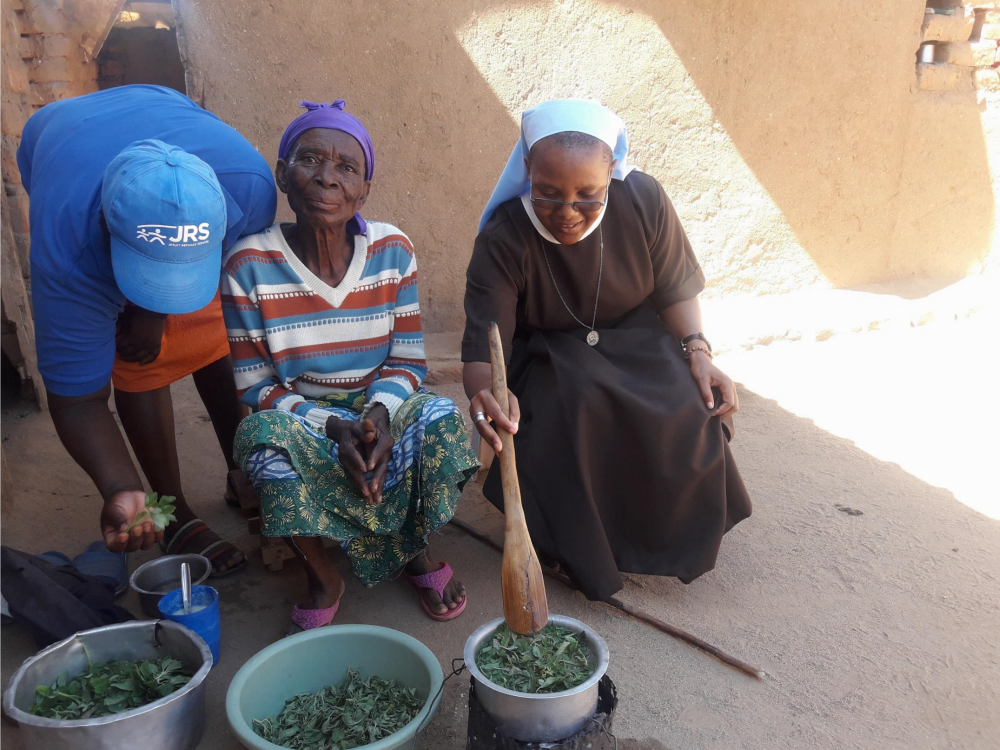
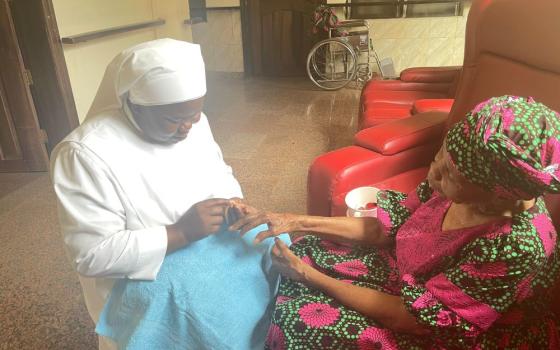
Carmelite Sr. Alice Nyazungu and Jesuit Refuge Service community counselors assist an elderly sick person with cooking in Tongogara Refugee Camp in Zimbabwe in March 2022. (Courtesy of Alice Nyazungu)
My biggest fear was the language barrier. Knowing my limitations, especially when it comes to learning languages, I kept asking myself: How am I going to communicate with these people? I was assigned to work under IMBISA (Inter-Regional Meeting of Bishops of Southern Africa). My apostolate involved offering counseling to refugees and conducting home visits. That is where the challenge became clear.
The refugees came from French-speaking countries such as the Democratic Republic of Congo, Rwanda, Burundi and Eritrea, while I come from an English-speaking country. Our native languages were completely different. My mother tongue is Shona, while the people I served spoke Kiswahili, Kinyarwanda and Kirundi.
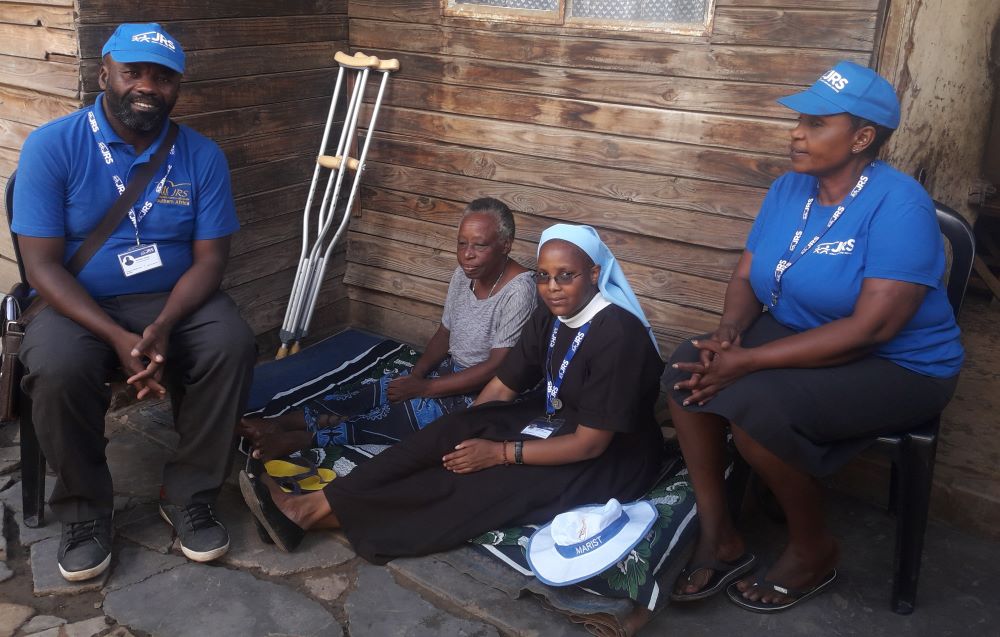
Sr. Alice Nyazungu and Jesuit Refugee Service community counselors visit an elderly person with physical disabilities in Tongogara Refugee Camp in Zimbabwe in March 2022. (Courtesy of Alice Nyazungu)
I came up with an idea. The children in the camp were able to speak English and even a bit of my native language because they interacted with Zimbabwean children at school. I began to befriend them, and they, in turn, started teaching me their native language. This approach worked very well. Within a short time, I was able to communicate quite nicely with them.
I began to enjoy my apostolate as I was able to communicate with the migrants in their own language. I even joined their choir practices, learned their songs and also shared Zimbabwean Catholic songs with them. During Mass, I was even able to do a reading in Kiswahili.
I stayed in the camp for three years before being assigned to another apostolate outside the camp. To be honest, the change affected me because I had grown close to the people there. After six years, I was appointed once again to return to the camp. I was happy to go back and reconnect with this lovely community.
This time, I worked with the Jesuit Refugee Service, specifically working with the elderly, orphans, people with mental and physical disabilities, the sick, single mothers and widows. The work felt different from my first assignment because I could now speak their language.
During my home visits, I developed a love for their traditional food. The elderly, especially, would prepare meals for me whenever they knew I was coming to visit. Some of them, when they were sick, would refuse to eat, saying they would only eat when "Sister" was there. Their family members would come to the convent to call me, and I would go to their homes to sit with them.
The bond we formed was very strong. Even now, although I am no longer in the camp, I remain in contact with them. They have become my family.
Sr. Jacintha Rantšo is currently the provincial leader of the Servants of the Immaculate Heart of Mary, also known as the Good Shepherd Sisters of Quebec. She lives in Lesotho, southern Africa. She joined the congregation in 1983 as a postulant. First, she taught in high school and later on trained as a social worker. She holds a degree from the University of Namibia. After graduation, Rantšo worked with those affected by HIV and AIDS from 2004-2011 then became an assistant of the provincial leader. She was appointed as provincial in 2017.
In 1983, I left my family to join religious life. At the time, my father was not yet baptized; he later became Catholic in 2005. He had serious concerns about my decision, but I felt a strong call. I gathered my belongings and left home in Ha Marakabei to go to St. Rodrigue, a formation house of the congregation in a different part of the country in Lesotho, away from my family.
At first, the journey did not seem difficult, though it was uncertain. Six of us, from different backgrounds, began our pre-novitiate together under the guidance of a wonderful mistress. Under her guidance, I began to change, to become a different person.
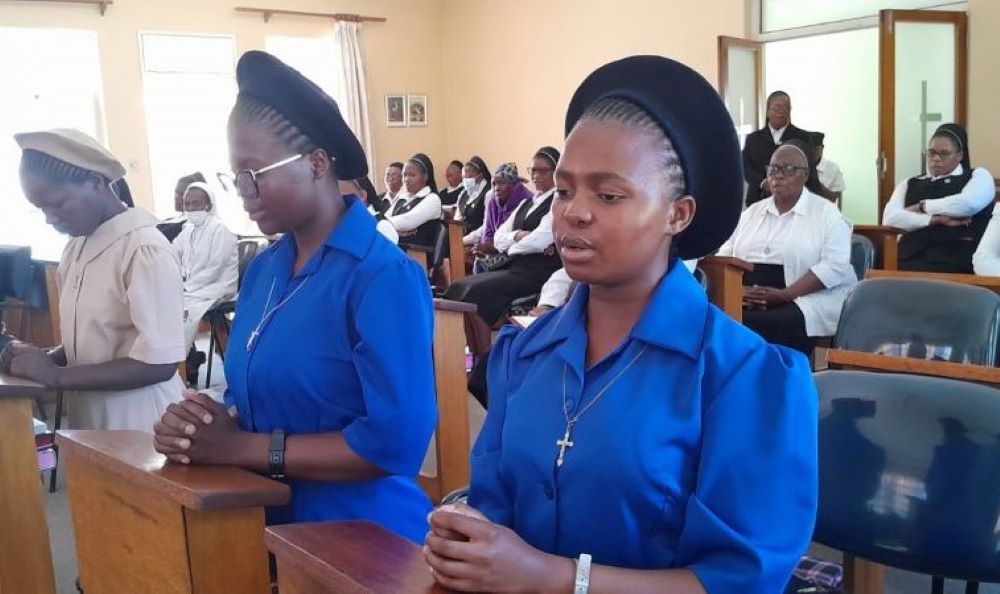
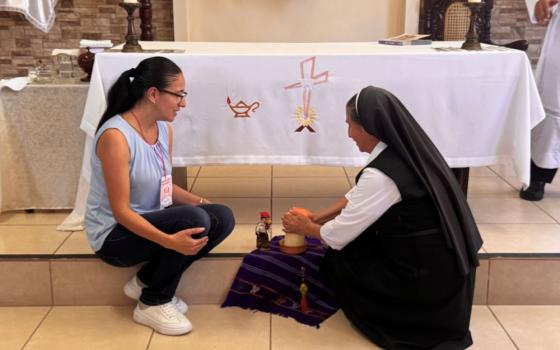
In her role as provincial superior, Sr. Jacintha Rantšo oversees the admission of new members, a community event celebrated in liturgical prayer where aspirants in brown and pre-novices in blue say yes to the call of religious life. (Courtesy of Jacintha Rantšo)
Years later, in 2017, I was called to serve as provincial superior. I accepted without fully understanding how demanding the role would be. Over time, I came to see that this yes was similar to that of the Blessed Virgin Mary, a call to give myself completely in faith and service, especially to those most vulnerable. That experience continues to shape my life.
Scripture reminds us that God creates each person for a purpose. The call stories of Moses and Jeremiah show that even those chosen by God often feel unworthy or afraid. Moses hesitated before the burning bush, and Jeremiah believed he was too young. Yet both were called to trust.
Mary also faced uncertainty. When the angel told her, "Do not be afraid … you will conceive and give birth to a son" (Luke 1:30-31), she responded with trust: "I am the Lord's servant" (Luke 1:38).
The call stories of Moses and Jeremiah show that even those chosen by God often feel unworthy or afraid.
Being chosen means being given the strength to overcome challenges in key leadership roles. Acceptance of such responsibilities goes along with the graces prepared for the journey. Through personal prayer, community meetings and religious practices, I progressed both in faith and leadership.
I grew through supporting others, managing resources, handling correspondence, scheduling meetings, and overseeing admissions and community events. I became more involved in spiritual activities, visiting the Blessed Sacrament, and dedicating myself to initiatives such as visiting sisters' families during illness or loss. Challenges became opportunities for growth, forgiveness, reconciliation and courage.
At the beginning of 2026, I stepped down, accepting that my time of service had ended. I give thanks to the Lord for all the grace and support I received and for the opportunity to offer it to others. Amen.
Sr. Kathleen Geaney is a member of the Missionary Sisters of St. Columban, an international congregation with missionary presence in China, Pakistan, Myanmar, the Philippines, Korea, Ireland, Britain and the U.S. Geaney was missioned in the Philippines, England and Myanmar. Her ministry centered on interfaith dialogue and working with women from different faith communities. She was enriched by 18 years of presence in Myanmar and returned to Ireland in 2024. Having had sabbatical time she continues to have an attentive ear and open heart as she strives to respond to the next stage of her missionary journey.
My immediate response to this question is to be drawn back to the moments when I said yes to God's call to be a Missionary Sister of St. Columban. This moment is one that has shaped all the other moments of my life over the past 56 years. I hesitate to say "moment" because, for me, it was a series of moments.
At that time, I was working in a government office in Dublin, Ireland's capital. I was inspired by the stories of people who went abroad to serve those most in need, and I longed to join them. I gathered information about various overseas organizations, but something else niggled at the edge of my consciousness. I didn't have words for it then, but gradually I recognized it as something to do with the engagement of the heart: "It is your face, O Lord, that I seek; hide not your face."
Advertisement
As I wandered around Dublin wondering what to do with "my one wild and precious life," that whisper was always there in the background. I said yes to it, in all its uncertainty, not fully knowing then, or even now, what it was fully about. This yes involved letting go. I was a young country girl experiencing, for the first time, the excitement of new friends and city life. I knew, too, that this decision would bring pain and heartbreak to my parents, as I am an only child. Yet, as Robert Frost wrote, "Two roads diverged in a yellow wood, I took the one less traveled by, and that has made all the difference."
"Let yourself be silently drawn by the strange pull of what you truly love," said the Persian poet Rumi. "It will not lead you astray."
That heart whisper — "It is your face/presence that I seek; hide not your face" — has been answered in so many amazing ways.
God, my beloved, has shown me his face in the little ones of this world, those often labeled as poor, but who are rich in what matters most: resilience, faith, hope, endurance, and, in the midst of it all, joy and steadfast love.
As I grow older, I am learning to recognize his presence even in the vulnerable and fragile places within myself.
God has given me companions on this journey: community members, friends and coworkers, who have led me, and continue to lead me, deeper into that heart space at the center of each of us, a space rooted in God.
Day by day, I come to see the truth of Gerard Manley Hopkins' words: "Christ plays in ten thousand places, lovely in limbs, and lovely in eyes not his, to the Father through the features of men's (and women's) faces."
Truly, from that initial yes, God has led me out and continues to speak to my heart.
Sr. Marian-Hagar Dadzie is a perpetually professed Sister of the Society of the Infant Jesus, an Indigenous women religious congregation in Ghana. She is a full-time media personnel who works with CAFDIL TV in the Catholic Archdiocese of Cape Coast as a television host, producer and public relations practitioner. She has worked in the media space for four years now. She is also the communications officer for her congregation. Currently she is pursuing a master's in business management and corporate governance.
As a young girl, there was never any indication that I would become a religious sister. I began my basic education in a convent school, but the experience did not inspire any desire to become a sister.
I am the youngest of six siblings, and the age difference between me and my immediate older brother is 12 years. The firstborn and I are the only females. My parents were already advanced in age when I was born, so I was the pampered one. There was never a time I imagined being separated from my parents.
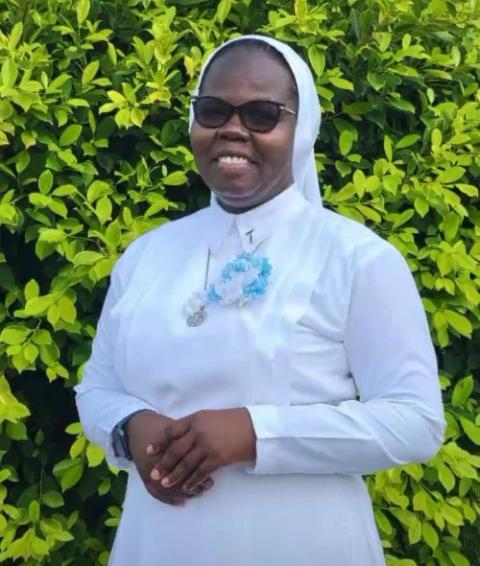
Sr. Marian-Hagar Dadzie celebrates 10 years of saying yes to God at Mary Queen of Peace Catholic Church in Cape Coast, Ghana, on Dec. 8, 2024. (Courtesy of Marian-Hagar Dadzie)
It was after high school that I developed the desire to become a sister. My mother was excited when I shared this with her. She then told me that she had once shared with a bishop, when I was a baby, her wish that I would become a nun. The bishop advised her not to mention it to me, saying that if it was God's will, I would profess that desire in the future.
The news of my desire brought joy to the family, until my older sister said no. She had a genuine concern. In Ghana, my Akan ethnic group is matrilineal, and she had three sons. My going to the convent would end the family lineage. I was the family's hope to continue the generation, and her refusal felt like a big blow.
I prayed fervently to God, though I was skeptical because it felt like a 50/50 deal. I remained focused on my decision while awaiting my family's final answer. Eventually, God came through: My sister agreed that I could enter the convent after other family members spoke with her.
It was facing these challenges in order to say yes to God that has brought me this far. Nothing discourages me. The struggle I endured to say yes has made me firm and resilient in the uncertainties of consecrated life. The vow of obedience is constantly tested in my line of work, yet relying on God's grace, I open myself to accept it as God's will for me.