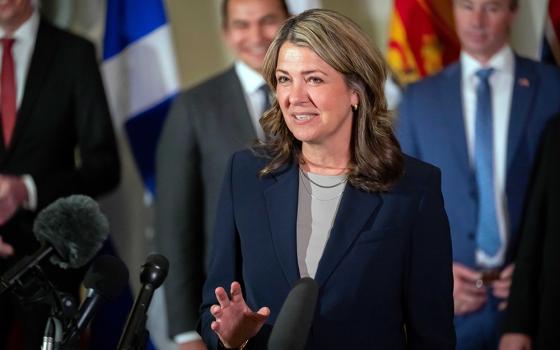
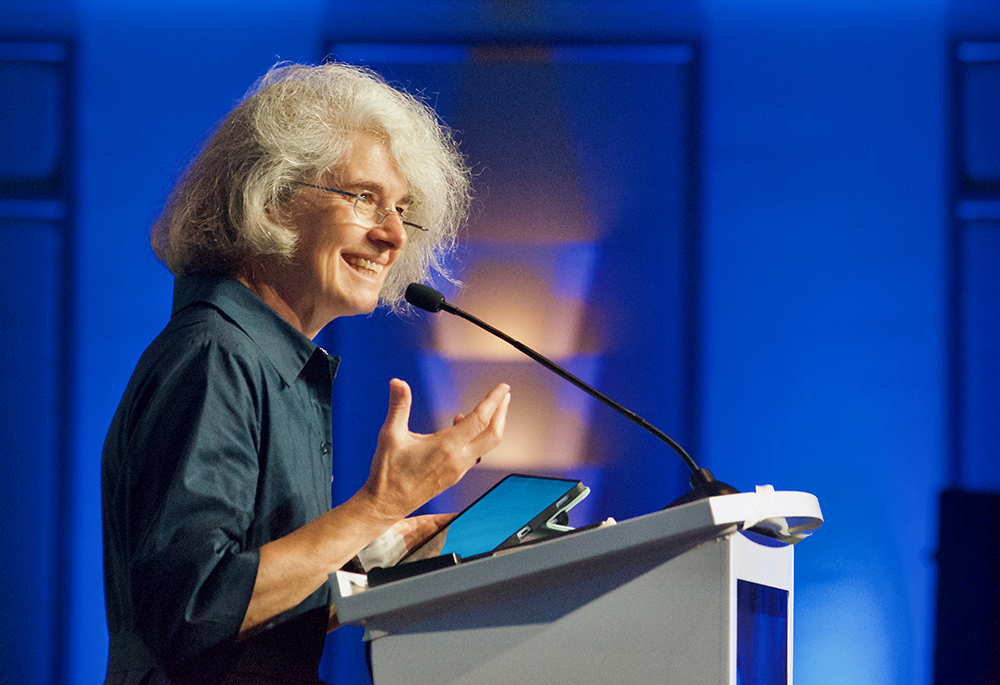
Xavière Missionary Sr. Nathalie Becquart, undersecretary of the Synod of Bishops at the Vatican, speaks Aug. 12 in Orlando, Florida, to the Leadership Conference of Women Religious' annual assembly. (GSR/Dan Stockman)
by Sr. Joyce Meyer
International Liaison, Global Sisters Report
I had the privilege of attending the 70th anniversary gathering of the Leadership Conference of Women Religious in August, where I met many sisters and brothers from Canada, Latin America and beyond, as well as our own U.S.
And when I saw on the program another presentation on synodality, I thought, "Oh dear, not again."
My reaction, however, was a terribly mistaken judgment that I later shared with the presenter, Xavière Missionary Sr. Nathalie Becquart. Her presentation was engaging and practical, and set a perfect context for the following two full days of practicing the participation that synodality — or "walking together" — calls for.
Becquart began her presentation stating that synodality was neither a program nor a project, but a commitment to a way of being and acting — a "style of life and mission … learned by doing." This caught my attention immediately. As baptized followers of Jesus, not only worshippers, synodal life is a willingness to be open and flexible to be guided by the Holy Spirit in all our encounters to fulfill our shared mission with Jesus to bring about the reign of the loving God.
It is also a call, she said, to a new way of being church.
This is not an easy call because it invites us to change our vision of what "church" is: a community, a family, where every voice is important. Our current church structures prevent the many voices needing space to be listened to and heard. We have been conditioned to living with structures of "clericalism, hierarchicalism and institutional self-sufficiency" for hundreds of years, preventing the needed "listening, co-responsibility, discernment and genuine exchange" the new vision offers. This new vision does not deny the need for authority, but it calls for a different way of exercising authority, whether in church or religious life itself, an authority that invites communion and participation of all the members, no matter how young or small or poor.
This new vision of church needs each of us, baptized persons, to claim and share her or his God-given gifts with the community, to see ourselves and others differently, all as family with whom God wants to communicate and foster friendship as Jesus did. The human Jesus of the Gospels is our model of relationship and mission in building the reign of God. This new vision may not seem practical because the goals are different, and it takes new skills that need constant honing.
This call to change came a little over 50 years ago now. Vatican II was called to break open old images of God, humanity and church that stifled the Spirit — to breathe in fresh air. The church that had first grown out of the life Jesus lived was a synodal church where everyone, women and men, enslaved or free, had a voice. As time passed it shifted to institutional structures that divided and excluded people, particularly women from having any place or voice in those structures. It became the belief that only those in authority heard the Spirit's callings.
Our call now, Becquart reminded us, is to bring back a church where everyone is welcome. It is a movement, she said, similar to that of migration. Migrants, leaving behind a way of life that was familiar and useful to seek a new life, are required to learn new skills and to rethink their identity. It is the same for our church at this time. The world has changed and continues to do so. We now live in a global and technological reality. How conscious are we of how this calls us as individuals and as church to recognize our place in it as followers of Jesus? How would Jesus respond to these new realities?
Advertisement
When we are willing to see with Jesus' vision, we will recognize that all those "others" in our global reality belong to us as brothers and sisters. Rather than following the temptation to keep alive divisions and hierarchies, how do we, who profess baptism, bring the Gospel message of inclusion and love into our neighborhoods, into this world?
Becquart acknowledged that the vestiges of exclusion and hierarchy of authority remain in many of our religious congregations as well. She noted that, in spite of this, the final document of the synod reminded us of our heritage as religious. Throughout centuries, many different forms of consecrated life "elaborated what we now recognize as practices of synodal living," maybe not always perfectly, but there were structures to practice communal discernment and to "harmonize" the gifts of all members and "pursue mission in common."
In our current global context, a new harmonizing can be seen in many communities that are like laboratories for inter-cultural living, including new membership from many countries and continents for a common mission. Their experience can be a resource for pastors of local churches and beyond.
This spirit and exercise of inclusion is possible at many levels, even during this time of transition to a new church. The final synod document calls the whole church to implement opportunities already canonically possible for both women and men, but particularly women, the most often excluded. It not only requires will, but also "imagination, and then a decision."
To give evidence of women's expertise for ecclesial opportunities, Becquart outlined numerous contributions U.S. women have made over the years, being the first to have women earn doctorates in theology, become presidents of Catholic universities, canon lawyers and formators in seminaries, chancellors and leaders in dioceses. She noted that theological wisdom has also been embedded in practices and traditions, ways of praying, and renewing founding charisms over centuries.
Her evidence of women's accomplishments for ecclesial service was inspiring, but I also loved what she said about how our religious life has a need for reciprocity, a willingness to also receive. This mutuality she named as "exchange of gifts."
We religious have usually been cast into roles as givers, but a new conversion is called for. In the North especially, we are realizing that in this time of aging and declining numbers we can no longer journey alone. Our vulnerability is a gift that pushes us into a more genuinely synodal life with all other disciples of Christ, "building relationships of authentic mutuality," moving from a past of "one-directional logic of giving and receiving." We have much to learn, especially from lay women who navigate many roles of mothers, singles, professionals, all in secular, often polarized environments.
Becquart painted for me a wide vision that will take me time to digest. She also encouraged me — and no doubt others — that for us as religious, no matter how much we have experienced synodal living, conversion will continue. It will be a long journey, but it will bear fruit.