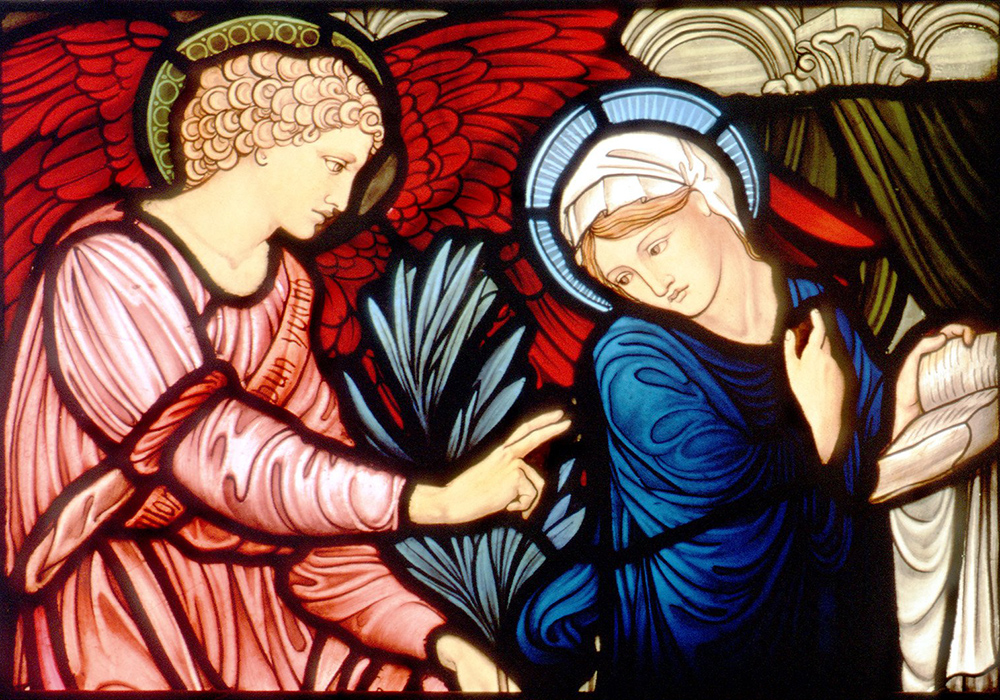
The angel Gabriel greets Mary in this church window depicting the Annunciation. (CNS photo from Crosiers)
by Sr. Joyce Meyer
International Liaison, Global Sisters Report
Karl Rahner believed that we are all called to be mystics, experiencing union with God in daily life. This challenges the idea that mystical experiences only come in quiet spaces of prayer and contemplation. I began pondering this in Mary's life as we celebrate her Annunciation experience. In doing this, I identified three important mystical moments: her experience of being presented in the temple by her parents at age 3, the Annunciation by an angel of her new role, and Mary's meeting with Elizabeth when she sang the Magnificat.
Granted, her presentation in the temple is a legend found in the apocryphal Protoevangelium of James, but it may truly have been a reality for the 3-year-old Mary. Children, as we know, even from our personal experience, often have mystical experiences of God, so it is not so far-fetched to think this of Mary. Her parents, Anne and Joachim, had taken Mary to the temple to present her to God as an offering of thanksgiving and of recognizing she belonged to God — a kind of promise made in her name that she would live her life in total faithfulness to God.
According to the legend, Mary eagerly climbed the steps of the temple, and when the priest received her and blessed her, she "danced with her feet." Being too young to articulate her joy in words, she danced because it was the only way she could express her ecstatic joy in God's love for her. Her entire being, spirit and body, was overshadowed, enlivened by the responsive spirit alive in her. Her dancing is a reminder to us that as bodily beings, when filled with ecstatic joy or awe, when no words can adequately express deeply felt emotions, the body moves without resistance to overwhelming spiritual impetus.
Advertisement
Mechthild of Magdeburg, one Christian mystic, describes well her recognition of God's overshadowing Spirit moving her from within: "I cannot dance, O Lord, / Unless You lead me. / If you wish me to leap joyfully, / Let me see You dance and sing — / Then I will leap into Love."
Mystical moments can be experienced in dance, and also at times of unexpected encounters and conversations that become revelations of our own identity, a mystery at times even to ourselves. Being overshadowed by God's Spirit we suddenly come to know who we are, alive in God at a deep level that leads us into silence, tears, dance or desire for deeper wisdom.
I wondered if Mary's childhood experience of the presentation in the temple became clearer to her when an angel appeared with God's request. In this Annunciation, God revealed to her a destiny and identity she could not have imagined. Even as blessed and beloved of God, she wondered how this could be, how she could, through God's choice, become the mother of the Messiah, Jesus?
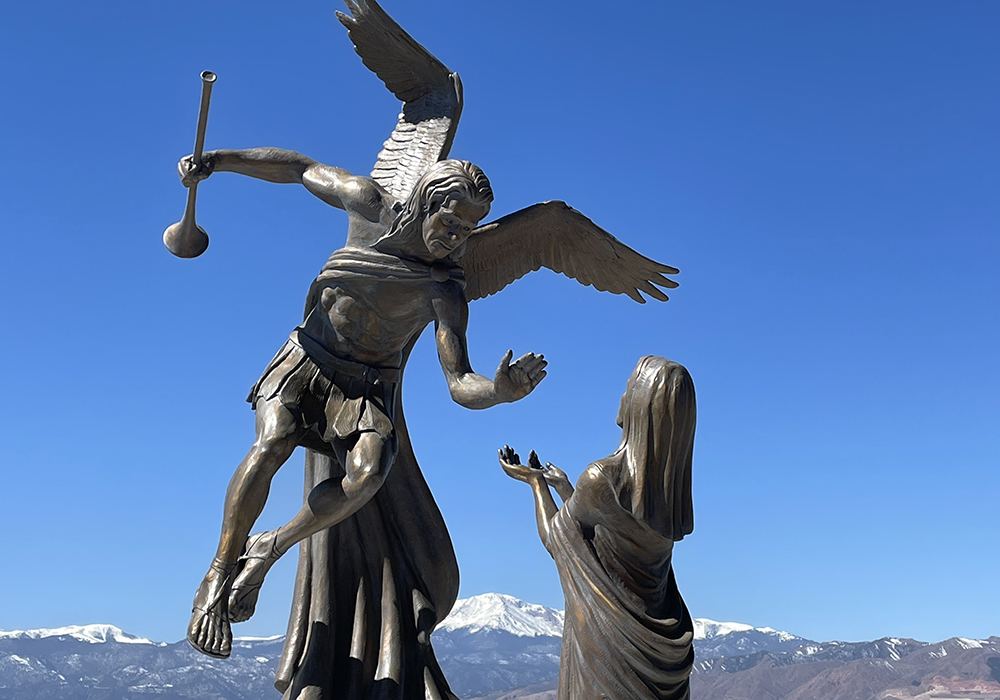
Statues of the archangel Gabriel and Mary depict the Annunciation outside St. Gabriel the Archangel Catholic Church in Colorado Springs, Colorado. (OSV News/Megan Marley)
This time of visitation, unlike in the temple, the Spirit gave her words, "How shall this be done since I do not know man?" Her words reveal intuitive recognition of the depth and risk of vulnerability her body and spirit would endure if she surrendered to God's choice.
The angel assured her that the Spirit would overshadow and empower her to live in these vulnerabilities. Nothing is impossible with God. "I am the handmaid of the Lord" was the only response Mary could give. Her encounter with the living God revealed a deep knowing of herself, living in God's mystery.
As I reflected on Mary's response, it felt to me to be both a personal "yes," and also a communal one — a covenantal response of her people. For me, she somehow stood as Moses had, a spokesperson for the covenant of her people with God, a promise of trusting in God's faithfulness. It is not unlike each of us. In every encounter and yes to God, we also stand as the entire family of God.
Mary's third mystical moment recorded in Scripture was her encounter with Elizabeth. In this meeting, the personal and communal dimensions were inseparable, revealed in the mutual recognition and response between the two women. Mary had been sent by the power of the Holy Spirit to Elizabeth both in service and as a messenger of Good News. When they embraced, Elizabeth intuitively and physically knew that Mary was more than a cousin when her own baby leapt within her. Elizabeth seemed to sense that Mary represented God's people and yet asked, "How does this happen to me, that the mother of my Lord should come to me?"
Mary, empowered once again by the Spirit, responded with song. It poured out from her being, soul and spirit, in ecstatic joy, sung with both a personal and communal voice. "My soul proclaims the greatness of the Lord; my spirit rejoices in God my savior." The Magnificat, confirmed God's faithfulness to the lowly, forgotten and powerless, and Mary's willingness — and that of her people — to believe in and live faithful to God no matter the vulnerabilities. She acknowledges and accepts to labor with the Spirit to shape Jesus' life as a living sign of God's faithfulness and the reign already present in him.
This prophetic song was sung in ecstasy and hope, and its living out in real time fulfilled Mary's Annunciation, her intuition of the sufferings of vulnerability lived in hope.
For me and maybe for each of us, the Annunciation is a time to reflect on our own mystical moments of God in prayer and in encounters, revealing God's faithful love and presence in life. Each of us, like Mary, stands for God's family, witnessing God's love and faithfulness, and embracing our role as messengers of this Good News.