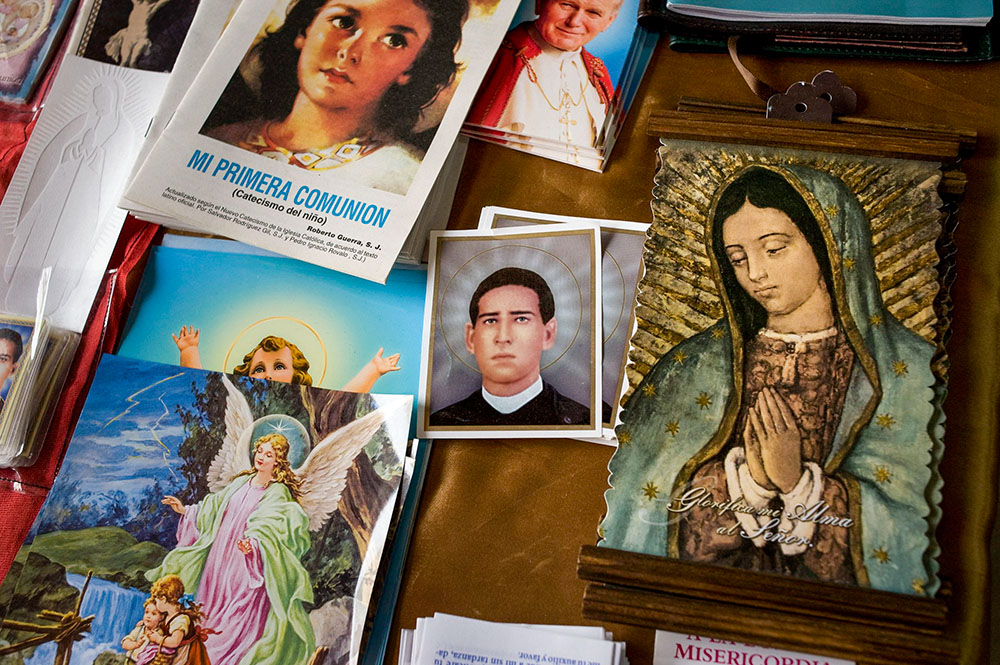
An image of St. Toribio Romo González, center, with St. John Paul II above him, is seen among other images laid out on a table at the St. Toribio Romo Church May 6 in the border city of Tijuana, Mexico. (CNS/David Maung)

by The Life Panelists

To honor the Solemnity of All Saints, Nov. 1, we asked our panelists: If you could choose a saint to spend a day with today, who would it be, and what quirky, surprising, or fun thing would you do together?
Their responses were varied, including Martha, the sister of Lazarus; one of our newest saints, St. Pope John Paul II; and a surprising revelation from one of the sisters that she is the cousin of a saint. The sisters and their saint companions spent their days hiking, traveling to Disney World, and visiting an ancestral village. What would you do with your favorite saint?
Sr. Alice Nyazungu of the Handmaids of Our Lady of Mount Carmel, based in Zimbabwe, was born and raised Catholic. She entered religious life in 2002. Alice has an honors degree in religious studies from the University of Zimbabwe. Soon after completing her degree, she was assigned to work with migrants and refugees while living among them in a refugee camp. Currently, she is studying canon law at the Catholic University of Eastern Africa in Kenya.
I would choose St. John Paul II. He was the head of the church from 1978 until his death in 2005, serving for 27 years. He was declared a saint by Pope Francis in 2014.
St. John Paul II is known for his stand against political oppression. He traveled extensively, visiting more than 129 countries and earning a reputation as the most-traveled pope. He started World Youth Day to engage and inspire young Catholics. In 1981, he survived a shocking shooting in St. Peter's Square and later publicly forgave his attacker.
John Paul II loved outdoor adventures, especially skiing, hiking, kayaking, playing soccer, jogging and swimming. Before his papacy, he frequently led youth groups on outdoor trips through the mountains and forests of Poland. He loved canoeing and navigating rivers, often celebrating Mass on an overturned canoe.
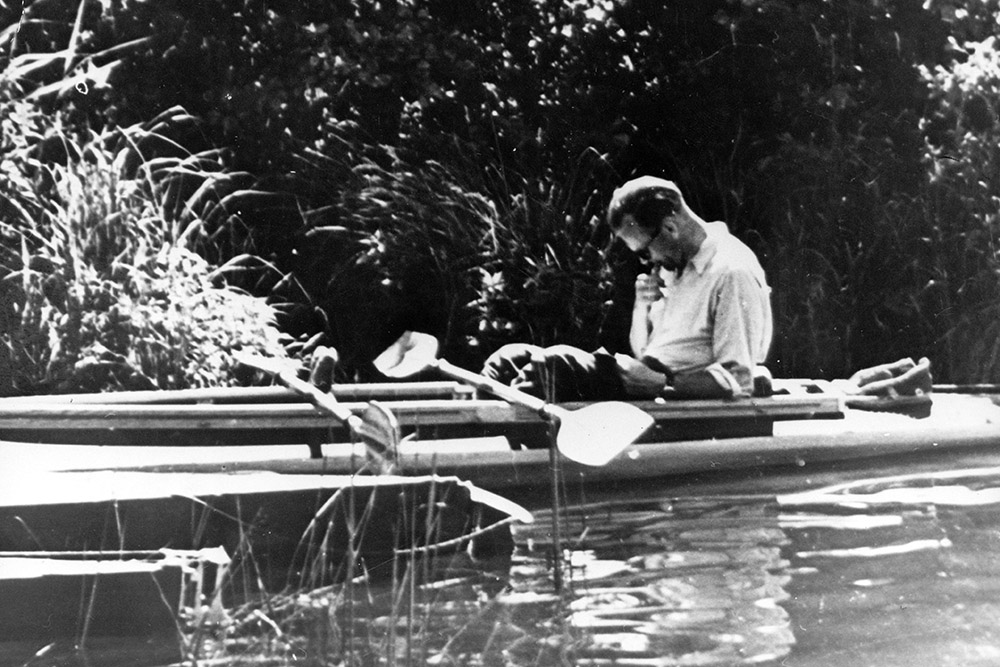
Then-Fr. Karol Wojtyla, the future Pope John Paul II, reads in a kayak in 1955. (OSV News file)
He had a talent for poetry and a remarkable facility for languages. St. John Paul II said the rosary was his favorite prayer. His papal motto, Totus tuus ("Totally yours"), reflected this deep spiritual consecration to Our Lady.
For these reasons, St. John Paul is my role model. He reshaped global Catholicism, modernized papal outreach, and influenced modern theology, human rights and interfaith relations. He defended the traditional moral teachings of the church and provided local cultures with modern role models by beatifying and canonizing nearly 2,000 persons.
In advance of our day together, we would agree to a hike on a lovely scenic trail along a beautiful mountain with a river running below.
7 a.m. — Morning hike
We would set off early in the morning to avoid the peak heat of the sun. During the climb, we would discuss practical ways to live our religious vocation fully and balance spiritual needs with human needs. I'd love to ask him questions about the nuisances of religious life.
11 a.m. — Rest at the summit
Tired from the journey, we would rest at the peak of the mountain to enjoy refreshments and contemplate the beauty of God's creation.
Advertisement
12:30 p.m. — Descent and rosary
When it was time to depart, we would begin the descent, praying the rosary together as we went.
2:30 p.m. — Boating
Once we arrived at the bottom of the mountain, we would head immediately to the river, where we would board a boat to rest and relax on the water. During this pleasant time, I would love to teach St. John Paul a few words of my native language.
4:30 p.m. — Mass
Our time together would end with St. John Paul celebrating holy Mass right there on the boat. Thus, we would conclude the day most appropriately, being sent forth from Mass, refreshed and renewed, and ready for mission.
Sr. Catherine Martinez is a member of St. Joseph Monastery, an autonomous Benedictine community based in Tulsa, Oklahoma. She was raised in Southern California. Her current ministry is coordinating a high school equivalency program with Catholic Charities of Eastern Oklahoma. She has a passion for creating relationships with diverse people. Traveling in Mexico with her grandmother opened her to new experiences, supported her facility in acquiring languages, and to this day helps her connect with all she meets. She enjoys reading, writing, all types of crafting, and traveling.
I would like to introduce you to my second cousin once removed. There are many stories and legends told about him, especially within the Hispanic community. Many have tales of encountering him on their immigrant trek to the United States. He is considered to be a patron saint of immigrants. Many of the stories portray him as a hero; other accounts show his actions to be miraculous.
My cousin is St. Toribio Romo González (1900-28), a martyr of Mexico's Cristero revolution. Along with 24 others, he was canonized in 2020. My maternal and paternal grandfathers were cousins to Toribio's parents.
My ideal day with Toribio would be spent in Santa Ana de Guadalupe, in Jalisco, where Toribio and many of his relatives were born. I would ask him to take me to all of his favorite places from his childhood and to share stories about our huge extended family. I would follow, trying to memorize every activity and encounter so nothing would be lost and no second be used unwisely.
At the end of the day, we would sit in the town plaza. I would allow myself three questions that we could discuss into the evening.
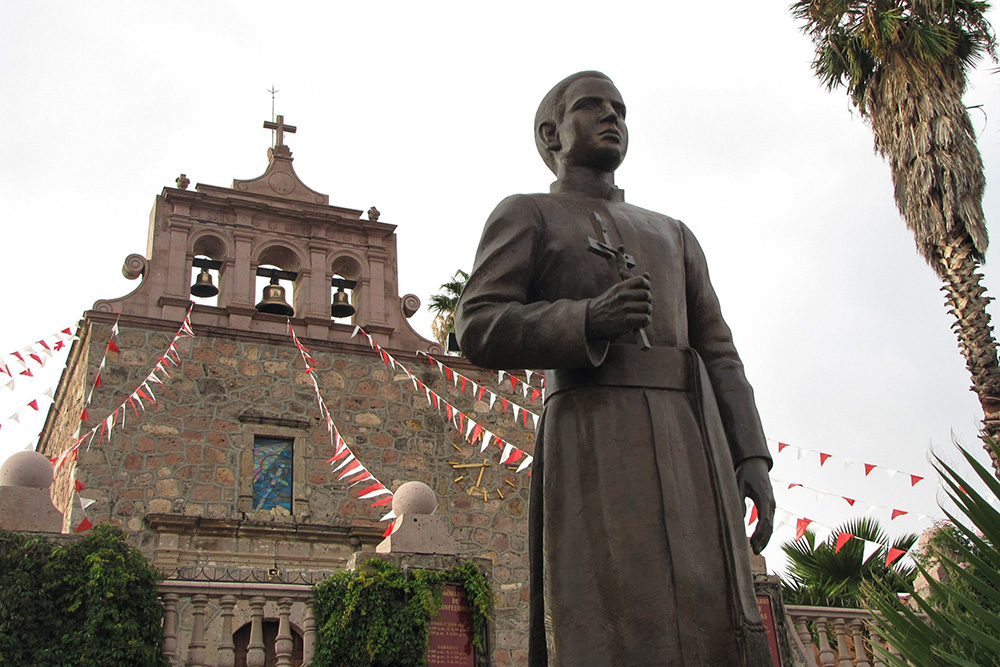
A statue of St. Toribio Romo González stands outside a sanctuary named after him in Santa Ana de Guadalupe, Mexico. (CNS/David Agren)
First, I would ask him what inspired him to continue practicing his faith even though he knew that it would probably lead to his death. I am fascinated with the stories of young men and women who have been martyred for the faith. But intriguing as those tales may be, I have often wondered what my response would be if my faith actually required the shedding of my blood.
My second question would be much more mundane. I would ask him if he had any memories or stories about either of my grandfathers and their families. I somehow suspect that my grandfathers were enough older than Toribio that he might not have known them too well. My grandfathers were both living in the U.S. by the time Toribio would have been old enough to remember them well. Considering that I come from a long line of storytellers, he might have some stories to share.
My third question would be for some advice on how to work with immigrants in our current society. My ministry offers multiple opportunities to be present to immigrants, both as coworkers and as students with whom I work. I would ask Toribio to help me to better understand their concerns, so that I can greet them with God's welcoming love.
Our day would be full. As I depart from him, I would ask Toribio to help me understand myself and others better. I would ask him to pray that my heart continues to grow daily in love of others.
Sr. Helen Mueting, a Benedictine Sister of Mount St. Scholastica, taught high school English in Kansas, Missouri and Iowa. Currently, she is secretary for the community in Atchison, Kansas. When not working in the office, she enjoys mowing, gardening, extracting honey and working outside. Her favorite Scripture quote is "My Father's house has many rooms; if that were not so, would I have told you that I am going there to prepare a place for you?"
There are many saints I would love to meet or talk to, but to spend a day with them is a little trickier. Several came to my mind but ultimately, I chose Martha.
She and I have a lot in common. I would have been right there with her when she complained about Mary not helping with the guests. I would have been in the kitchen helping Martha get ready. I would also have been there confronting Jesus when her brother Lazarus died.
Martha had spunk. She knew what she wanted and knew what she deserved from a very close friend. She was down-to-earth and realistic. She also openly stated her belief in Jesus, calling him the Messiah and Son of God. Legend has it she accompanied her brother when he fled Judea and assisted him in proclaiming the Gospel.
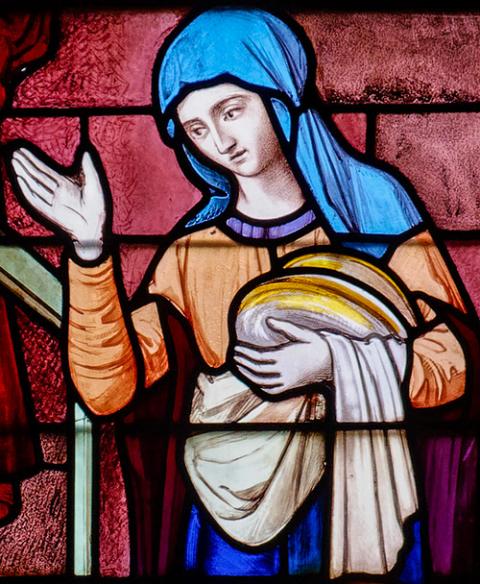
St. Martha is depicted in stained glass at the Church of Sainte-Marthe des Quatre-Chemins in Pantin, France. (Dreamstime/Pixelia21)
If I could spend a day with her (over a meal, of course), I would ask her what it was like to be a friend of Jesus. She might even share with me some of her favorite recipes. After that, we would talk about what it was like for her to be an apostle.
Me: Martha, what was it like to be a good friend of Jesus? Did he come to your house often?
Martha: I loved to see Jesus come to our house. He was special in many ways. I felt important to him, and I felt like he listened to me. I was not just a friend. I was someone he asked for advice and someone with whom he shared some of his fears. He once spoke of how he wished he could have included women among the Twelve. He felt we were more compassionate and caring; we knew loving others was most important.
Me: How did you feel when you tried to get Mary to help you and he told you Mary had chosen the better part?
Martha: At first, I wanted to argue with him, but then I realized being present to those around me was important. Yes, the work had to get done, but did it need to be done right then? Of course, being me, I was still irritated at Mary. She could have at least helped me a little before Jesus got started.
Me: I understand! I would have felt the same way. I'm curious. What was the resurrection of Lazarus like?
Martha: I believed Jesus could bring him back to life. I knew he was the Messiah and that he could make anything happen. I was scared when we approached the tomb, but Jesus reminded me that if I believed, I would see the glory of God. I believed with all my might. When Jesus called, "Lazarus, come forth!", Lazarus came stumbling forth. I was so shocked I couldn't move. My brother was back!
Me: Martha, I could ask you many more questions, but I have asked enough. Just sitting here with you, listening to you, I experience your great love of this man you called a friend.
Sr. Jean Flannelly, a Sister of Charity of New York, holds a doctorate in clinical psychology from Fordham University, a master of theological studies from Weston Jesuit School of Theology, and a certificate in spiritual direction from Hesychia School of Spiritual Direction. She has devoted much of her ministry to preparing both lay and ordained individuals for church service. Previously a pastoral associate for faith formation, she managed liturgy, spirituality and faith formation in a large urban parish. Now based in rural New York, she continues her outreach to underserved communities, bringing spiritual guidance and support to those in need.
My family tells a story that traces my truth-loving core to when I was about 2 or 3. The details of the event are not as relevant as my solemn admonition to my uncle: "Don't toll me a lie!"
I give pride of place to two commitments: seeking truth in all its guises and speaking the truth in love. I also have an intolerance for manipulation, lying, and all the euphemisms we give to lying: "misspoke," "alternate facts," etc.
For these reasons, I'm drawn to St. Thomas More, the 16th-century chancellor of England beheaded by King Henry VIII for refusing complicity in the king's plans to divorce and remarry. Though separated from us by 500 years, Thomas can shed light on the chaos that engulfs our country and the world. I invited him to spend a day with us and let him choose where we would meet.
Thomas wanted to go to Disney World, not surprising, given that he wrote Utopia, a satirical treatise that posits a perfect world as a critique of the existing one. At the end of the day, as the sun was inching down to the horizon, he told me two of the rides might point our way forward: "It's a Small World" and "Pirates of the Caribbean."
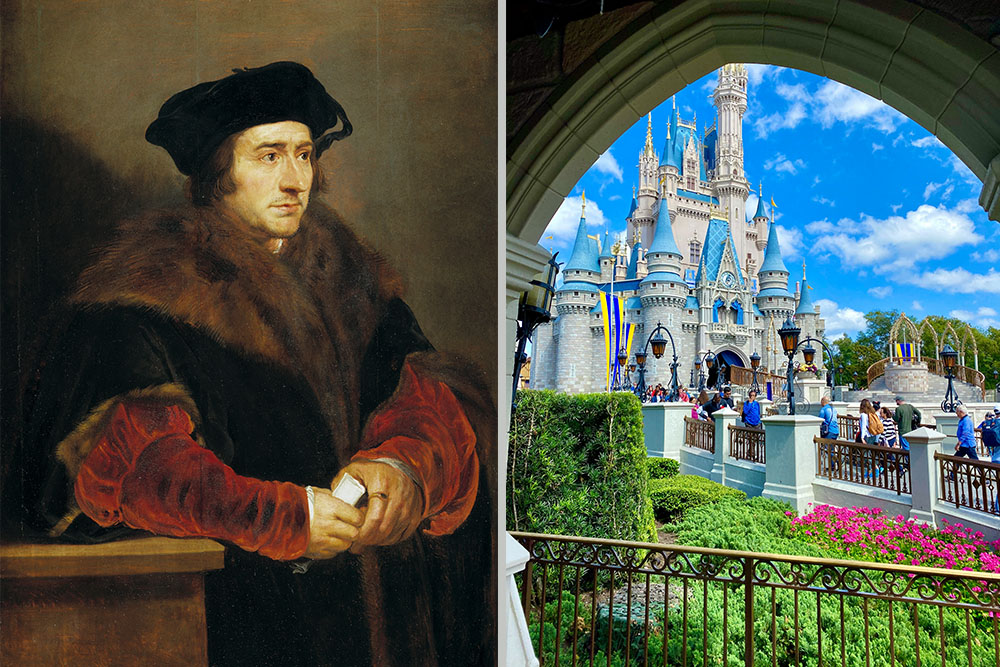
Left: "Portrait of Thomas More" by Peter Paul Rubens (Wikimedia Commons); right: a view of Magic Kingdom Park at Disney World in Orlando, Fla. (Unsplash/Rayna Tuero)
The message of "It's a Small World" was straightforward: We are all related. When we understand that, we also understand "your joys and pains are my joys and pains." Thus, we will be less likely to demonize the "other" and instead become curious and seek to understand how others make sense of their experiences.
Thomas gave more time to describing the pirate ride. He was entertained by pirate tales, he said. That ride, he said, was designed to scare us. Why? In the boat surrounded by family and friends, we were safe. A scary ride in those circumstances would stir threatening emotions in a safe environment and could defuse negative feelings, teaching that one need not be overwhelmed by them. One can conquer and move through them to a larger world where more positive options are available.
Using this bedrock principle of psychotherapy, Thomas suggested "Pirates of the Caribbean" can call us individually and communally to face our fears rather than defend against them. That would give us greater freedom, he said.
It was getting dark, and Thomas was eager to return to his other life, but he wanted us to remember not to let go of our search for the truth, and to find the courage to speak it in love.
Josephine Kwenga is a sister of St. Joseph of Tarbes-Kenya. With an academic background of higher studies in development, project management and sustainable development, she has been a school administrator and worked in the administration and leadership of the Association of Sisterhoods of Kenya's program offices in environment, gender, and justice and peace. She is currently development coordinator for her congregation's Kenyan province and works with SJT Peace Service in partnership with AGIAMONDO, a partner organization from Germany.
St. Francis of Assisi lived centuries ago, but his spirituality speaks to me powerfully today, in a world that is faced with climate change and environmental degradation. This is the saint I would choose to spend a day with, and the quirky, surprising and fun thing we would do is plant a tree, then reflect on the current environmental concerns. I would attentively listen to his advice since we have something in common: love for nature.
St. Francis spent time with nature and used it to communicate God's love to humanity. As a passionate organic farmer, I would be delighted to invite him to spend a day with me. I would joyfully tour him around our St. Joseph of Tarbes organic garden, where I imagine he would be delighted to walk through the organic demo farm field and the forest design garden. Both are nature-friendly, having zero conventional or chemical fertilizers that kill insects. Instead, we apply organic manure and herbs that naturally repel insects.
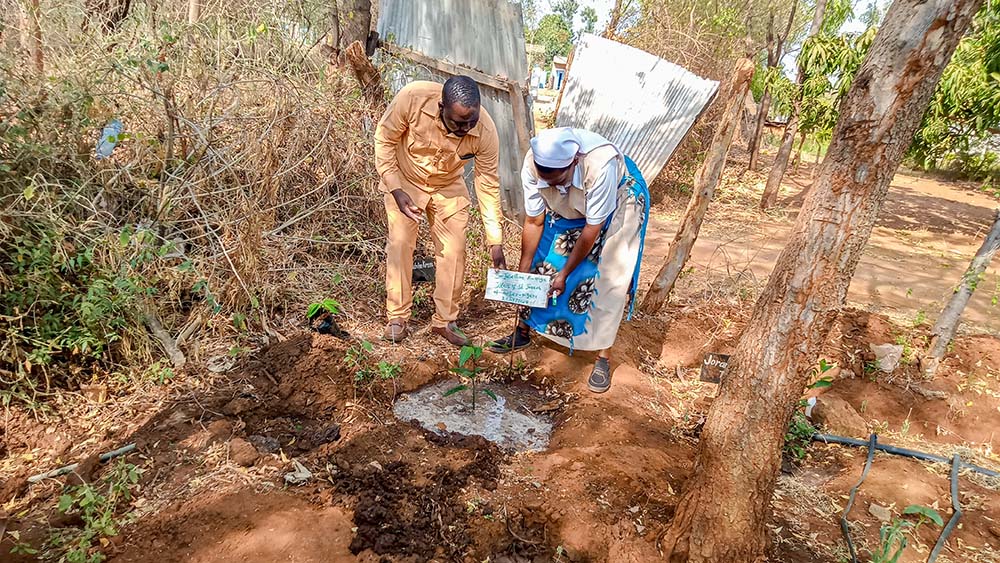
Sr. Josephine Kwenga, a sister of St. Joseph of Tarbes, plants a symbolic fruit tree during a United Nations World Environmental Day commemoration with Indigenous farmers in Kenya. (Courtesy of Josephine Kwenga)
Anyone observing us converse would see St. Francis delighting in the nature that he called "sister and brother" — a family of creation. They would see him reach out for a tool and some indigenous seedlings. I would hand him a farm tool and invite him to participate in our sustainable farming practices that restore soil health, conserve water, protect biodiversity and reduce dependence on harmful chemicals.
As we worked, we would converse about the farmers' struggles with unpredictable rainfall, uncertain harvest and the rising cost of living. The important question would remain: How can we care for the Earth while helping people live with dignity?
As we conclude our day together, I imagine St. Francis and I would join our community for a meal around our kitchen farm table, and the food would have come from the very soil we would have spent the day reflecting on and with gratitude. We would sing the Magnificat.
I imagine St. Francis' final words might be a reminder to me that caring for creation is not about workshop sessions, conferences and beautiful statements, but something more practical in our day-to-day lives.
St. Francis of Assisi, pray for us.