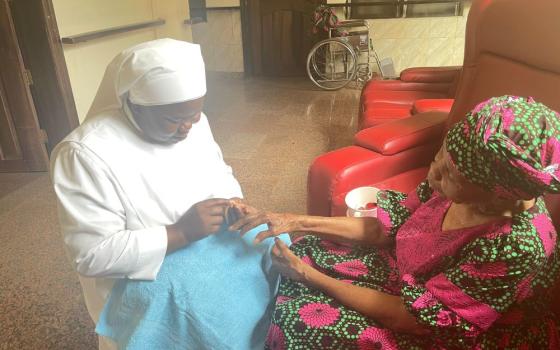
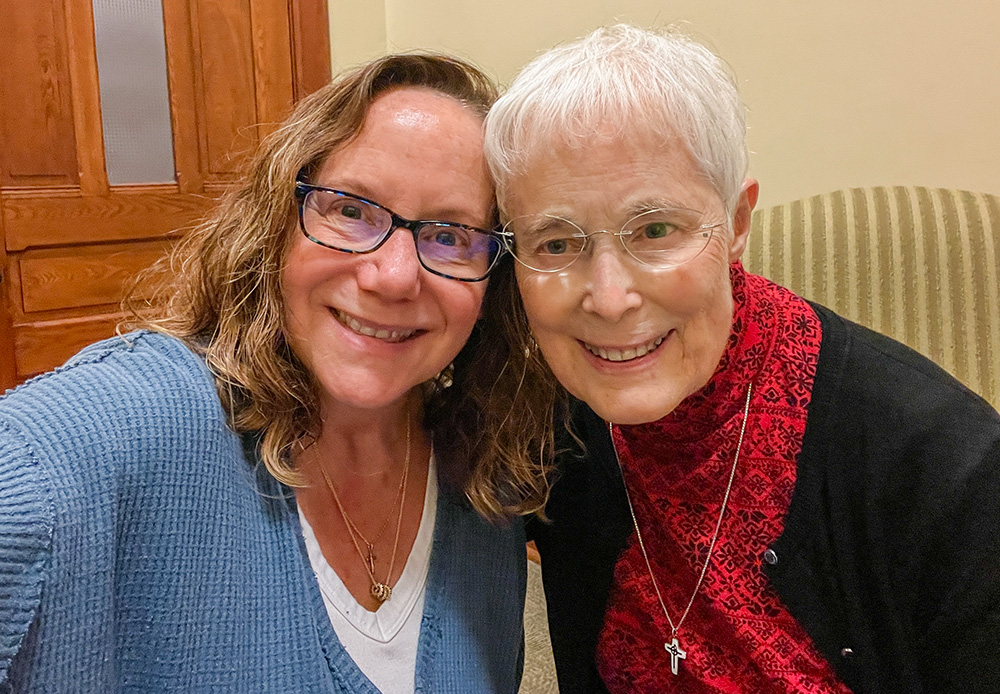
Christine Turo-Shields with Providence Sr. Connie Kramer (Christine Turo-Shields)

by Christine Turo-Shields
When I learned that my 82-year-old spiritual director, Sr. Connie Kramer, had a brain tumor in the shape of a butterfly, I asked if she might consider recording a StoryCorps interview. As a Catholic nun, grief specialist and mentor, Sister Connie's vast wisdom needed to be preserved.
In her typical fashion, she agreed joyfully and we sat together to capture her reflections on faith, loss and the gifts that grief offers. It was after that recording that I began making frequent pilgrimages to the motherhouse of the Sisters of Providence of St. Mary-of-the-Woods. Much like Mitch Albom chronicled in his bestselling book Tuesdays With Morrie, I came to think of these visits as "Sundays With Sister."
Our ritual was simple but sacred. With her walker, lovingly named George after her father, we attended the 11 a.m. Mass together at the Church of the Immaculate Conception, followed by lunch in the cafeteria among her sisters. Then we spent time alone in sacred conversation until she retired for her afternoon rest.
Those Sundays became a rhythm of grace. We spoke of life and death, of the past and future, of faith, hope and the profound gifts of grief. As she said more than once, "Grief is God's greatest gift to us."
Sister Connie fully embraced her pending death. She rejoiced that her tumor was butterfly-shaped, a sign of transformation.
Sister Connie was a petite, spry woman with white hair and a skip in her step and a lift in her voice. But I saw noticeable changes in just a short time. Her breathing grew shallow and rapid. Her once-bright eyes dimmed. Her familiar smile was present but strained. We would always hold hands during Mass, but her arm began quivering as she pressed it against my side. Her legs shook slightly as she struggled to stand throughout Mass. There was even a faint new smell that lingered near her, distinct and unmistakable signs that her body was entering the active stages of dying.
One particular day, the advent of her death pressed itself into my senses in a new and piercing way. Tears filled my eyes, and I could not look at her for long. Instead, my eyes ascended as I lifted my gaze to the painted dome and stained glass illuminated on that winter's day. It felt as though she was already traveling in that direction — upward, toward the God she so loved.
Matthew 25:13 reminds us that we know not the day nor the hour. However, I longed for more time, perhaps to see her in early February when our pilgrimage group would visit, or in spring when the grounds of St. Mary-of-the-Woods would blossom with life, or on April 1, her birthday, which she found delightfully humorous. But my heart knew the end was near.
Sister Connie fully embraced her pending death. She rejoiced that her tumor was butterfly-shaped, a sign of transformation. Ever practical, she also expressed gratitude that it was inoperable. As the former treasurer of her community, she saw it as a gift that spared her sisters the burden of costly treatment. Gratitude, even in illness, was her constant refrain.
Advertisement
Her wisdom was never abstract. As her cognitive ability declined with the growing butterfly in her brain, she prayed daily: "God, help me remember what you want me to remember, and help me to feel what you want me to feel."
She reminded me that memory is a sacred gift — an enduring bond, a way of staying connected to God and to one another. "Gratitude," she said quite often, "is the memory of the heart."
In the early morning of Jan. 31, 2025, I received the call that Sister Connie had surrendered her earthly body to her loving God the evening before. Even now, her words echo deeply in my soul: "You are me ... and I am you ... and we are one." Her life and death taught me that grief is not an enemy, but a companion. She held tightly to Psalm 139 that "darkness and light are the same to God," and, in that assurance, "it is only when it is dark do the stars shine most brightly."
Sister Connie's spiritual guidance was present until the end. Grief calls us to not fear death, but to befriend it. She passionately allowed grief to lead her through life, giving her the wisdom and perspective to have reverence for life.
Grief is the place where darkness and light meet, where absence becomes presence, where memory becomes gratitude. In walking with her, I learned what she already knew: Death is not the end, but a holy passage into the fullness of God.