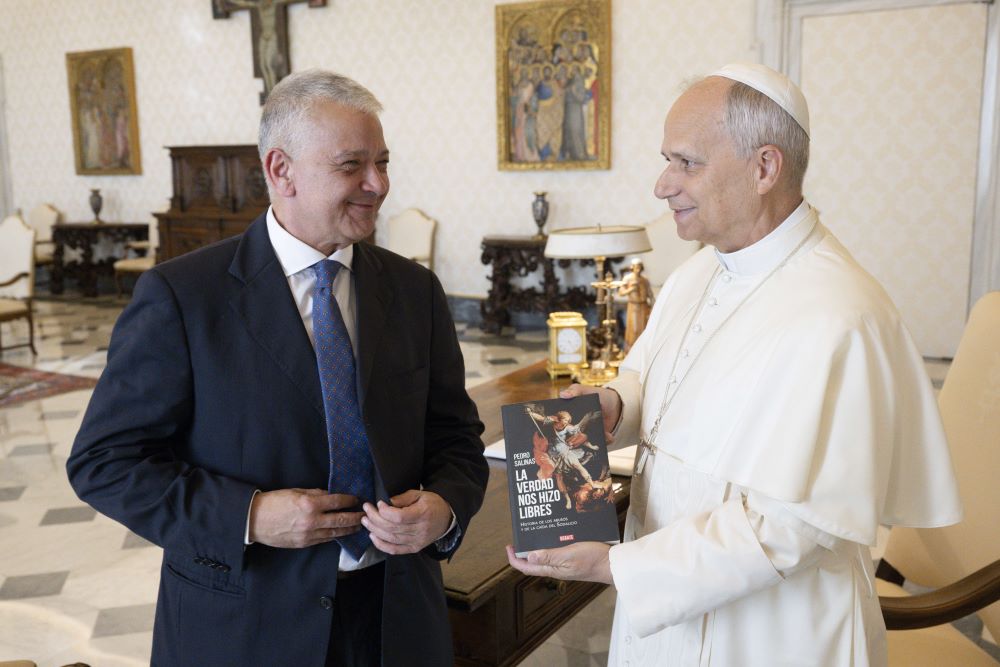
Pope Leo XIV meets with Pedro Salinas, a Peruvian journalist and abuse survivor, in the library of the Apostolic Palace at the Vatican Oct. 20, 2025. Salinas is a former member of Sodalitium Christianae Vitae who suffered physical and psychological abuse by the movement's founder, Luis Fernando Figari. (CNS/Vatican Media)

by Consuelo Vélez
Recently in Spain, there has been talk of a Catholic turn to the faith among young people, visible in religiously inspired music and in groups that attract significant numbers of youth who gather to pray, sing, adore the Eucharist, and engage in other expressions that make their faith visible.
This phenomenon is not limited to Spain. In Latin America (and likely other parts of the world), similar groups have emerged — not only among young people, though with strong youth participation — offering weekend retreats marked by conversion testimonies and various prayer practices or liturgical expressions that generate strong emotional impact in participants. As a result, many remain connected to the groups promoting these experiences and churches (or at least their communities) see increased participation, and religious practices are revived in ways that seem to confirm this so-called Catholic turn being discussed today.
Personally, I have questions about these experiences. They remind me of the rise of the so-called "new ecclesial movements" strongly supported by Pope John Paul II, some of which over time have revealed a lack of coherence between what they claimed to live and what was later observed. Some founders and members of these newer movements or religious communities have been found guilty of pedophilia, sexual abuse and psychological abuse toward their members or those they served. Not all groups, but too many. Many of these movements still exist today (only a few have been dissolved), which I find difficult to understand. It is hard to grasp why a charism would continue to be followed when it is associated with such grave abuses. Yet this is how structures work — whether civil or ecclesial: Once consolidated, they are very difficult to dismantle, even when their foundations are questionable.
What concerns me most about the current groups is the doctrinal traditionalism they often display, which seems far removed from the spirit of the Second Vatican Council and the synodal vision through which Pope Francis—and now Pope Leo XIV — seek to renew the Church.
A doctrinal note published recently by the Commission for the Doctrine of the Faith of the Spanish Bishops' Conference titled Cor ad Cor Loquitur ("Heart speaks to heart"), on the role of emotions in the act of faith, responds precisely to these experiences.
The document does not explicitly mention doctrinal traditionalism, which I believe accompanies these experiences, but it does emphasize "emotionality" as a defining element of these new religious expressions. It also stresses the need for a spirituality that integrates all dimensions of the human person and calls for discernment regarding such experiences — discernment exercised by ecclesial authority as guarantor of the authenticity of the faith and of these new initiatives.
The note explicitly refers to experiences centered on the "initial proclamation" of the faith, which, while appearing fruitful, raise concerns due to their partiality centered on emotions and their difficulty integrating into the broader life of the church.
Advertisement
The document is divided into two main parts. The first explains the importance of emotions in the experience of faith and the need to include all other human dimensions. The second offers criteria for discerning these kinds of spiritual experiences.
On the first point, it makes important affirmations for living faith authentically. Faith must involve the whole person: affective, intellectual and volitional dimensions. Therefore, if emotionality is overemphasized, there is a risk of becoming "consumers of emotionally charged experiences and insatiable seekers of spiritual feeling," rather than witnesses of Christ, conformed to His life. The center of the Christian message is the paschal mystery, which has transformed history and is capable of transforming every human life. For this reason, every "emotional impact" must also be expressed in concrete action.
The absolutization of emotion is one of the defining traits of postmodernity. "I think, therefore I am" is being replaced by "I feel, therefore I am." But emotion alone leads to immediacy and the present moment, and in the context of faith this can lead to dependence on feelings — often strengthened in group settings. Emotion is easily manipulated and can even lead to spiritual abuse.
A faith experience based solely on emotion may lead people to believe they are having mystical experiences. Yet this was not the experience of the great mystics. They also knew the dark night of faith and integrated their whole person into the journey of belief.
At the same time, the note does not deny the importance of feelings in spiritual life or, in other terms, the need to recover the centrality of the "heart" in the human person — the place of decision, truth, encounter and covenant. In fact, recent magisterial documents such as Caritas in Veritate (Benedict XVI, 2009) and Dilexit Nos (Francis, 2024) call for a renewed appreciation of the heart in Christian life, since it integrates affective, bodily, rational, intellectual and volitional dimensions, along with commitment. In this way, faith becomes a totalizing event in the believer's life.
For all these reasons, the Commission for the Doctrine of the Faith proposes the following theological-pastoral criteria for discerning such spiritual experiences:
- Our faith is trinitarian, which frees believers from individualism and opens them to community.
- Faith has a personal dimension that goes beyond rules and involves an encounter with the person of Jesus. This encounter brings joy, but also the call to carry the cross with Christ.
- Alongside its personal dimension, faith has an objective dimension, requiring deeper doctrinal formation. Formation becomes essential for integrating truth and love. The emotional experience of faith must be grounded in the objective truth of the kerygma, contained in the Word of God as transmitted and interpreted by the church.
- By the very logic of the incarnation, our encounter with God is always mediated through the church. An authentic ecclesial experience of faith does not absolutize the charism of a particular group, but recognizes the richness of the whole. New groups require discernment of their authenticity and appropriate oversight by ecclesial authorities. Their role is not to quench the Spirit, but to test it and hold fast to what is good. A true sign of ecclesial life is the willingness to submit these practices to the discernment of the bishops and the competent diocesan bodies.
- The ethical and charitable dimension is a sign of a true encounter with Christ — one that not only transforms the believer's interior life, but also impels them toward concrete commitment within the church and in the world. Faith must take shape in charity toward the poorest, in witness and in service that help to transfigure the world by making present within it the values of the kingdom.
- Finally, the experience of faith requires a celebratory dimension that cannot be reduced to individual prayer or mere devotionalism, but necessarily includes the communal, objective and sacramental life of the church. In this regard, the note cautions against so-called "eucharistic adorations" when they become detached from the liturgical celebration and from the belonging of all the faithful to the body of Christ.
Although this doctrinal note is addressed to the Spanish church, the presence of these groups — or of a spirituality more centered on emotion — is not limited to one country. It is important for all of us to discern their relevance and application in the various contexts where they are emerging. It is true that we must not "quench" the Spirit, who always makes all things new. Yet it is also a moral responsibility to discern its manifestations, especially in light of very recent experiences of too many wolves in sheep's clothing.