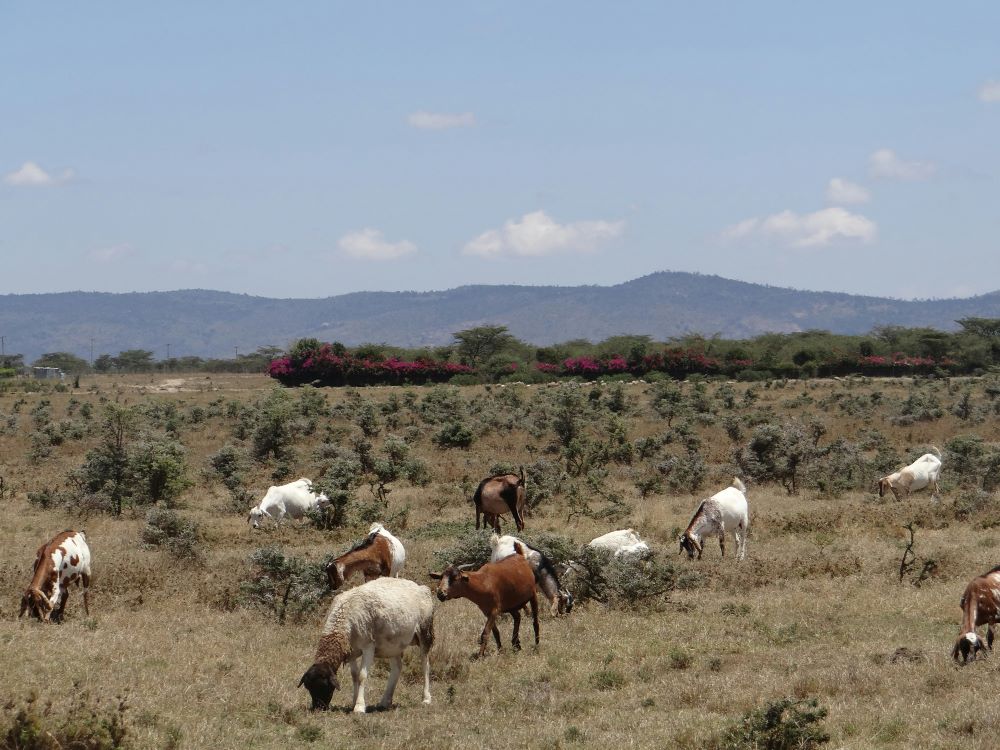
Loldaiga Hills in Nanyuki, Kenya (Unsplash/Tourite Safaris)

by Sr. Josephine Kwenga
In the highlands of Muringato, Nyeri County, Kenya, a quiet yet profound transformation is underway. Once silenced by poverty, isolation and systemic neglect, women at the grassroots level are becoming voices of resilience and agents of change. At the heart of this change is a collaboration among the Sisters of St. Joseph of Tarbes; Sisters Rising Worldwide (SRW), a mission-driven nonprofit that empowers religious sisters with connectivity, visibility and funding to address injustice from the ground up; and Learning for Humanity, a program sponsored by Medicines for Humanity, an NGO whose mission is at-risk children under 5 and their mothers.
The collaboration began when SRW funded our congregation's demonstration farm in Nyeri, Kenya. The farm offers food production and farming education to local families, and funding was intended to help us solve a long-standing problem that affected our efforts: repeated crop destruction by wild animals, including elephants, antelopes, gazelle, porcupines and monkeys. These wild animals, especially during drought seasons, consistently moved into cultivated lands, seeking food and water, destroying crops. The losses they caused were demoralizing to the farmers and a barrier to meaningful agricultural learning and crop productivity.
As a solution, we installed a durable chainlink security fence around the entire farm, including an iron door at the entrance that remained closed, keeping out unwanted animal visitors. With this protective measure in place, farmers could finally observe thriving crops rather than the broken and wilted stems of plants, and training activities could resume.
Mary Wanjiru, a single mother and beneficiary of our training, described the value of the fence. "We used to plant and lose everything to animals," she said. "Now we are harvesting hope. This fence is more than a boundary against the wild animals. It protects our sweat of hard work tilling the land."
The threat of birds is still one challenge we have not yet managed to address. They come in huge flocks, particularly during the dry seasons, around January and February, and again in September and October. Swooping down, they eat the vegetable leaves, leaving only empty stems that are not of any use to farmers.
With the assistance of SRW, we also began providing training demonstrations of climate-smart, sustainable farming methods to our women's group,
"Multi-story Gardens and Food Forest Systems," enabling the cultivation of multiple crops on a circular tower of soil, ideal for women with limited land space. One woman told me, "My multi-story garden feeds my children and gives me dignity, and I no longer buy vegetables."
Advertisement
We practice farming inspired by nature's own design, where different varieties of plants each contribute, support each other and add value to the environment. Domestic food forest farming integrates trees, shrubs, vegetables and medicinal plants into a single ecosystem. These systems not only yield diverse produce but also regenerate the soil, conserve water and increase long-term productivity —the goals of permaculture farming.
The combination of these techniques has strengthened food security and resilience among smallholder farmers in our area, extending its benefits to urban families. Urban families had learned to rely on ready access to food, and on free aid programs that were gradually becoming inaccessible. Despite this, a shift to self-reliance through farming was unattractive because they could not see it as a reliable source of livelihood. Reliance on free provisions seemed easier than investing in efforts to learn new agricultural methods. Farmers were also skeptical, but when they saw results, many began to change their views and are now becoming champions of agroecology and sustainability.
I was able to address their skepticism by completing a four-week program called "Turning Passion into Action Through Advocacy." The course reawakened in me a strong desire to do everything for those who do not have access to the necessary spaces and basic needs around me. This inspired my team and me to design an advocacy project, funded by SRW, with a focus on women who had been excluded from resource allocation and public decision-making.
We hired a trainer from Laikipia Permaculture Center, and, for one week, we held community forums and workshops. Open dialogue and participatory learning helped beneficiaries reflect on their realities, identify challenges, and explore pathways toward empowerment and self-reliance. Workshops covered awareness building of personal potential, skills development, economic empowerment and possible income-generating activities that could create sustainable livelihoods.
Jane Muthoni, a widow and landless farm laborer, shared her experience of the forum and workshops: "For the first time, someone listened to us. We were not just given handouts. We were taught to think and do for ourselves. I now know that I have the potential to claim my right to fair prices and support."
We have learned that impact not only happens through resources but through relationships, solidarity, trust and partnerships that do not dictate but empower. Today, behind the protective fence, beneath the shade of fruiting trees, and in the determined voices of empowered women, hope is no longer a dream — it is a daily harvest.