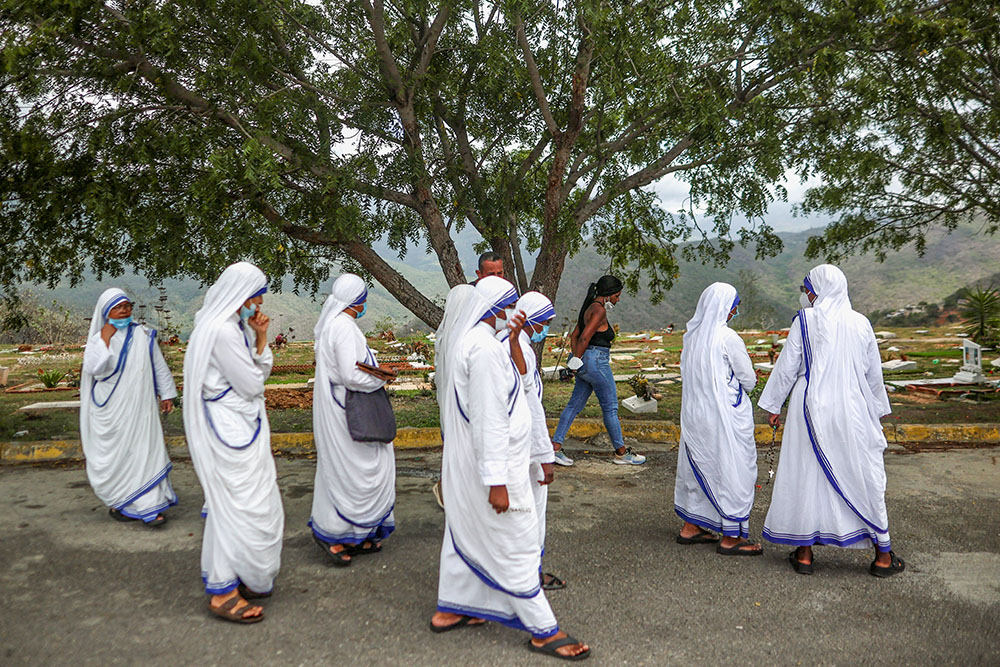
Members of the Missionaries of Charity walk after accompanying a burial for earthquake victims at La Esperanza Cemetery in La Guaira, Venezuela, July 6, 2026. Two catastrophic earthquakes hit Venezuela in quick succession June 24, leaving at least 3,500 dead, which experts say is a major undercount. (OSV News/Reuters/Adriano Machado)
by Sr. Maura Aranguren
On June 24, 2026, Venezuela experienced one of the greatest tragedies in its history when two powerful earthquakes, measuring 7.2 and 7.5, struck the state of La Guaira, parts of Caracas, and the states of Falcón and Miranda. The disaster has plunged us into deep grief for the lives that have been lost. Once again, our country has been shaken. And once again, we promise ourselves that we will rise, shake off the dust and keep moving forward.
The question continues to echo: Where is God? Did God want this to happen? No. God does not want his children to suffer. Yet God is present in the midst of this pain, offering signs of light and hope in every child, father, mother and older adult pulled from the rubble. God is present in every volunteer who has left everything behind to search for survivors; in every sister, brother and priest who has gone to the disaster areas to bring comfort and compassion; in every Venezuelan determined to clear away debris with little more than bare hands; in every person using social media to share information; and in every group gathered in prayer, asking God to bring comfort and keep our faith strong.
As the country faces this national emergency, religious congregations and Cáritas Venezuela have transformed their parishes, schools, ministry centers and convents into shelters and places of hope for people who have been displaced. They are providing food, shelter and emotional support to thousands who have lost everything.
Once again, religious life has responded to suffering. We do so not out of abundance, but out of what defines us: our call to serve God among those who are poor and most vulnerable. We seek to be a source of hope by caring for others, listening to their stories and creating safe spaces for children and older adults.
Advertisement
Every parish and every Catholic school untouched by the earthquakes have opened their doors, classrooms and parish halls to families who have lost their homes. They have laid out mattresses, welcomed displaced families and become collection centers where relief supplies are received, sorted and distributed.
One example is St. Jude Thaddeus Parish in the La Florida neighborhood of Caracas, where my sisters are serving at a center that receives and distributes donations.
The same is true of Venezuelan-founded congregations such as the Carmelite Sisters of Mother Candelaria and the Little Sisters of the Poor, who have taken in hundreds of children now left without families. They are caring for these young lives, knowing they are especially vulnerable to criminal groups seeking to exploit the chaos and suffering.
Many sisters, brothers and priests are providing psychological, emotional and spiritual support to those affected by the earthquakes. They are living their pastoral mission by helping people cope with trauma and find meaning in the midst of suffering. They have also gone to the disaster sites to pray for the eternal rest of those who have died, for those who are still missing, and for those who have been found alive.
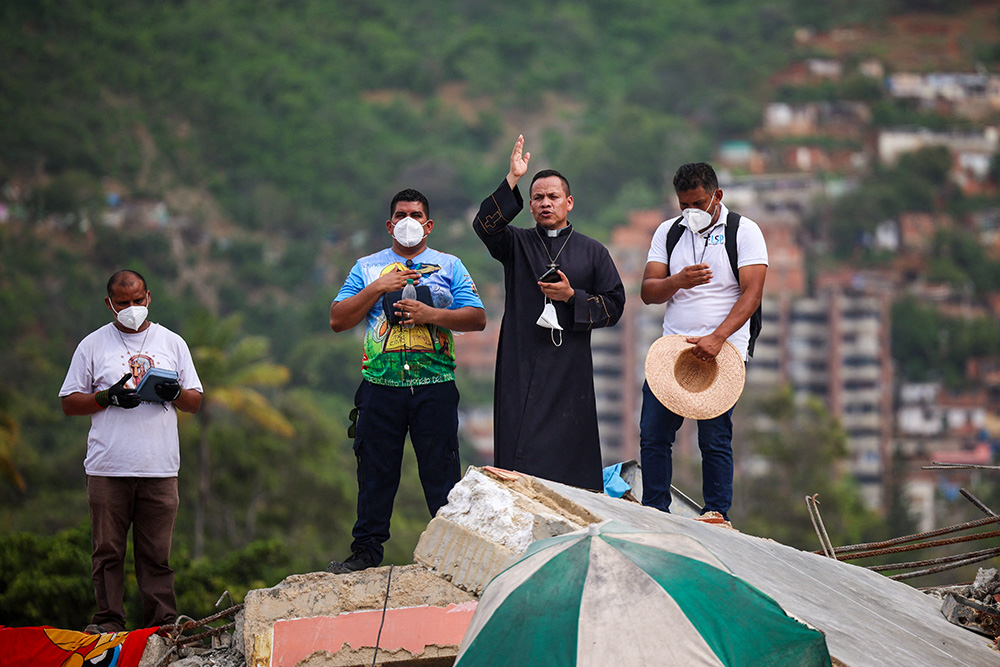
A priest gives a blessing as he stands amid rubble at the site of a collapsed building in La Guaira, Venezuela, July 1, 2026, in the aftermath of earthquakes. (OSV News/Reuters/Adriano Machado)
Religious communities involved in health care ministry have also found new ways to continue serving. Because damage to hospitals has made it impossible to provide care inside their facilities, the sisters at San José Hospital, operated by the Little Sisters of the Poor, have moved their ministry to Padre Machado Plaza near the hospital. That is what religious life in Venezuela does: We find new ways to serve.
It has been inspiring to see how we, as women and men religious, have come together through our communities, schools and ministries to coordinate relief efforts and serve as channels for delivering aid directly to Cáritas Venezuela. We have collected medical supplies, personal hygiene items, clothing for adults and children, nonperishable food, diapers and medications.
One example is our Nuestra Señora del Valle School. Together with our students and the young people of Proyecto Líderes, we receive, sort and pack everything that is donated before delivering it to the Cáritas center at St. Francis Xavier Parish in Porlamar, on Margarita Island.
We have also thanked God for the presence of our young people, whose leadership, commitment and desire to respond to God's call have been a blessing. Watching them serve with such generosity, without worrying about the time or the exhaustion, has been deeply moving. They had one goal: to serve their neighbor.
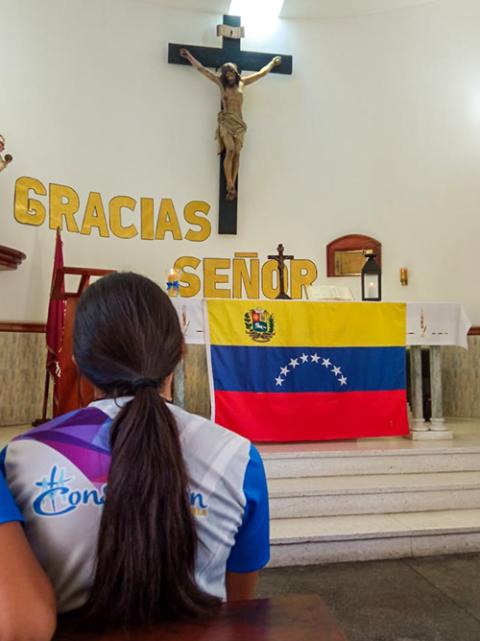
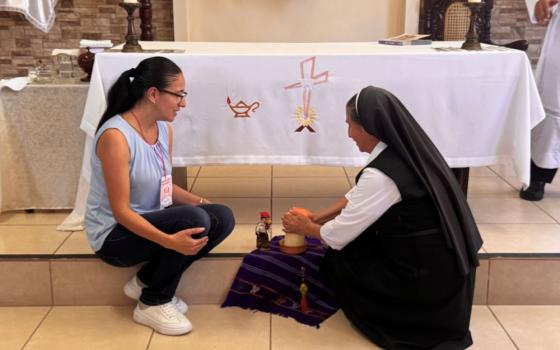
A young woman from Proyecto Líderes prays before the altar at St. Francis Xavier Parish in Porlamar, Venezuela, in July 2026. (Courtesy of Maura Aranguren)
We also wanted them to understand that nothing is possible without God. At the end of each day, we gathered in the chapel to give thanks and pray for all our brothers and sisters. During those moments of prayer, silence settled over us. We carried mixed emotions: grief for those who are no longer with us, for those who are still missing, and for those who have lost everything; yet also joy each time someone was found alive.
For religious life and for all people of faith, the call has been made clear in the words of Archbishop Raúl Biord of Caracas: "Our first priority now is to save lives and rebuild lives," even as many of our own buildings have also been damaged by the earthquakes.
His words reaffirm our mission to accompany those who suffer and to be a source of hope: "Then I will give you shepherds after my own heart, who will lead you with knowledge and understanding" (Jeremiah 3:15).
There is no doubt that the Lord continues to strengthen us in our vocation and urges us to give our lives through what we are and what we know how to do in this moment: to pray, to love, to care, to comfort and to accompany.
God has made himself known as the God of life in every rescue. He has shown us the power of faith and given us signs that his love sustains the lives of those who have lost everything.
This emergency is far from over and requires the help and commitment of us all. While authorities work to provide permanent housing, religious communities continue to show that when buildings collapse, solidarity and faith become the strongest foundations for rebuilding the country.
This emergency has exposed the government's greatest weaknesses. It has revealed a lack of organization, inadequate preparation for a disaster of this magnitude, and years of insufficient investment in maintaining public infrastructure. But it has also revealed the compassion and solidarity of so many Venezuelans. It has shown that when we stand together, we are stronger. It has highlighted the generosity of volunteers, rescue workers, and women and men who have come from Mexico, Ecuador, El Salvador, Israel, the Netherlands, Spain, Brazil, Turkey, Colombia, Germany, India, the United States and many other countries.
We give thanks to God for bringing us together and keeping us steadfast in faith in the midst of suffering.