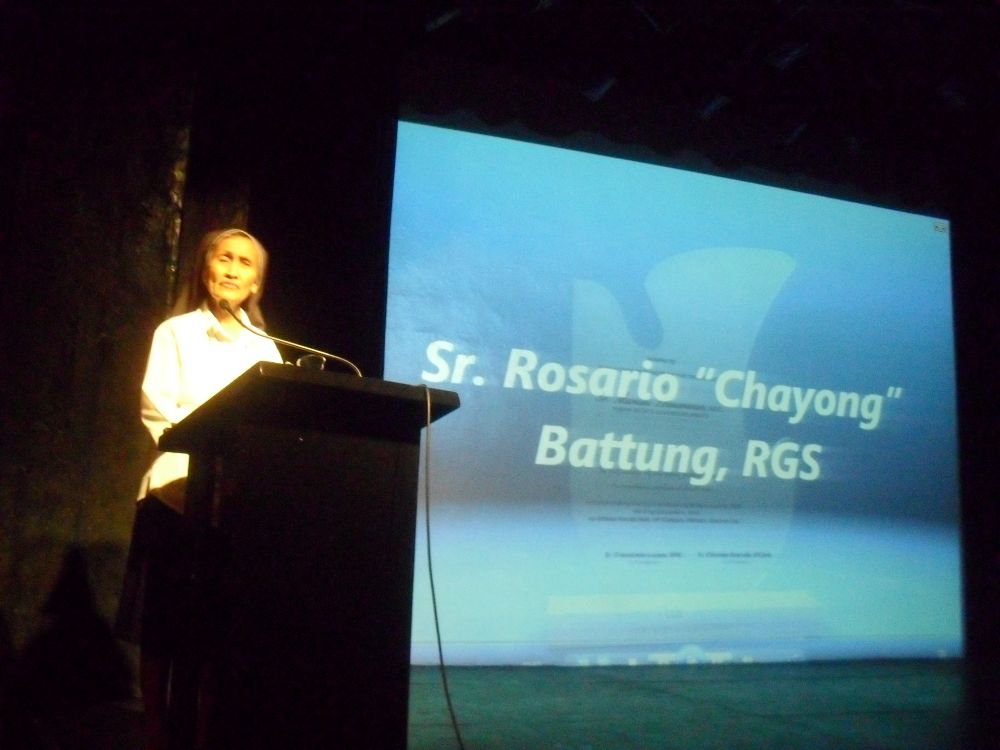
Good Shepherd Sr. Rosario Battung is recognized during an event marking the 40th anniversary of the Task Force Datainees of the Philippines, a human rights organization, at St. Joseph's College in Quezon City. (Courtesy of RGS Philippines-Japan Secretariat Office)
by Sr. Maureen Catabian
I was a young college graduate from a well-known Catholic university in Manila and newly hired as an employee in a telecommunications company in the Makati financial district when Mr. Benigno "Ninoy" Aquino was assassinated in 1983. The political and economic situation in the country was very fragile. It was during this time that I had my first experience joining a workers' strike demanding a wage hike. In 1985, I resigned from my job as a psychometrician to enter as a postulant of the Religious of the Good Shepherd. It was then that my story of activism began to take shape.
When I began my initial formation, the congregation was still grieving our four sisters who died in the MV Doña Cassandra tragedy. The Doña Cassandra, a passenger ship, sank in the deep waters off Butuan, Mindanao, during a typhoon on Nov. 21, 1983. The sisters, together with other religious and lay church workers, were on their way to attend a retreat in Cebu. The sisters who recounted the story from survivors noted that the four who drowned "were seen distributing their life vests to the poor people and children who were with them in the boat." Their final moments became a living witness for us of self-giving love, shaped by the spirit of the Good Shepherd who lays down her life for others. That memory marked the beginning of my formation and was where I first encountered what it means to belong to a congregation formed by such a witness.
As an aspiring candidate in my early 20s, I encountered several Good Shepherd Sisters who were considered social activists, progressive and radical in their commitment to the people, especially the poor. I visited sisters living in an "inserted" community in the slum areas of Leveriza in Manila.
It was there that I met Sr. Christine Tan, who became the first Filipina provincial of the Good Shepherd Sisters in 1961. Sister Christine, together with four other Good Shepherd Sisters, chose to live among the poor in Leveriza, an urban poor community in Manila. She is a staunch advocate for social justice and a pioneering voice for the church's preferential option for the poor.
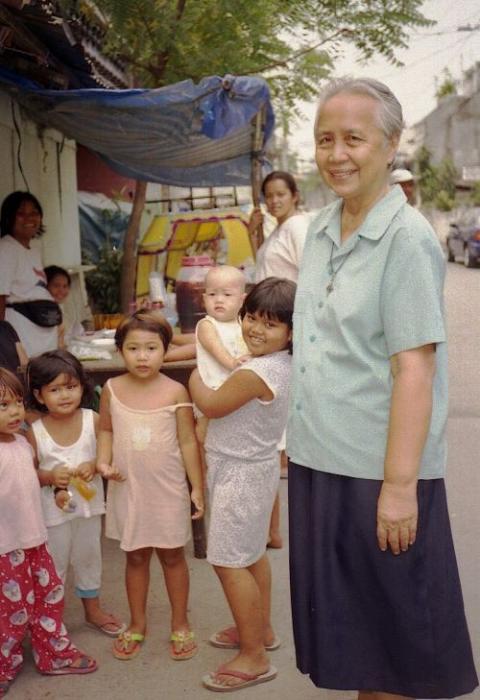
Sr. Christine Tan stands in Leveriza, Manila, Philippines. She and four other Good Shepherd Sisters chose to live among the urban poor. (Courtesy of RGS Philippines-Japan Secretariat Office)
During the 1970s, worsening poverty and political instability in the country moved the sisters to discern more radical ways of living out our mission of reconciliation in the world.
The traditional ministries of residencies for girls and women, started by foreign missionaries who arrived in 1912, continued. At the same time, the sisters were challenged to "go where the people are, especially the poor." As a result, socio-pastoral apostolates were established in Luzon and the Mindanao region.
Pastoral programs were initiated to serve different sectors of society, including youth and farmers in Isabela province, urban poor communities in Manila, Indigenous peoples in Mindanao, migrant workers in Davao, and women in situations of prostitution along with children in Cebu. These programs prioritized community-based interventions for poor and marginalized communities.
Our sisters were actively involved in street protests and mobilizations that led to the 1986 People Power Revolt, the largely bloodless uprising along EDSA (Epifanio de los Santos Avenue) that ousted dictator Ferdinand Marcos Sr.
A constitutional commission was later convened, and Sr. Christine Tan was appointed a member. The commission drafted the 1987 Philippine Constitution under the revolutionary government of President Corazon Aquino.
Other Good Shepherd "gentle giants" who became visible in their advocacies included Sr. Pilar Verzosa, founder of Pro-Life Philippines; Sr. Soledad Perpiñan, who initiated the Third World Movement Against the Exploitation of Women and advocated against the presence of U.S. military bases in Olongapo during the 1990s; and Sr. Rosario Battung, an active member of the Ecumenical Association of Third World Theologians, a group of religious men and women who articulated contextualized theology in the Philippines and across Asia.
It was within this framework of contextualized theological formation for religious that I was formed, de-formed and transformed. I developed a preferential option for the poor, learned to read the signs of the times, learned from grassroots communities through exposure and immersion programs, and to stand in solidarity with the struggles and dreams of poor and marginalized sectors of Philippine society journeying towards fullness of life.
The introduction of contextualized theology and formation for priests and religious in the 1990s was promoted by progressive missionary congregations such as the Order of Friars Minor, the Redemptorists, the Missionaries of the Sacred Heart, the Carmelites, the Augustinian Missionary Sisters and the Religious of the Good Shepherd through the Inter-Congregational Theological Center, or ICTC.
ICTC was a nontraditional institute where students studied and lived among the poor sectors of society. Our classrooms were the streets of Quiapo and Baclaran. Climbing Mount Banahaw in Quezon province, we learned about popular religiosity and mysticism. We studied theology alongside fisherfolk, urban poor communities and farmers, while also joining protest mobilizations of workers and students.
We learned the tools of social analysis and biblico-theological reflection during our exposure and immersion programs.
We learned the tools of social analysis and biblico-theological reflection during our exposure and immersion programs.
The juniorate summer programs in the Good Shepherd congregation were developed in collaboration with networks of nongovernmental organizations and people's organizations using contextualized formation as a model.
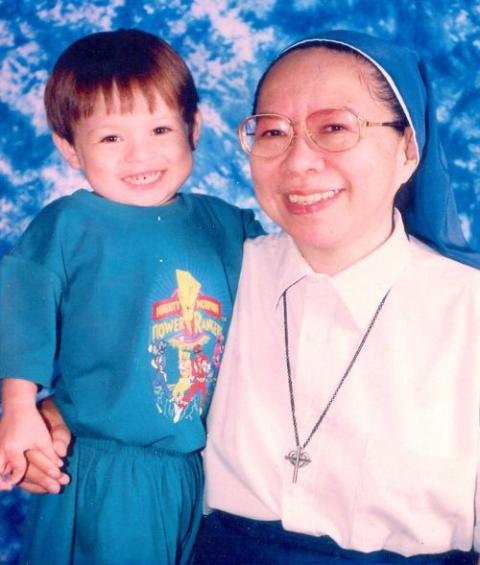
Sr. Soledad Perpiñan appears at Nazareth Growth Home in Quezon City. Perpiñan led the Good Shepherd Sisters AIDS ministry. (Courtesy of RGS Philippines-Japan Secretariat Office)
One summer, I worked as a factory worker in a Century Tuna canning factory to better understand the exploitative and oppressive working conditions faced by female workers. I slept on picket lines in solidarity with workers on strike and attended discussions among labor union leaders.
My encounters with the realities of poor communities helped me understand that "the poor are the true evangelizers" as they endure daily struggles with deep faith in a God who liberates.
The group reflections and integration sessions we engaged in after each encounter with poor communities sharpened our critical analysis of the social conditions contributing to the impoverishment of many Filipinos.
We came to understand their daily struggles and dreams for social and integral transformation. These experiences strengthened our commitment to stand in solidarity with the poor as we joined protest rallies demanding accountability from the government.
Advertisement
The preferential option for the poor, reading the signs of the times and learning from people on the ground became some of the foundations of my political and social activism. The inspiration, witness and mentoring of our elder Good Shepherd Sisters and co-workers sustained our commitment to work for the liberation of women from oppressive structures, advocate for social justice, pursue peace efforts and care for our common home.
Our charism of mercy and mission of reconciliation continue to evolve within changing and complex global realities. The Women, Justice and Peace and Integrity of Creation ministries of the Good Shepherd Sisters in the Philippines and across Asia continue to sustain our journey toward building a universal culture of justice and integral transformation in our world.