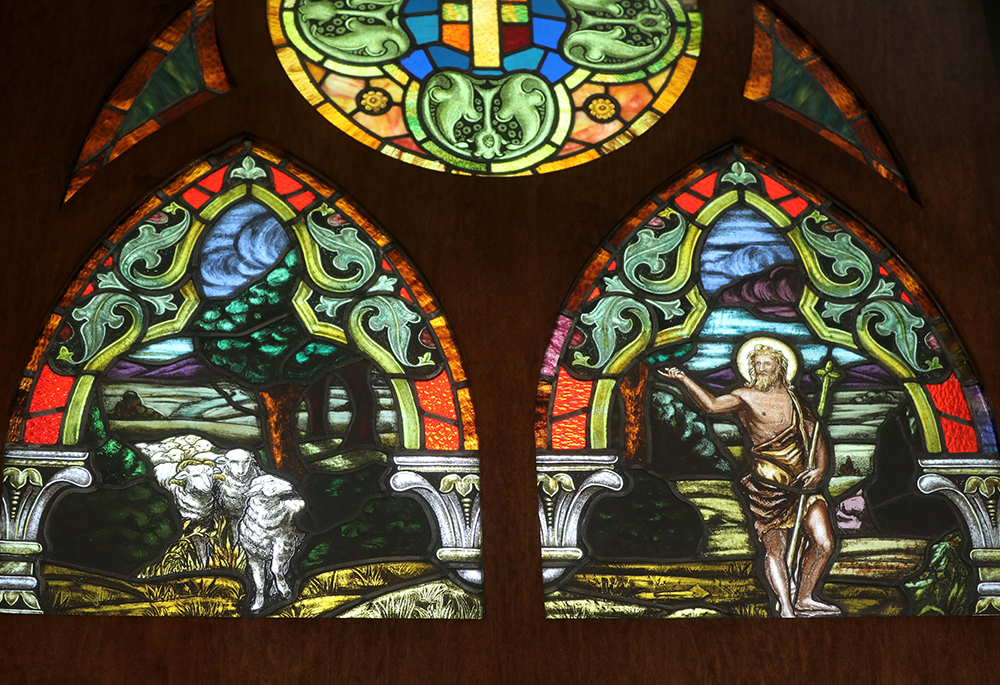
A stained glass image of Jesus the Good Shepherd is pictured at Jesus the Divine Word Church in Huntingtown, Maryland, May 6, 2021. (CNS/Bob Roller)

by Sr. Monique Tarabeh
After the merging of the three provinces in the United States into one region of the Our Lady of Charity of the Good Shepherd United States/Toronto, Srs. Brigid Lawlor and Barbara Beasley of the Sisters of the Good Shepherd offered their wisdom and guidance by initiating an online course on Christogenesis and Good Shepherd spirituality. Open to sisters and partners in mission, the course created a reflective space to deepen our understanding of what it means to come together, not only structurally but also spiritually and communally, as one body.
There are moments in life when we are invited not simply to learn something new, but to become new. I entered the Christogenesis course with curiosity; I carried questions shaped by my own journey. What unfolded was not a set of answers, but a widening horizon. It invited me to see my life within a larger story, one that holds both personal experience and cosmic belonging.
The course introduced us to the universe story, a narrative that begins with the emergence of the cosmos and continues through the unfolding of life on Earth. This perspective situates human existence within a dynamic and evolving process. It challenges the tendency to see ourselves as separate and instead reveals a profound interconnectedness. As the saying goes, "We are in the universe, and the universe is in us." This insight reframes identity itself. We are participants in an ongoing process of creation, shaped by a history that stretches far beyond our individual lives.
Recognizing this changes how we understand our origins. We come from the same creative energy that formed the stars and galaxies. The elements that make up our bodies were forged in the depths of the cosmos. To say that we "come from the earth" is to affirm a sacred continuity between humanity and all of creation. This awareness invites reverence, not only for human life but for the entire Earth community.
At the same time, the course deepened our Christological understanding. Christ is not external to this evolving universe. Rather, Christ can be understood as the dynamic presence within creation, drawing all things toward unity and fulfillment. Christogenesis expresses this ongoing reality. It is the continuous emergence of Christ in the world, not limited to a historical moment but alive in the unfolding of the cosmos and in the life of every person.
Ilia Delio captures this vision clearly when she writes, "God is not an idea but the living wholeness of reality." In a video for the Center for Christogenesis, she said:
Evolution is an unfinished process, and Christ is an unfinished person, and therefore that divine love incarnating our lives, and the livingness of things in the universe, is the building up of Christ, or the ‘birthing’ of Christ.
We who are conscious beings in this evolutionary process are called to a conscious birthing of this power of divine love within us, that the world itself may move more fully towards a fullness of life within the embrace of divine love. We have the power to create a new world.
This perspective moves beyond a static understanding of Christ and opens a relational and evolutionary vision. Christ is encountered not only in tradition but also in the very movement of life toward greater complexity, consciousness and communion.
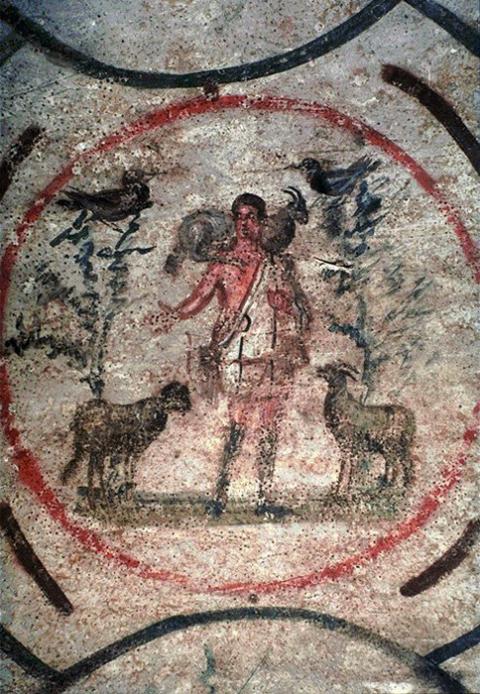
A detail of the "Good Shepherd" fresco, dated to the second half of the 3rd century and located on the ceiling of the "Velatio" cubicle in the catacomb of Priscilla, in Rome. (OSV News/Wikimedia Commons, public domain)
For those of us rooted in Good Shepherd spirituality, this insight resonates deeply. Our charism calls us to be attentive to relationships, to seek out those on the margins and to embody a love that restores dignity. Through the lens of Christogenesis, this mission is expanded. It is not only about responding to immediate needs, but also about participating in a larger process of healing and integration that includes all creation.
The image of the Good Shepherd takes on renewed meaning within this framework. It reflects a presence that gathers, guides and sustains. It speaks of a relational field in which all are held and invited into communion. This understanding aligns with an evolving sense of mission, one that is attentive to ecological responsibility, social justice and the interconnectedness of all life.
The invitation to "touch the earth" becomes a concrete expression of this awareness. It calls us to reconnect with the ground of our being, to recognize that we are part of a living system that sustains and shapes us. This connection is not symbolic. It is a call to live differently, with greater care for creation and with a renewed sense of responsibility for the future we are shaping together.
One of the most significant dimensions of the course was its communal character. Engaging this material alongside sisters and partners in mission created a space of shared reflection. The diversity of perspectives enriched the process, allowing us to see more clearly the depth and breadth of our collective experience.
Through dialogue, listening and contemplation, a deeper sense of unity began to emerge. This unity did not erase differences. Instead, it held them within a larger vision of communion. The experience of being "one heart and one soul" became tangible, not as an ideal, but as a lived reality shaped by mutual openness and respect.
This communal journey reflects an essential aspect of Christogenesis. Becoming is not an individual achievement. It unfolds in relationship. It is shaped by encounters, by shared insights and by a common commitment to growth. The course created conditions for this process to take place, fostering a sense of belonging that is both personal and collective.
Advertisement
In this context, the merging of the provinces takes on a deeper meaning. It is not only an organizational restructuring. It is an invitation to grow into a new form of communal life. It calls for a shift in consciousness, from operating as separate entities to embracing a shared identity rooted in connection and mission.
Coming and becoming are therefore inseparable. We come from a shared source, from the creative love that gives rise to all life. We are becoming through our relationships, our commitments and our openness to transformation. This movement is ongoing. It does not reach a final point, but continues to unfold as we engage with the realities of our time.
The Christogenesis course offered both language and experience to support this journey. It provided a framework for understanding our place within the larger story of the universe and a space to reflect on how this understanding shapes our lives and mission.
This journey invites us to live with greater awareness. It calls us to recognize the sacredness of our interconnected existence and to respond with responsibility and hope. It encourages us to remain open to transformation, trusting that new life continues to emerge within and among us.
Christogenesis is not simply a concept to be studied. It is a way of seeing reality, a way of engaging with the world and a way of becoming together as one body, one heart and one soul.