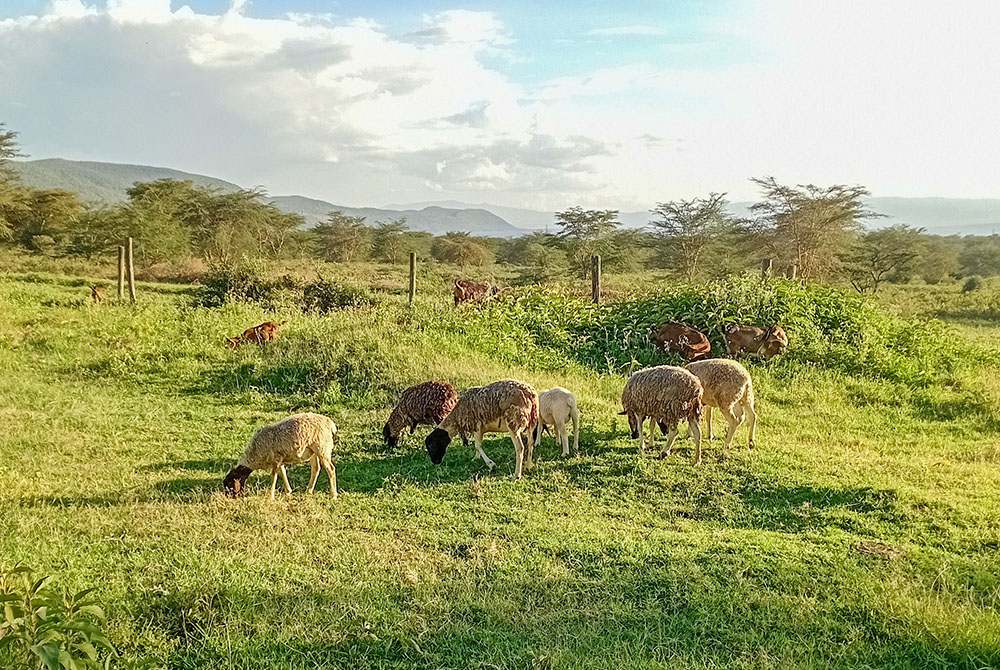
Animals graze on the Catholic farm in Thika, central Kenya. The farm curbs land degradation through non-till practices, promoting agroforestry and other ways of improving tree cover and soil health. (GSR photo/Shadrack Omuka)
On a hot afternoon, a beautiful landscape, clean air, and vocalization from livestock welcome visitors at a Catholic farm in Thika, central Kenya.
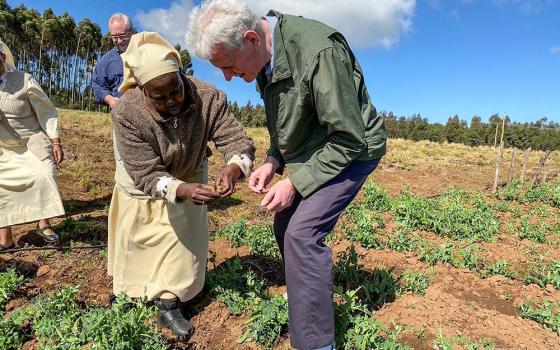
Here, Sr. Susan Wanjiru, a director at the farm and graduate from the Sisters Leadership Development Initiative, is busy tending to seedling crops that were transplanted to the main farm a few days ago.
The farm, located about 45 km northeast of capital Nairobi, is one of its kind in the region by sustainably curbing land degradation through non-till practices, promoting agroforestry and other ways of improving tree cover and soil health.
Wanjiru and the Assumption Sisters of Nairobi have engaged in sustainable farming to battle food insecurity and promote environmental upkeep.
The 70 acres of land is just one of the few Catholic-owned farms in Kenya established by missionaries in the early 19th century to produce food for the missionaries, sisters and Catholic schools. The farm also served as a recreational park for missionaries.
Today, the farm is a social enterprise that demonstrates eco-friendly farming practices, generating income from horticulture, coffee, dairy and aquaculture to support the sisters' congregation and to fund scholarships.
The farm is fitted with a robust drip irrigation system where water is delivered directly to the roots of plants through a network of tubes and emitters. This slow delivery minimizes water loss through evaporation and runoff, making it a highly efficient and sustainable irrigation technique.
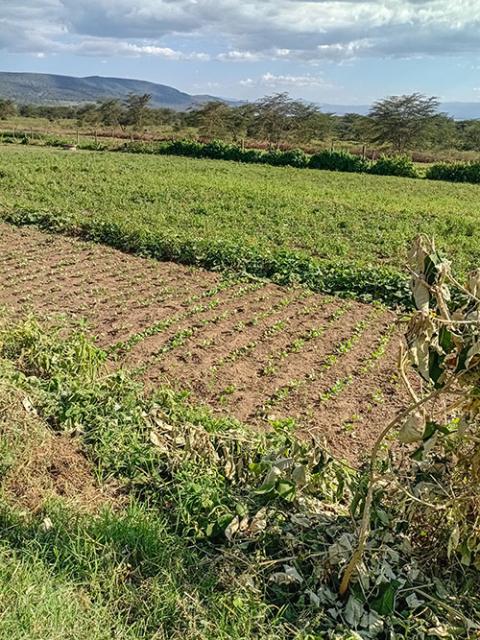
A tree nursery at the Catholic farm in Thika, central Kenya (GSR photo/Shadrack Omuka)
Livestock contribute to the farm's production, with 20 head of dairy cattle, about 100 pigs, and a few fishponds that yield thousands of tilapia each season.
Through efforts like irrigation, the farm grows a variety of produce, to meet high demand for food in the densely populated Thika and its outskirts. The farm is recognized by international organizations like Sucafina and the African Sisters Education Collaborative for its efforts.
Coffee crops have been a major enterprise for the farm, bringing in an annual income of about $7,500.
"Our major mission here is to eradicate hunger. We grow various food crops, cash crops and keep livestock," Wanjiru told Global Sisters Report.
Though most of the labor in the farm is done by sisters themselves, some community members have had opportunities to work there, especially during the harvest season.
"Most of the work is done by ourselves but when the work becomes much for us, we hire some community members to help us hit our target," Wanjiru said. "We also hire agronomists to support us."
Susan Mwangi, 48, a single mother of eight, told GSR she has been working at the farm as a seasonal laborer for many years, earning enough to enable her to send her children to school and to afford nutritious meals for her family.
"When I go to work in the farm, I am sure of earning some money and return home with some foodstuffs for the family," said Mwangi, who lives in the nearby Kiandutu slums."This saves me a lot and I thank the management of the farm for their kind heart."
Mwangi said that she also receives clothing donations, counseling and spiritual nourishment from the sisters who have become her close friends.
Advertisement
According to Wanjiru, the project is directly aligned with the United Nations' sustainable development goal No. 2, which is to achieve food security, improve nutrition and promote sustainable agriculture to ensure everyone has access to sufficient, safe and nutritious food.
According to the World Health Organization about 733 million people faced hunger in 2023, equivalent to one in 11 people globally and one in five in Africa.
The annual report, launched last year in the context of the G20 Global Alliance Against Hunger and Poverty Task Force Ministerial Meeting in Brazil, warns that the world is falling significantly short of achieving sustainable development goal No. 2, "Zero Hunger," by 2030.
Kenya remains particularly vulnerable, with 38.6% of its population living below the poverty line, according to the World Food Program, while malnourishment affects 29% of children in rural areas and 20% in urban areas.
Thika farm uses natural and biological substances like animal manure, compost, green manure (cover crops), and crop residues for soil fertility.
"Here we use droppings from our livestock and green manure to farm. We've avoided synthetic fertilizer or conventional farming as we don't want to destroy our soil and also we wanted to produce a healthy food and lessen pollution, especially to water sources as we continue respecting late Pope Francis' encyclical on caring for our common home, planet Earth."
The farm's produce is not only consumed by parishioners and local community, but also in the schools and rehabilitation centers run and managed by the sisters.