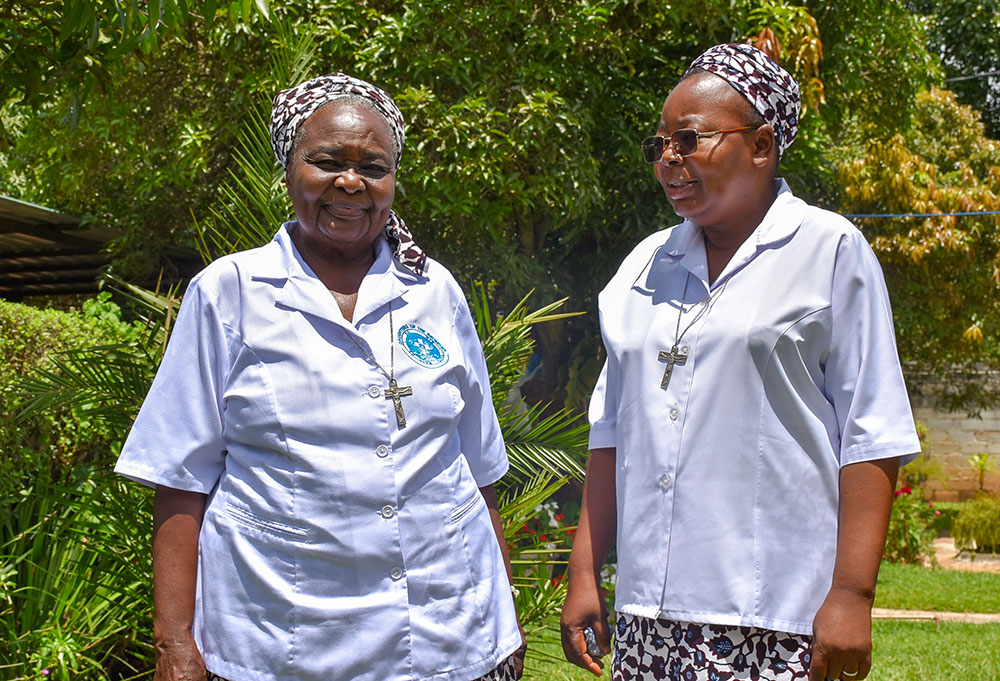
Sr. Rose Nyondo, the program director for the Community Transformation Programme, and project coordinator Sr. Matilda Mubanga. The program, run by the Daughters of the Redeemer, promotes agricultural productivity in Chibombo and other areas in Zambia. (Derrick Silimina)

by Derrick Silimina
As the first rays of light illuminate the lush farmlands of the Chibombo District, Ronald Kangabala breathes in the cool morning air, watching the emerald-green shoots of his crops sway softly in the breeze.
"Our crops barely produced enough to feed us. We would always depend on food aid from religious sisters at St. Thomas Mission Hospital," Kangabala told Global Sisters Report. "Today, not only do we eat from our harvest, but we also sell the surplus and are able to sustain our livelihoods."
Kangabala, a maize and vegetable farmer in Chibombo, once resorted to charcoal burning after his horticulture production efforts failed due to a lack of farming materials and reliance on rainfed agriculture.
He said that the Daughters of the Redeemer not only transformed his quest for household food security but also introduced smart agriculture.
"We were invited by the sisters to join an agricultural program, and they taught us how to come up with gardens to grow maize, cassava and sweet potatoes through climate-smart agricultural mechanisms."
The Chibombo District, situated 93 km north of Zambia's capital, Lusaka, is afflicted by widespread economic hardships typical of many rural regions in southern Africa. Its rural setting also heightens its vulnerability to climate-related challenges such as unpredictable weather patterns and droughts. The onset of the 2024 drought affected approximately 9.8 million people in Zambia, almost half of the country's population.
In 2022, the Daughters of the Redeemer were supported by the Hilton Fund for Sisters and Cross Catholic Outreach to launch the Community Transformation Programme (CTP) and promote agricultural productivity in Chibombo and other areas. (The Hilton Foundation is a major funder of Global Sisters Report.)
Advertisement
The program supports five villages through agricultural mentorship, nutrition programs, and water, sanitation and hygiene activities. They also work on improving livelihoods by distributing food aid to vulnerable communities, providing educational scholarships, fostering financial literacy and building capacity in sustainable agriculture practices.
Hellen Chibwe from Chibombo is among 200 beneficiaries who have engaged in practical, hands-on training, which has empowered her and others to adopt improved farming methods.
"We observed significant improvements in our crops after using manure, which is more cost-effective and effective than fertilizer," Chibwe told GSR.
She expressed optimism about the recent cabbage harvest, which she helped cultivate in a field organized by the sisters. She said this collaborative, hands-on approach has significantly improved agricultural productivity and sustainability, thereby contributing to enhanced food security within her community.
Chibwe said the harvested cabbages were sold to marketeers at Lusaka's Soweto Market. The proceeds from this sale were then invested in a social fund called "village banking," where women can borrow at interest to invest in their personal enterprises.
"This reflects not only an improvement in our living conditions, but also a boost to our overall well-being. It's a clear sign of the positive impact the CTP model has had on our community," she said.
As Chibombo faces unpredictable weather patterns, the adoption of climate-smart agriculture can play an important role in promoting food security, supporting sustainable farming practices, and empowering rural communities by building resilience against climate variability.
"The program emerged from a deep reflection on how to transform the communities we serve. Thus, it was initiated to strengthen resilience, enhance livelihoods, and restore dignity, while remaining rooted in our mission of evangelization and compassionate service," said program director Sr. Rose Nyondo.
Sr. Matilda Mubanga, the project coordinator, said that due to the current high cost of living in Zambia, the program is vital for vulnerable households.
"Unlike initiatives that focus on a single sector, this program combines six components into a cohesive framework. This ensures that interventions are mutually reinforcing, promoting sustainable development while also radiating the charism of the Daughters of the Redeemer," she said.
Mubanga added that by addressing immediate and long-term needs, the initiative helps families cope with economic pressures while building sustainable livelihoods.
Mubanga told GSR that a baseline assessment was conducted at the program's inception, which helped track progress in food security, household income, health and hygiene practices, educational support, and spiritual engagement. She added that there has been concrete evidence of change within the communities served.
She further shared that after Chibombo served as the pilot site for the program, the initiative has been replicated in other areas where the Daughters of the Redeemer serve, including Lusaka and other parts of the Eastern Province.
She emphasized that despite key challenges such as limited financial resources, high cost of living and inflation, low literacy and technical skills among beneficiaries, as well as environmental and climatic issues, she feels inspired by the successful integration of spiritual mission with practical humanitarian service.