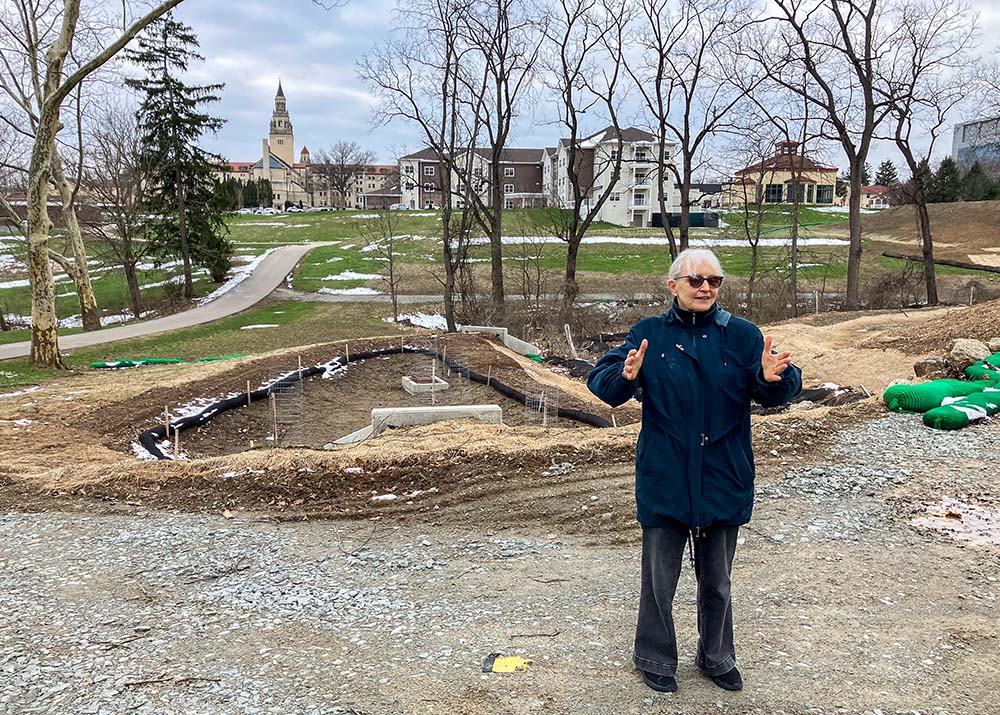
Stefani Danes stands on the Rachel Carson EcoVillage's construction site. The building with a high tower in the background is the Sisters of Divine Providence's 100-year-old convent, now part of La Roche University. (Jennifer Szweda Jordan)

by Jennifer Szweda Jordan
When the Sisters of Divine Providence near Pittsburgh tried to sell an 8-acre forested parcel, they were disappointed. Potential buyers didn't offer what the sisters thought it was worth. And for those prices, the sisters didn't want to see the land razed.
The sisters' grounds are idyllic. To get there, you have to travel one of the busiest roads in the region, lined with strip malls. But when you turn off the road and reach the site, the landscape shifts. A reservoir sits at the base of the property. A steep roadway surrounded by trees leads up to the sisters' property and La Roche University, which the sisters founded.
The development proposals would have required significant tree clearing, said provincial director Sr. Michele Bisbey. "The wetlands and the hilly nature," she said, "made it not ideal for development."
The land put up for sale had once been ideal for growing food. When Bisbey entered the community, the sisters still harvested peas, beans and apples. Over time, expanding ministries took them away from farming. In recent decades, the community's numbers in Pittsburgh dwindled, so they didn't need all their land.
At the same time, Bisbey said, "we were paying attention to things like Laudato Si', the pope's call," referring to Pope Francis' 2015 encyclical subtitled "On Care for Our Common Home."
"We were certainly aware of things like climate change and our need to be sustainable of the property ourselves," she said.
So when the land offers didn't match their commitments, they took the property off the market.
Advertisement
Meanwhile, a group of local residents was trying to find a location for a nonprofit sustainable housing development after an agreement with a property owner had fallen through. The Rachel Carson EcoVillage — named for the legendary environmental writer who grew up in the region — urgently needed a place to build.
The sisters and the EcoVillage members happened to have the same lawyer, who told them about each other. The EcoVillage's land manager, architect Stefani Danes, was eager to connect with the sisters. She'd already worked with several communities of women religious to make their buildings more sustainable. When she and the Sisters of Divine Providence met, Bisbey said, "we really recognized in [the EcoVillage members] a shared vision of ecological responsibility."
What's more, Bisbey said she admired "their whole way of living community." The EcoVillage includes a common house for meals and activities. It had a parallel to convent living. Bisbey was also impressed with the community's self-governing model called sociocracy. It draws from Quaker principles of the Spirit leading decisions.
The sisters saw the EcoVillage members not just as land buyers but partners in their mission. They began discerning whether to donate the land outright.
"There's certainly questions like, 'Is this a wise thing to do?,' 'Are we going to need money that we're not taking if we had leased the land or sold it?' " Bisbey said. "But it also felt like we were planting seeds for a future that we might not see but we believe in."
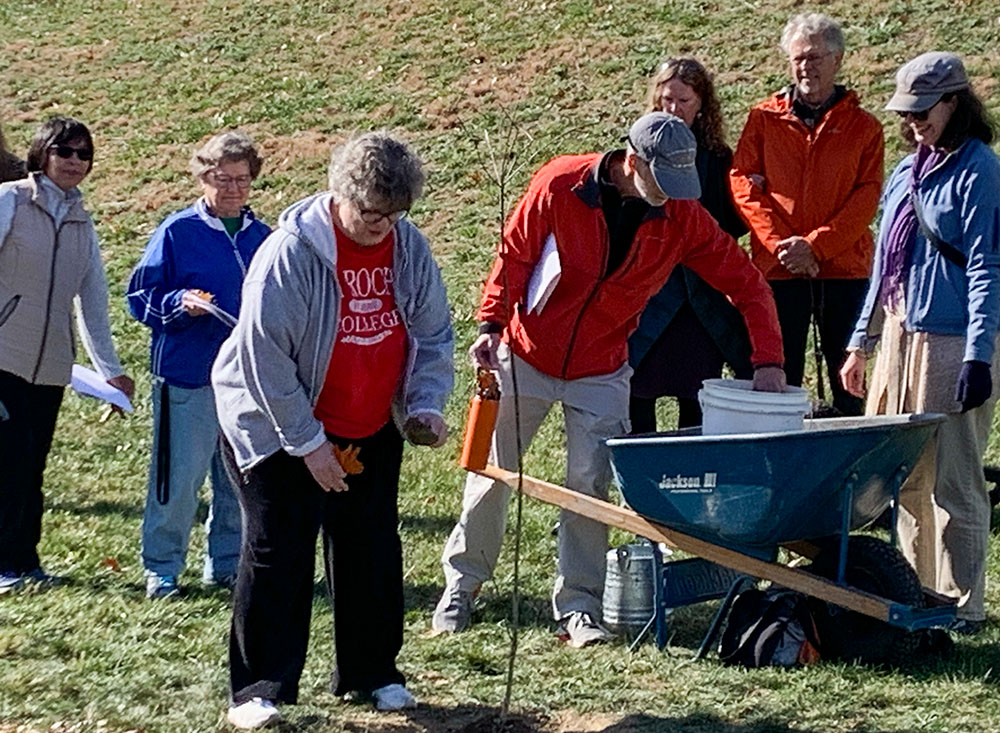
Sister of Divine Providence Judy Connor, at center in red, adds soil to the hole where a white oak tree is being planted on the sisters' property near Pittsburgh. On the left are Srs. Betsa Palomino and Donna Marie Gribschaw. To the right are EcoVillage members Sam Spofforth, Mel Scott, Stu Bush and Rachelle Nordman. (Courtesy of Stefani Danes)
Within a few months of first meeting, the sisters offered the land to the EcoVillage community to build. The project began moving forward with ecologists and an arborist evaluating the species, age and condition of more than 500 trees on the site.
"It helped us to see where on the site the trees were weak or in poor condition," Danes said. "We identified those as our building sites, leaving everywhere where the forest was intact as our preserved area."
Today, the 35-unit community is under construction, with members expected to move in sometime this year. The work underway is visible through the floor-to-ceiling windows of a chapel in the Kearns Spirituality Center, which the sisters own. It's jarring to see the felled trees, upturned earth, and a yellow excavating vehicle just a short walk from the sisters' cemetery full of uniform white crosses. But inside the chapel, a globe-shaped dark metal tabernacle seems to offer reassurance that the temporary upheaval is part of something greater and lasting.
The EcoVillage homes are designed to look similar to Appalachian-style cabins. The buildings' insulation is double what modern building standards require. So, Danes said, "consumption of energy is under 20% of even well-built houses today. Our utility bills for the entire heating and cooling year-round are likely to be in the range of $15 to $20 a month."
Danes said that helps defray the significant cost of the homes — $260,000 for a studio, $643,000 for a two-bedroom and two-bath unit.
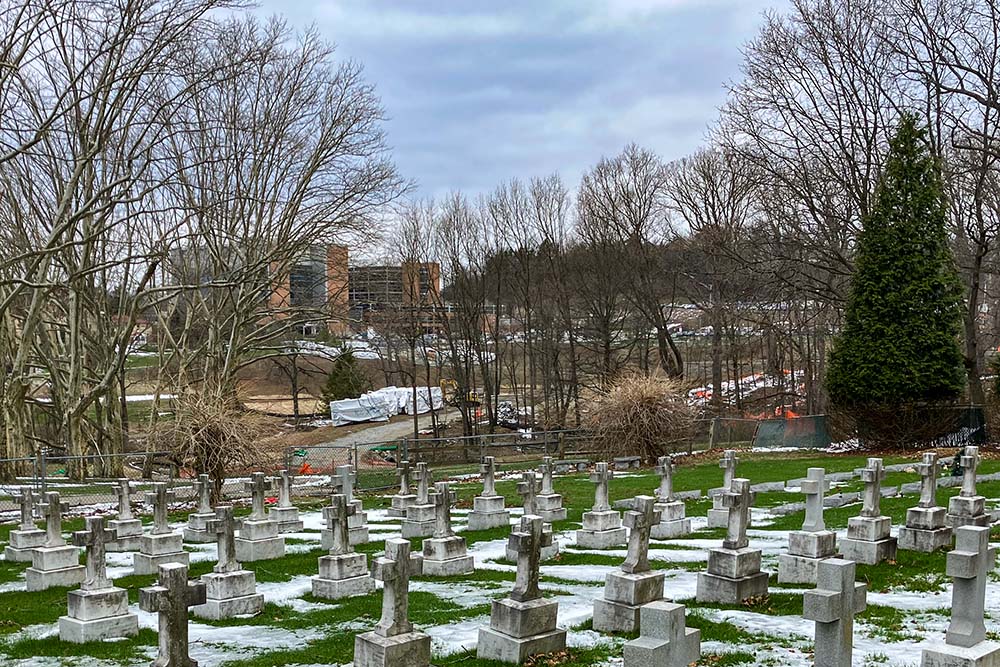
The EcoVillage construction site is visible from the Sisters of Divine Providence's cemetery. The EcoVillage's lead contractor and its land manager both said they're moved by the history of the many women who lived and worked here. (Jennifer Szweda Jordan)
Asked how the housing costs square with the sisters' values, Bisbey said the community is very concerned about the national affordable housing crisis. But she added, "We also have a desire for accessible and just housing. ... And the economics of ecological building, the infrastructure, financing often makes affordable housing very difficult."
The nonprofit got state funding to subsidize one unit for a family with a disabled child. And it collects donations to reduce the costs of housing for low-income families.
The sisters and the EcoVillage community are already establishing connections in ways beyond the housing development. Some of the EcoVillage members have become official associates of the Congregation of Divine Providence. And some are supporting the Bridges of Providence ministry that provides microlending and other support for women entrepreneurs in developing countries.
Both the sisters and the EcoVillage members hope that the development will be a model for students attending classes at La Roche — both traditional undergraduates and those of all ages who attend La Roche's Introcaso Center for Lifelong Learning.
On a recent day, as seniors rolled up their yoga mats after a class, Jennifer Engel, the Introcaso Center's executive director, described the EcoVillage development as "thrilling." She's looking forward to the EcoVillage residents taking classes and offering opportunities "where we get to see how the various systems in the EcoVillage operate to understand sustainable living."
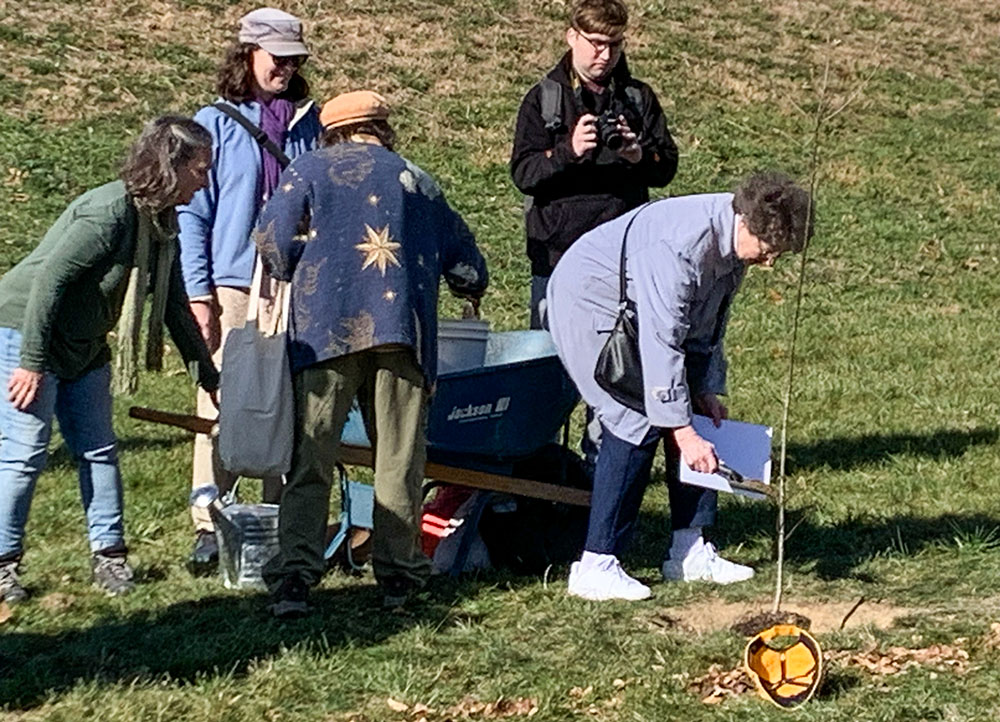
Sisters of Divine Providence work with EcoVillage members to plant a white oak tree on their property near Pittsburgh. (Courtesy of Stefani Danes)
In November 2024, the EcoVillage members and sisters held a prayer service celebrating the project, and a "Land Acknowledgement and Tree Planting Ceremony." Standing outdoors on a hillside near the retired sisters' residence, the sisters and EcoVillage members alternately read from a prepared program about the "terrors and gifts" Europeans brought to this land first inhabited by Indigenous peoples.
They also recalled the accomplishments of the "hundreds of Sisters of Divine Providence who have called this place home for nearly one hundred years, giving their hearts, minds, bodies, and souls to the service of the poor and marginalized in Pittsburgh and beyond."
To end the ceremony, they planted a native white oak sapling, because, as a speaker in the ceremony said, the tree is "revered for its persevering strength and power to stand tall in hard times. It is a symbol for living well in community, since it supports a diversity of living creatures. Oak acorns were an important food source for indigenous peoples, just as they are for wildlife today."
While the EcoVillage won't have the numbers that the sisters once had, they will resume planting vegetables as when Bisbey entered. And they'll share the bounty with the sisters when they join them for meals.
"Essentially we are each alone," Bisbey said. "But at the same time, we form community. And there are circles of community within community and without community."
The EcoVillage, she added, "just broadens that circle. And I think it does the same for them."