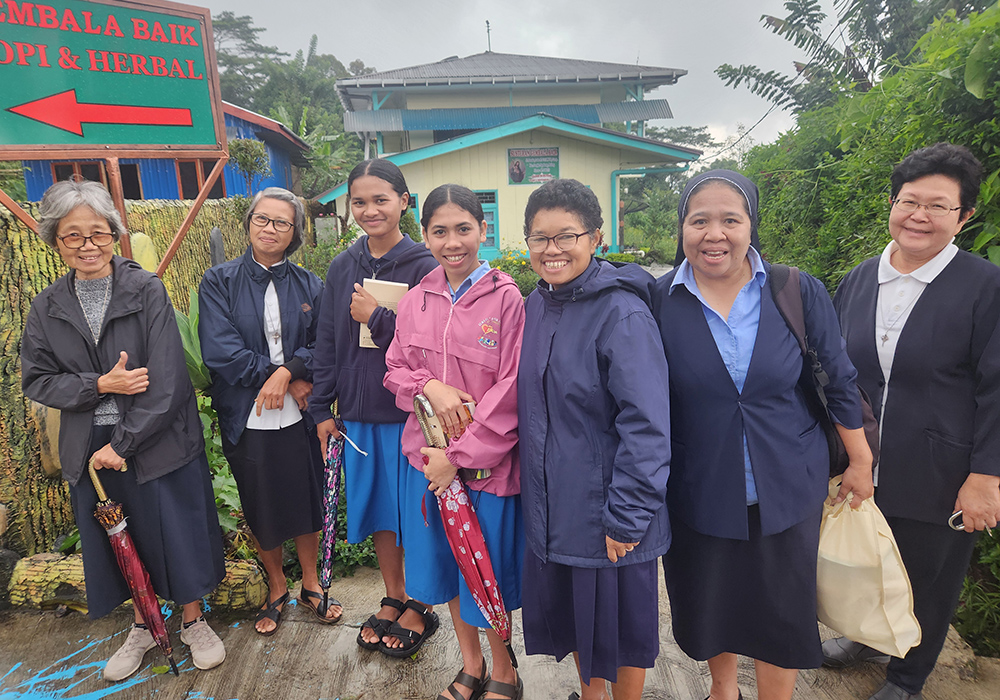
Sr. Flora Nirmala, second from right, the unit leader of Good Shepherd Social Services in Ruteng, Indonesia, poses with other members of her Good Shepherd community. (GSR/Chris Herlinger)

Editor's note: This story is part of Global Sisters Report's yearlong series, "Out of the Shadows: Confronting Violence Against Women," focused on the ways Catholic sisters are responding to this global phenomenon.
(GSR logo/Olivia Bardo)
The significance of a large red-lettered banner in an Indonesian convent and community center is hard to miss.
"Stop violence against women and children," it says in the Indonesian language at the Good Shepherd community center in Ruteng, Indonesia.
The message affirms the dignity of people who are often denied it, continuing the mission of the Good Shepherds' founder, St. M. Euphrasia Pelletier. Her ministries in 19th-century France focused on the needs of women and children, and she famously said that "A person is more precious than the whole world."
That remains the governing principle for the congregation as it ministers throughout Ruteng, a town of about 4,000 in the near-western highlands of Flores — Indonesia's only predominantly Roman Catholic island.
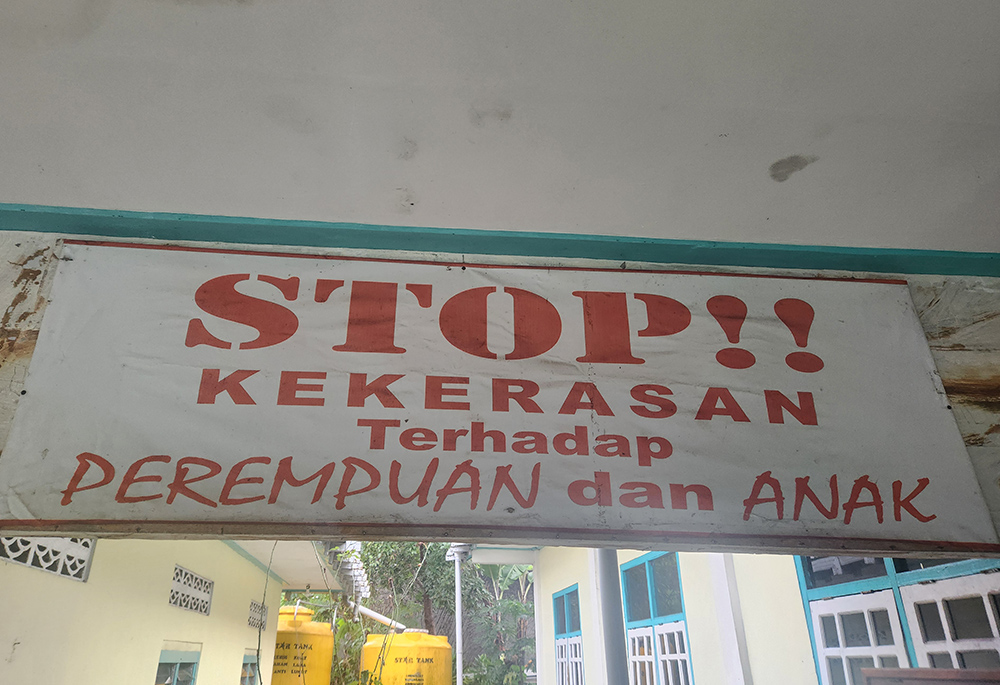
"Stop violence against women and children," reads the banner in the Indonesian language at the Good Shepherd community center in Ruteng, Indonesia. (GSR/Chris Herlinger)
"It's what makes our mission and vocations more meaningful," said Sr. Flora Nirmala, the unit leader of Good Shepherd Social Services in Ruteng.
But the vow to fight violence against women and children also stands as a hallmark for the Good Shepherds who minister to women and children throughout Indonesia, as well as other congregations doing similar work.
"What happened in our own foundress' time, is happening now," said Sr. Theresia Kurniawati, interviewed in the capital of Jakarta where Good Shepherd ministries include running a shelter for abused women and their children. In Ruteng, the sisters also run a shelter and minister to struggling college-age students living in crowded and often unsafe rented housing.
"This is part of our charism," said fellow religious Sr. Alfonsa Sudaryanti in Jakarta, who said her congregation has made a conscious choice to counter gender-based violence in all of its forms.
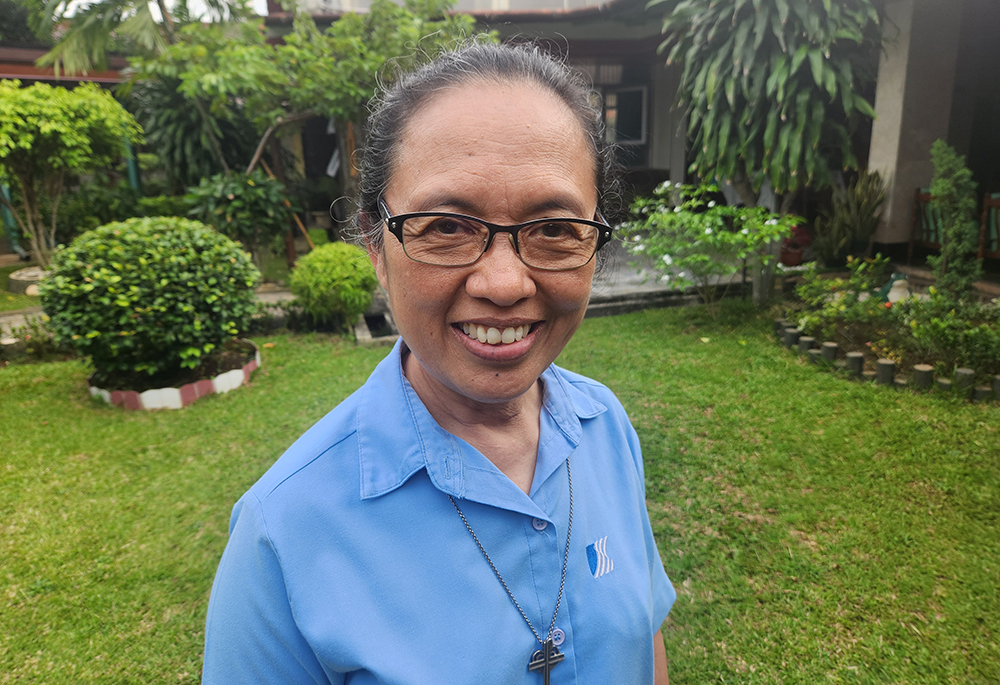
Good Shepherd Sr. Alfonsa Sudaryanti in Jakarta, who said her congregation has made a conscious choice to counter gender-based violence in all of its forms (GSR/Chris Herlinger)
At the local level, silence remains a problem
Violence against women and children remains a grave problem in the world's fourth most populous nation, borne out by recent statistics. The Indonesian National Police reported 36,148 cases of gender-based violence in 2025, with only about 13% resulting in legal resolution.
Such statistics are not likely representative of the true extent of the problem, advocates argue, as stigma about reporting such crimes remains a challenge.
"There are serious problems with domestic violence in Jakarta, and there is often silence about it," said Sr. Angela Marici, a Franciscan Missionary of Mary whose congregation also runs a shelter in Jakarta for women and children facing abuse and trafficking.
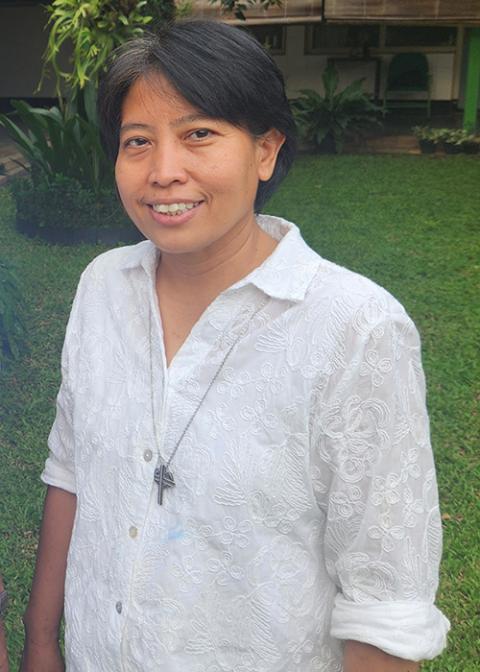
Good Shepherd Sr. Theresia Kurniawati, in the Indonesian capital of Jakarta, where Good Shepherd ministries include running a shelter for abused women and their children (GSR/Chris Herlinger)
In Indonesia, raising visibility is an important first step — though the challenges are deep and not easily solved, said Kurniawati, who earned a law degree in 2024 and whose ministry in Jakarta includes providing legal assistance to women who are taking their cases of abuse, often by their spouses, to court. (Similarly Marici is studying law in hopes of becoming a lawyer to help women in her ministry.)
Kurniawati said it is important for children in congregation-led schools to be aware of the dynamics of violence within families and they should not be afraid to speak out if they are experiencing violence. "It's important to break the cycle of violence and how it impacts the family," she said.
In late January, the shelter was full with 15 guests, who were provided food, shelter and counseling. "Here they feel safe, they feel peace, they can think clearly and make good decisions," said Kurniawati, noting that "when they run away from their husbands, they bring nothing with them." (The congregation also runs a shelter for unwed mothers at another site.)
She said each case is unique and that generally, abuse cases are less complicated to try because they only involve a spouse, whereas trafficking cases involve networks that are prepared to fight the advocates for trafficking survivors in court.
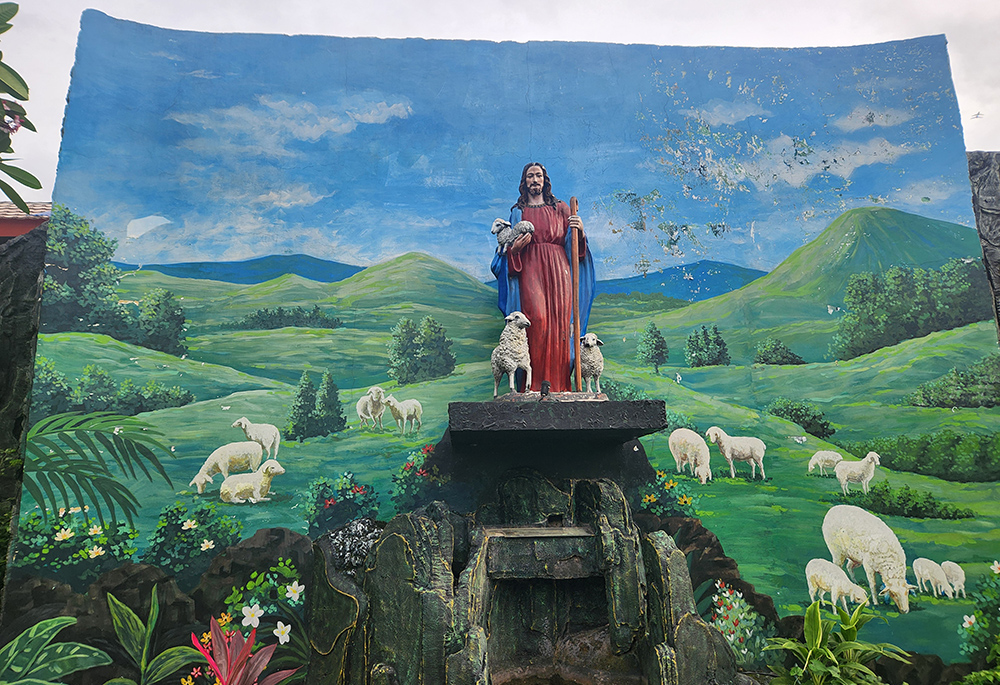
Jesus as the symbol of the Good Shepherd on the grounds of Good Shepherd ministries, in the Indonesian capital of Indonesia (GSR/Chris Herlinger)
Kurniawati said while attitudes by law enforcement have improved somewhat, she said too often authorities are slow to cooperate with abuse investigations. "Their perception is not our perception," she said.
In one recent year, 2022, Kurniawati said she handled 26 cases: two for trafficking, 22 for domestic violence, and two for sexual abuse.
What were the results?
She said the 22 for domestic violence ended in divorce — a point that the sisters do not necessarily like because of church teaching, but said are justified because she and other members of the congregation "are committed to the safety and health of the women and children." She notes that in nearly all cases, women who come to the sisters for help come with children.
Advertisement
Economic poverty is a key dynamic fueling abuse, Kurniawati said, with men often reacting to powerlessness in their lives by taking it out physically against women — the act of violence becoming an act of domination, which violates the sanctity of marriage.
There is thankfully more awareness about the challenges faced by women, she said "but abuse still happens," and with Sudaryanti adding that "it's like some men can't break the cycle of violence. The behavior is learned."
'It's like some men can't break the cycle of violence. The behavior is learned.'
—Sr. Alfonsa Sudaryanti
But it is also true that economic dependence on men is a key factor, with the dowry system leading to a dynamic where men often feel they are entitled to dominate a relationship. "It's like being bought," Sudaryanti said of women's experiences.
But the lingering effects of sexism are also a challenge, said Sudaryanti, who said that in predominantly Islamic Indonesian society, "cultural patriarchy" still poses a serious challenge.
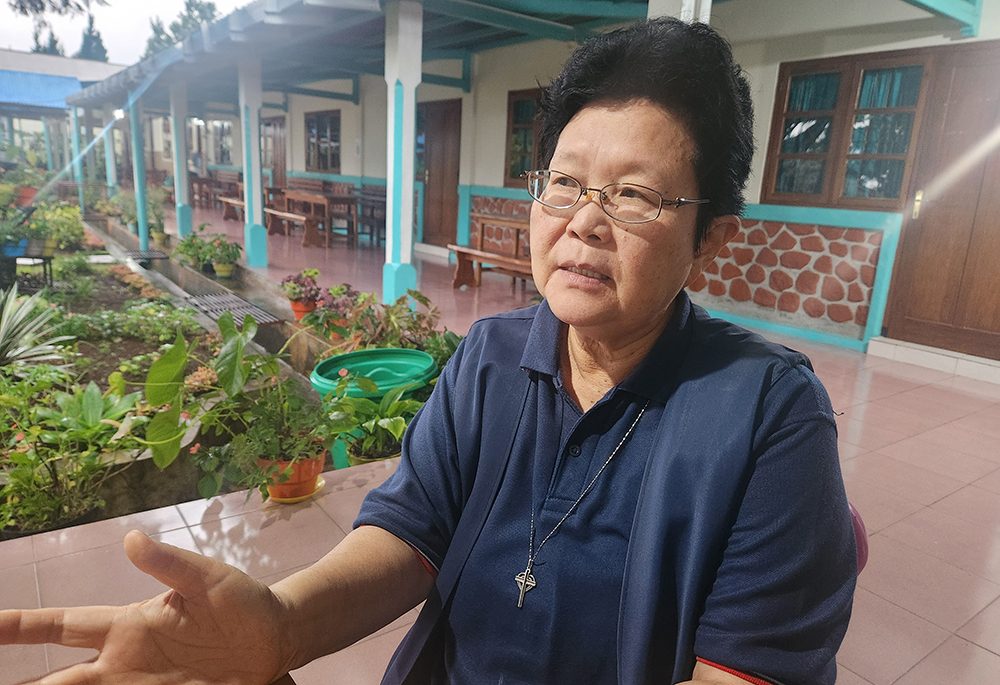
Good Shepherd Sr. Natalia Tanzil in Ruteng says that everywhere women and children suffer and must face the challenges of economic poverty, domestic and sexual abuse. (GSR/Chris Herlinger)
Fellow Good Shepherd Sr. Nataia Tanzil in Ruteng concurs, noting that "everywhere women and children suffer and must face the challenges of economic poverty, domestic and sexual abuse, which she said are made worse by patriarchic systems that put women at a distinct disadvantage.
"The future of the family depends on equality of gender."
'The future of the family depends on equality of gender.'
—Sr. Natalia Tanzil
Solving a challenge requires a team
Getting to that point requires collaboration, advocates say.
In Maumere, on the eastern Indonesian island of Flores, the Missionary Sisters Servants of the Holy Spirit believe it is important to work as a team to solve the challenges of trafficking and gender-based violence.
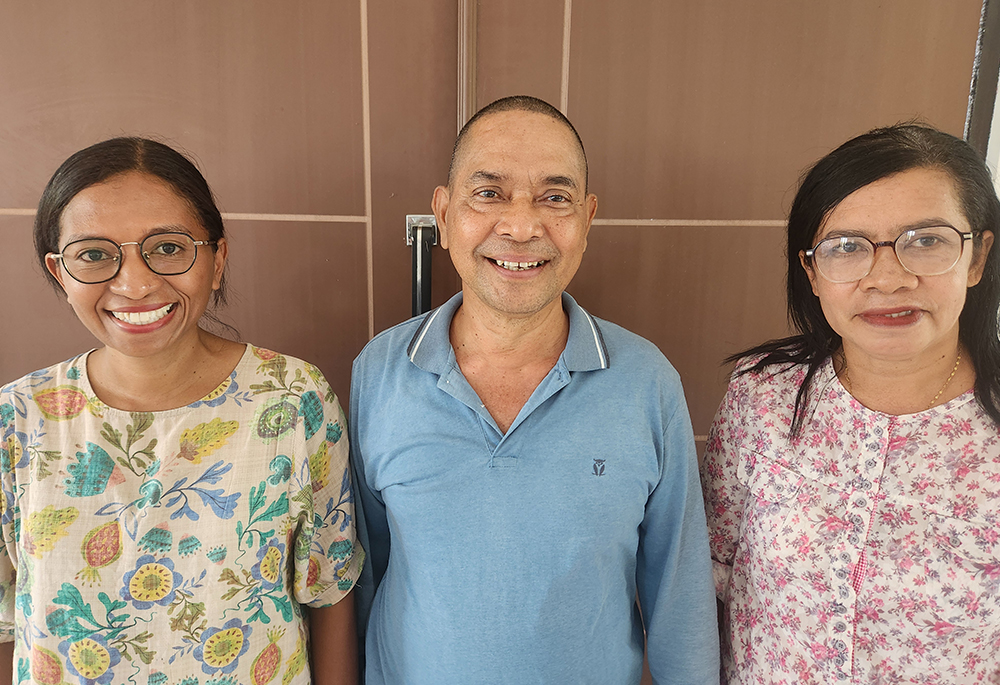
Staff and volunteers at TRUK F, or the Flores Humanitarian Volunteer Team, are pictured. From left to right are staff attorney Elisabeth Bestyana, volunteer lawyer Falentinus Pogon and staff member Yosephina Dafrosa. (GSR/Chris Herlinger)
One way is to work with the Divine Word Missionaries, a male religious order, which cofounded a shelter in Maumere. The shelter is a cornerstone of work by a nongovernmental organization known as TRUK F, or the Flores Humanitarian Volunteer Team, and is operated by a staff of 17 and three lay volunteers.
The Divine Word Missionaries work with the sisters in a number of ways, including providing counseling for those in the shelter.
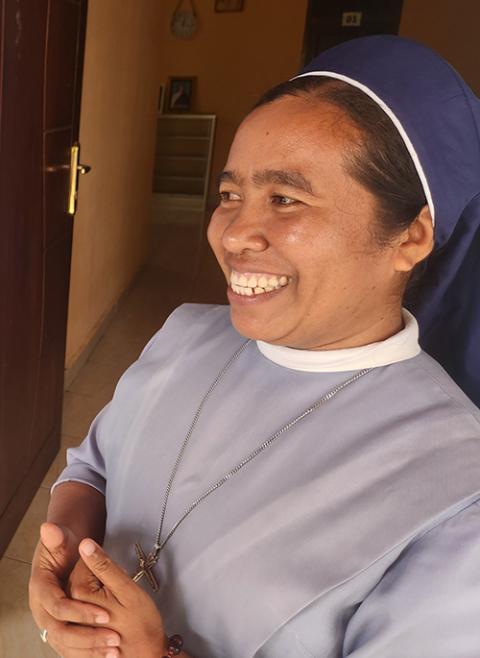
Sr. Fransiska Imakulata, a member of the Missionary Sisters Servants of the Holy Spirit and coordinator of the Flores Humanitarian Volunteer Team, or TRUK F, in Maumere, on the eastern Indonesian island of Flores. (GSR/Chris Herlinger)
The idea of "team" is important, say volunteer lawyer Falentinus Pogon, staff attorney Elisabeth Bestyana, and staff member Yosephina Dafrosa who in a joint interview said that a vision of a different society with a more dignified life for women and children animates their work and mission. "It's important that we continue this cause," Dafrosa said.
"As a man, I understand that men have a lot of power in our society and that the power is too embedded in the mentality of men," he said. "It has to change — but it's not easy."
Still, efforts are being made.
TRUK F has formed a self-help group for men, including for one-time perpetrators, called New Men. There are 16 men involved in the training for the group.
"The involvement of these men is very important because they can become mentors for other men, whether they are already married, or are planning to start a family," said Sr. Fransiska Imakulata, TRUK F's coordinator.
"If the men are open to it, and work with us, they can change," Daprosa said.