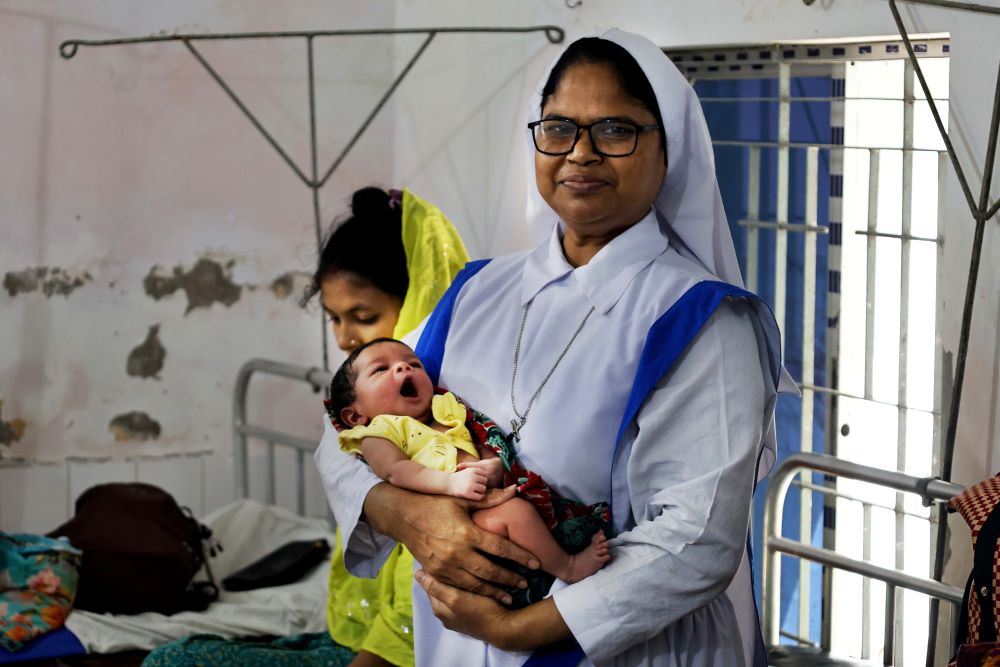
Sr. Mary Piusha holds a newborn baby at St. Paul's Hospital in Mongla, Bangladesh. The Associates of Mary Queen of the Apostles Sisters have been overseeing St. Paul's Hospital for 50 years. (Stephan Uttom Rozario)

by Stephan Uttom Rozario
The Associates of Mary Queen of the Apostles Sisters, known to the people of coastal areas of Bangladesh for providing low-cost medical services, have been overseeing St. Paul's Hospital for 50 years.
St. Paul's Hospital, located in a coastal area about 200 kilometers (124 miles) south of Dhaka, Bangladesh's capital, has only 10 beds.
"This hospital was established in 1976, but the sisters have been providing their healthcare even earlier. Back then, it started with 10 beds, but due to financial constraints, it still has 10 beds," said Sr. Mary Piusha, the matron at the hospital.
At least four doctors are required to run a 10-bed hospital, Piusha said, but due to a lack of money, the hospital only has two doctors on staff.
About 300 patients come daily to St. Paul's Hospital for treatment. Patients suffering from water-borne diseases are most common among outpatients.
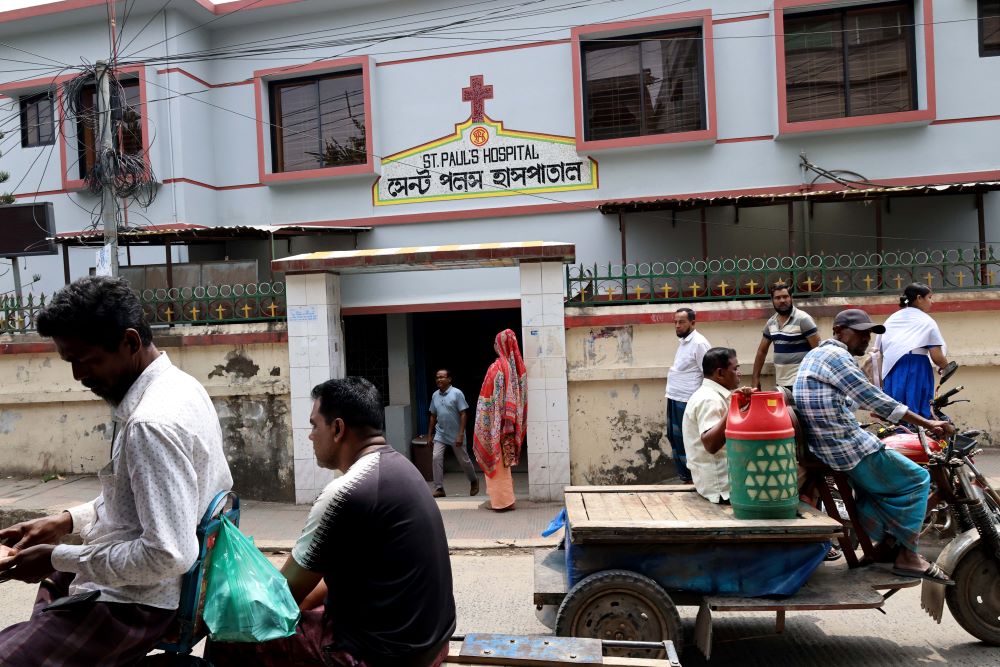
St. Paul's Hospital was established in 1976, and is run by the Associates of Mary Queen of the Apostles in Mongla, Bangladesh. (Stephan Uttom Rozario)
Shipra Banik, 42, has been in the hospital for three days with her sick father, Ajit Banik, 71. Ajit has been diagnosed with an infection in his blood and needs regular antibiotics as well as occasional oxygen due to breathing difficulties.
"We took my father to a doctor in Khulna city," Shipra told GSR. "The doctor said there was an infection in his blood and gave him injections. If we take him home, we will not be able to give him injections and oxygen, so we have admitted my father to this hospital so that he gets proper treatment."
Shipra, a Hindu, said that St. Paul's Hospital is popular in the area. Many locals go there, even if they are referred to a different hospital. "The cost of medical care here is low and round-the-clock service is available," she said. "The sisters also serve the patients with importance, that's why we come here."
Mongla, located in the Khulna Diocese, is north of the Sundarbans, the largest mangrove forest in the world, and the Bay of Bengal. There are rivers on three sides of the area, and there are no bridges. The boat and ferry are the only ways to cross the river to reach Mongla. According to the government, about 200,000 people live there, but there are only two hospitals, one run by the government, and St. Paul's Hospital.
This region also experiences severe cyclones and tidal waves. And as global temperatures rise, the salty water of the sea increases day by day, damaging the coastal region.
A 2024 World Bank study shows that women in coastal areas who live between 28 and 32 degrees Celsius have a 25% higher risk of miscarriage.
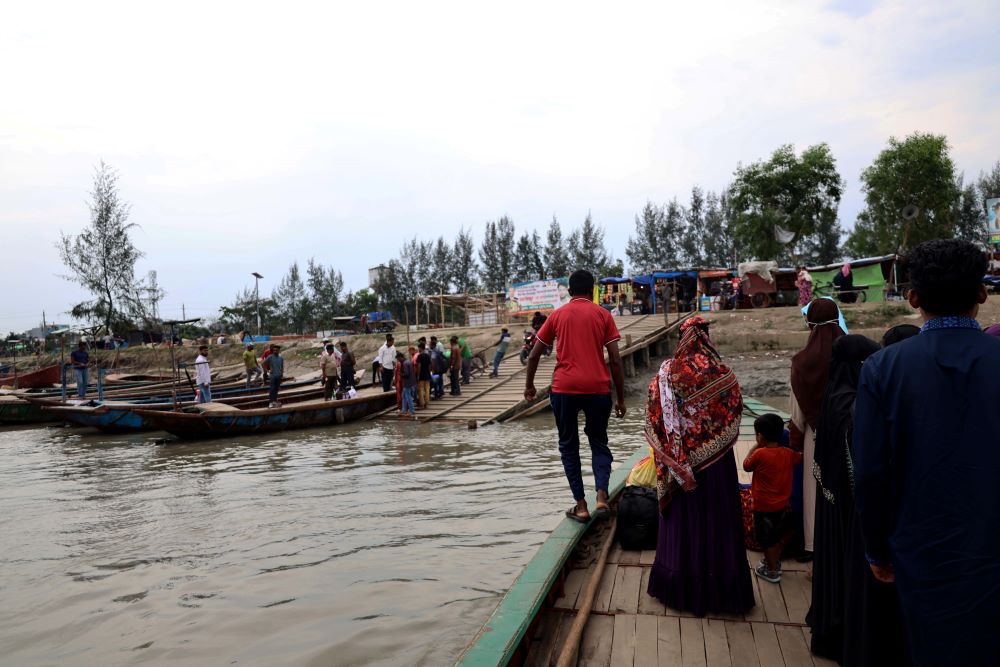
To reach St. Paul’s Hospital in Mongla, Bangladesh, locals must cross this river by boat. (Stephan Uttom Rozario)
Hasi Begum, 35, a Muslim, came to the hospital with her younger sister, Liza Begum, 19, who had just given birth. Hasi thanked God and the sisters that both the mother and child are healthy.
"When my sister Liza was pregnant, we used to have routine checkups at St. Paul's Hospital on the advice of the sister. But later it was found that due to abnormalities, the baby was delivered by cesarean section, but both are normal." Hasi said.
Due to poverty and lack of education, the family married Liza at just 15 years old. This is a normal practice in this area, said Piusha.
In the meantime, the sisters are providing healthcare with limited staffing and medical equipment. The hospital has 25 staff, including two sisters and two doctors.
Advertisement
Dr. Sudipta Mondal has been working as a medical officer at St. Paul's Hospital since 2020. He said it is quite difficult to provide modern medical services within the hospital's capacity, but they are doing their best.
"Since we only have two doctors here, specialist doctors and insufficient modern equipment, we cannot provide the best service to many patients," Mondal told GSR. "We refer them to other hospitals after primary treatment."
Patients with major health issues like cardiac arrest or severe accidents have to be referred to other hospitals after providing primary treatment.
"We don't have CT scan machines here, we don't have any modern machinery," Mondal said. "If we had these and if we could bring in specialist doctors, the people of this area would have received more and better services."
The hospital's monthly expenses of 600,000 taka (USD$4,800) have to be met from its income, which is collected from patients.
Piusha said that if any foreign or domestic organization or individual wants to provide financial assistance, the hospital authorities would welcome it.
"We give more importance to service than money, but without money, nothing good can be done," she said.