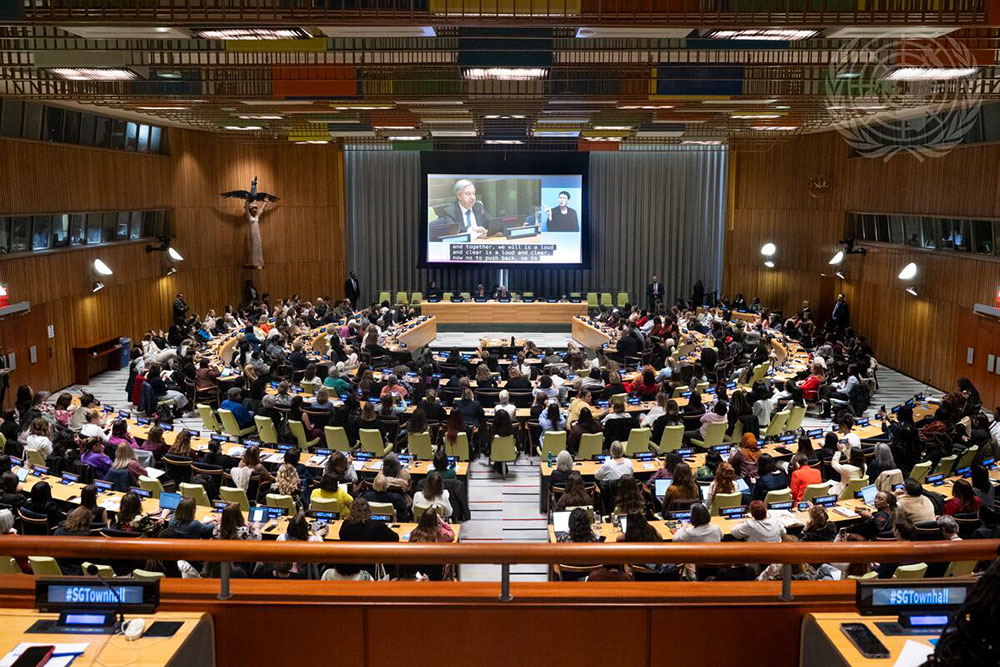
On the second day of the United Nations' Commission on the Status of Women, held at U.N. headquarters in New York, United Nations Secretary-General António Guterres met with members of nongovernmental groups. (U.N./Eskinder Debebe)



Sisters and congregational lay representatives praised the 70th session of the United Nations' Commission on the Status of Women for highlighting the continued challenges women face in achieving gender equality. Still, they expressed frustration that so many obstacles remain.
"The attitude remains that women count for less," Annemarie O'Connor, the representative to the United Nations for Passionists International, told GSR. "It's a long journey."
The commission said that the center of the annual convening, held March 9-19 this year, was discussion of the theme "Ensuring and strengthening access to justice for all women and girls, including by promoting inclusive and equitable legal systems, eliminating discriminatory laws, policies and practices, and addressing structural barriers."
In opening remarks on the first day of the gathering, held at the United Nations headquarters in New York, Maritza Chan Valverde, a Costa Rican diplomat, said, "No country has full legal equality — and women globally still hold only two-thirds of the legal rights that men enjoy."
In a preparatory report issued prior to the meetings, the United Nations said that despite advances in some areas, legal infrastructure "often fails to uphold the rights of women and girls, who face challenges such as discriminatory laws, inaccessible justice mechanisms, weak implementation and restrictive and patriarchal norms."
Such concerns highlighted numerous events that included Catholic sister participation, with a particular concern being the continued threats women and girls face from gender-based violence and human trafficking.
"Human trafficking thrives where poverty and gender discrimination exist, where debt traps are exploited and migration is unsafe or restricted. Women's work is exploited, and their care work is undervalued," said Good Shepherd Sr. Taskila Nicholas, director of advocacy and main representative for Good Shepherd International Justice and Peace at the U.N.'s Geneva office.
Advertisement
Nicholas spoke at a March 18 event at the Church Center for the United Nations. The event's co-sponsors included the Congregation of Our Lady of Charity of the Good Shepherd and the Institute of the Blessed Virgin Mary-Loreto Generalate.
In an interview, Sr. Barbara Bozak, who represents the Congregations of St. Joseph at the U.N. said that the value of the Commission on the Status of Women is in bringing people together, in an ethos in which nations can have equal representation.
She added, though, that one of the repeated themes heard throughout the 11-day conference was the "blowback" and reaction against whatever gains women have made globally in recent years.
"Women are getting empowered and some people are getting afraid," Bozak told GSR about those opposed to such advances.
Highlighting that concern was a dissenting vote on the commission's first day, in which the United States — concerned over language over gender — was the sole country to vote against the commission's agreed conclusions, which are usually adopted by consensus by the commission's members. Six countries abstained, while 37 voted in favor.
In his March 17 remarks at the convening, Archbishop Gabriele Caccia, apostolic nuncio and the permanent observer of the Holy See to the United Nations, said that ensuring access "to justice for women and girls requires more than just formal legal protections. It also involves addressing the root causes that put them at risk, prevent them from seeking justice and ultimately undermine their God-given human dignity."
Caccia added: "Ensuring access to justice is vital for achieving a just society. This requires a holistic approach involving the eradication of poverty, the combatting of discrimination and violence, the strengthening of institutions, and education. The Holy See and numerous Catholic institutions will continue to support these efforts."
Maryknoll statement calls for end to war against Iran
The four organizations of the Maryknoll family — sisters, fathers and brothers, lay missioners and affiliates — issued a joint leadership statement on March 16 calling for an immediate ceasefire of the U.S- and Israeli-led war against Iran and a return to diplomatic negotiations.
"We join a global chorus in pleading for a stop to the fire," the statement said, "urging leaders to set aside their weapons and return to the difficult, sacred work of the negotiation table."
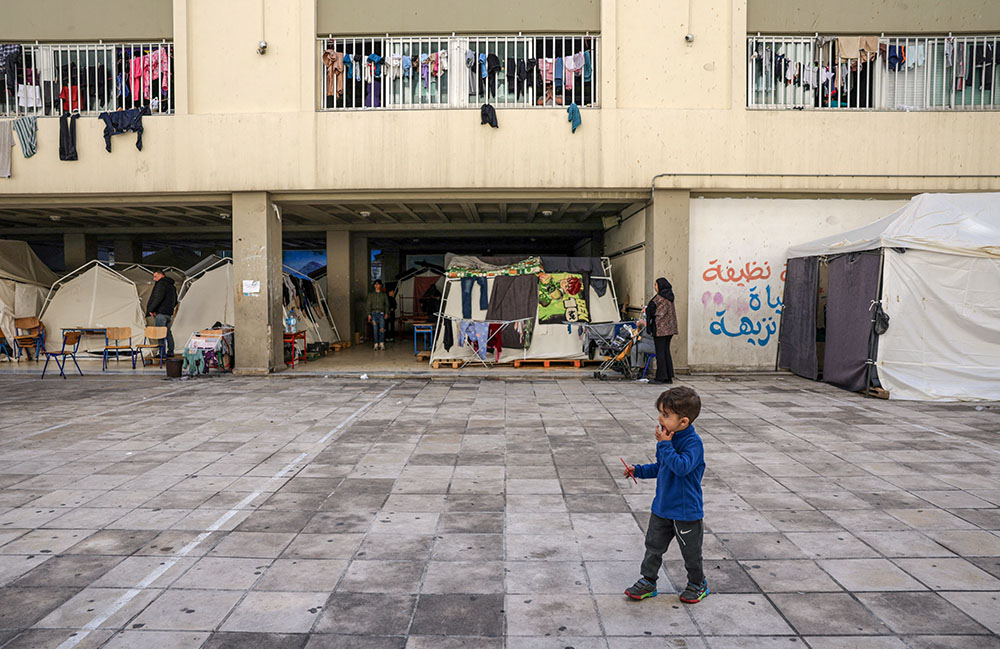
A child walks at a school turned into a shelter for displaced families in Beirut March 16, 2026, following an escalation in aerial attacks between Hezbollah and Israel, amid the U.S.-Israeli war with Iran. (OSV News/Reuters/Khalil Ashawi)
The statement, released by the Maryknoll Office for Global Concerns, calls upon the leaders of the United States, Israel and Iran "to make the courageous choice for dialogue over destruction."
"We advocate for an immediate de-escalation that protects the innocent, a commitment to diplomacy that honors international law, and the swift, unhindered delivery of aid to those whose lives have been upended. Together, as the Maryknoll family, we stand firm in the belief that even in the darkest hour, the path to reconciliation remains open to those who seek it."
Saying the statement came "from a place of deep sorrow and shared hope," the declaration cited the Maryknoll tradition of missioners crossing borders "to accompany communities in the Global South, sitting at the tables of those the world often forgets or disregards."
It added: "Today, as the shadow of war between the United States, Israel, and Iran stretches across the Middle East, we do not see a conflict of 'interests' or 'assets.' We see the faces of our neighbors."
"In a world increasingly divided by labels," the statement said, the Maryknolls "reject the idea that any nation or people exists outside the circle of our common humanity."
LCWR praises appointment of new papal nuncio
The Leadership Conference of Women Religious issued a statement welcoming Archbishop Gabriele Giordano Caccia as the new apostolic nuncio to the United States, replacing Cardinal Christophe Pierre.
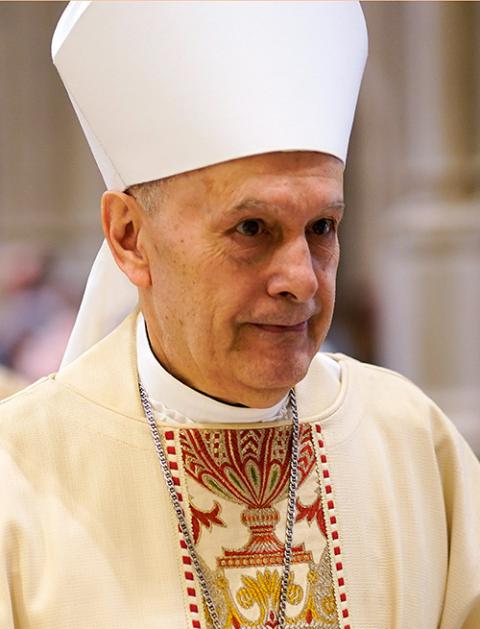
Archbishop Gabriele Caccia (OSV News/Gregory A. Shemitz)
"His 35 years of service as a Vatican diplomat — including assignments in Tanzania, Lebanon, the Philippines, and the Vatican's Secretariat of State — have prepared him well for this important role," the March 9 statement said of Caccia, who is currently the Holy See's permanent observer to the United Nations.
"These years of ministry have clearly equipped him with the wisdom, diplomatic skill, and pastoral sensitivity needed to accompany the Catholic Church in the United States at this moment in its history while faithfully representing the moral voice of the Holy See."
The apostolic nuncio is the pope's representative and recommends priests for elevation to bishop; the Vatican announced Caccia's appointment March 7. LCWR represents about two-thirds of the nearly 35,000 Catholic sisters in the United States.
In his most recent role at the U.N., Caccia "demonstrated a deep commitment to the global common good and a thoughtful engagement with critical issues such as climate change, migration, nuclear disarmament, and conflict resolution," LCWR's statement said.
The leadership organization also thanked Caccia's predecessor Pierre: "Through his pastoral approach to leadership, he was a wise and steady presence who consistently encouraged dialogue, fostered synodality, and helped guide the Church in the United States through moments of tension and challenge."