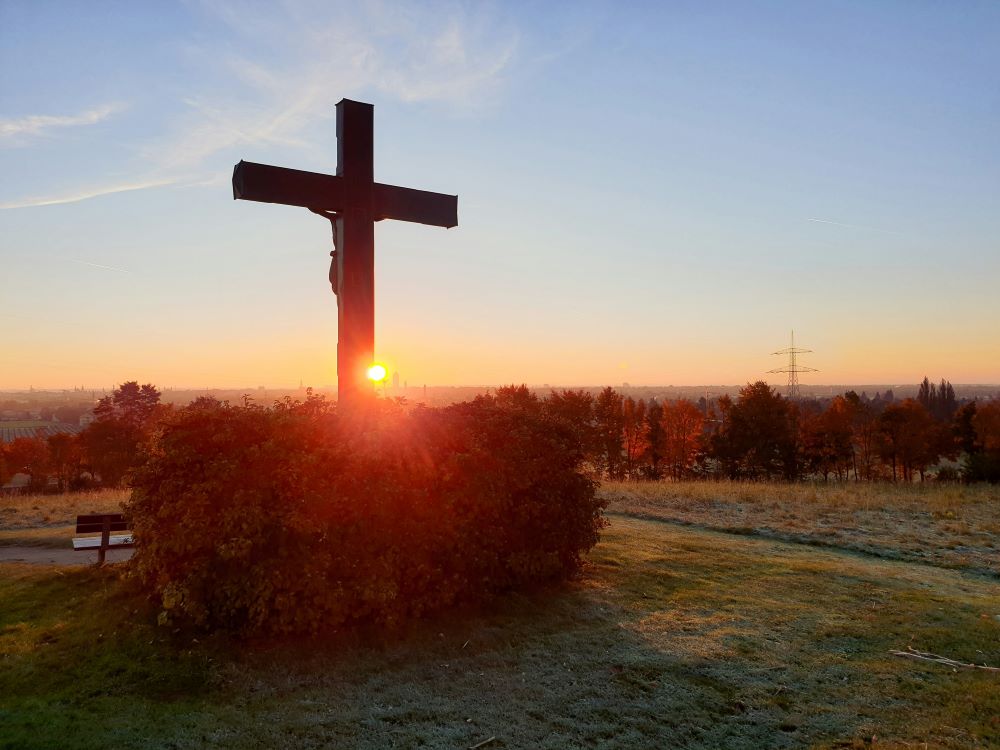
(Unsplash/Matthias Münning)

For three years I have awakened to the "beep, beep, beep" of backing up trucks, the clackety clack of flatbed carts being pushed into place, the crashing of trash from the third-floor windows into barrels, the murmurs of the workers as they begin their day, all beginning around 6 a.m. Just recently most of the work has been finished and I had a chance to go through the building. Simply put, I was quite amazed. I thought that to make this happen it needed a vision and it needed people who were stubborn enough to believe in its new life.
This close-to-100-year-old structure had been the dorms for the college we built in Detroit, Michigan. As I walked through, I thought about the thousands of young women who would have walked these halls, living in dorms, and studying in pretty small spaces. Hundreds of our sisters, robed in blue, teaching, administering, devoted to education. Now it is ready to receive new occupants, groups like the Black Leaders Detroit, who inhabit a newly created conference space looking out onto the campus. The Detroit Youth Choir, which has at least two wings filled with practice rooms, and the small chapel with beautiful stained-glass windows now complemented with large mirrors for practicing their routines. The Marygrove Conservancy administrative offices are housed there, welcoming all who come to campus.
It thrilled me, and as I walked around I thought about the stubborn hope of resurrection.
When Marygrove College closed, its fate was unknown. But with vision, hard work, good luck and the stubborn belief in, as the CEO said to me, "good bones," it has undertaken a new birth.
Those two thoughts — "the stubborn hope of resurrection" and "good bones" — stayed with me as I reflected this Lent on what is happening to us today.
President Donald Trump's choice to start a war in the Middle East intensified the dismantling of political, cultural, economic and religious structures that have served humanity, some for hundreds of years. What we hear and see are the sounds and signs of demolition — in some cases these structures, policies, laws, norms and values are being abandoned; others are demolished, others are too quickly replaced and few are being seen with the potential for transformation. And I wonder: Where is the "stubborn hope" for the "good bones" to anchor us as we move into the future?
Even as we hear the sounds of destruction we must tap into our stubborn hope to assess what are the good bones and begin the revisioning of what we have into what can be
Throughout our evolutionary process we have experienced extinctions and mutations. We have seen evolution's powers for destruction as well as creativity. Life forms disappear and new ones emerge in more complex and stronger forms. Pierre Teilhard de Chardin believed that there was a directionality in it all, moving toward the Omega Point.
I wonder what our time is telling us and asking of us in this evolutionary process? Are we to struggle with new understandings of what our "good bones" are, which will continue to evolve? What are the "good bones" which make a good human being? Ensure the health of our Earth Home? Create the political and economic systems that can serve us into the future? Or what does it mean to be a citizen of one's country and of the world? What can provide a skeleton, framework or container within which such transformation happens?
The evolutionary process will continue long after we have left this world, and what we do now is critical to its ongoing emergence. Even as we hear the sounds of destruction we must tap into our stubborn hope to assess what are the good bones and begin the revisioning of what we have into what can be.
We have to be stubborn about this and have hope. I invite you to reflect on what is happening today in light of resurrection. I don't think of this as an easy fix, a giving over to someone else. Rather, it is a deep belief that there is an underlying desire and trajectory within the universe and each life toward union and love. I believe Teilhard's insight of evolution's directionality offers us some of the "good bones" that we need and which reflects the vision of the resurrection.
In John's Gospel (14-17) we hear Jesus share promises with his friends that were to give hope after he was gone: "Do not let your hearts be troubled; I'm going to prepare a place for you; I will not leave you orphans; you all are one; you will do greater things than I and you are to love one another."
Science tells us that we are not isolated individuals, but that we are both interconnected and separate. We have more in common genetically with each other than how we are different. Jesus may not have known the science, but from the depths of his prayer, he knew that we are all one as his Abba God and he are one.
For many scholars, the next stage of evolution is the development of consciousness and that what each of us does is essential to its emergence. In this context, Jesus' desire that we will do greater things than he did is critical. Jesus wanted people to follow him; to live out of love; to show mercy and compassion; to be just. This is not so that we'd get to heaven, but rather that we could bring his "kindom on earth as it is in heaven." Jesus lived and died aligned with Divine Love, assuring us that we can live that way as well. We can draw strength from him here and now to live lives with the fullness of eternity. Jesus offered us some of the "good bones" of a future consciousness that continues to emerge.
Advertisement
Jesus died with nothing to show for it. There was no church or organized movement. Even most of his disciples deserted him, except for the women. However, Jesus' words and life became the "good bones" that would evolve into the early Christian community.
How would they begin to enflesh those bones? In the midst of persecution, there were those who believed and were stubborn about it. The Acts of the Apostles 2:44-47 tells us: "Those who believed lived together, shared all things in common; they would sell their property and goods, sharing the proceeds with one another as each had need. They met in the Temple, and they broke bread together in their homes every day. With joyful and sincere hearts, they took their meals in common, praising God and winning the approval of all the people."
Although that early structure didn't prevail as it was, it did inject itself into the evolutionary process, offering some insight and hope as to how to enflesh the good bones of the Gospel for the future.
Jesus' life puts forth the vision. The circumstances of our time provide the environment in which we choose to keep that vision alive and from where we discern the "good bones" we want to evolve as the future emerges. Resurrection is the invitation to keep that "stubborn hope" alive, to trust, to love one another as ourselves and to align with Divine Love permeating and embracing our evolutionary process toward a future in which we can know, love, serve and be with God forever.