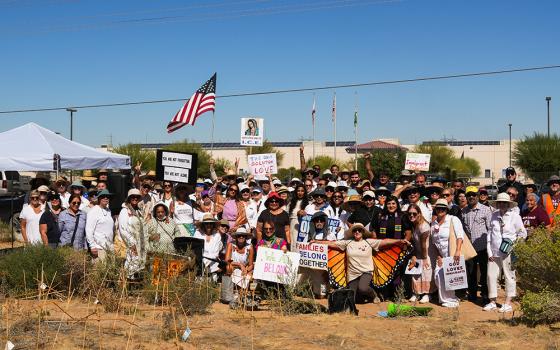
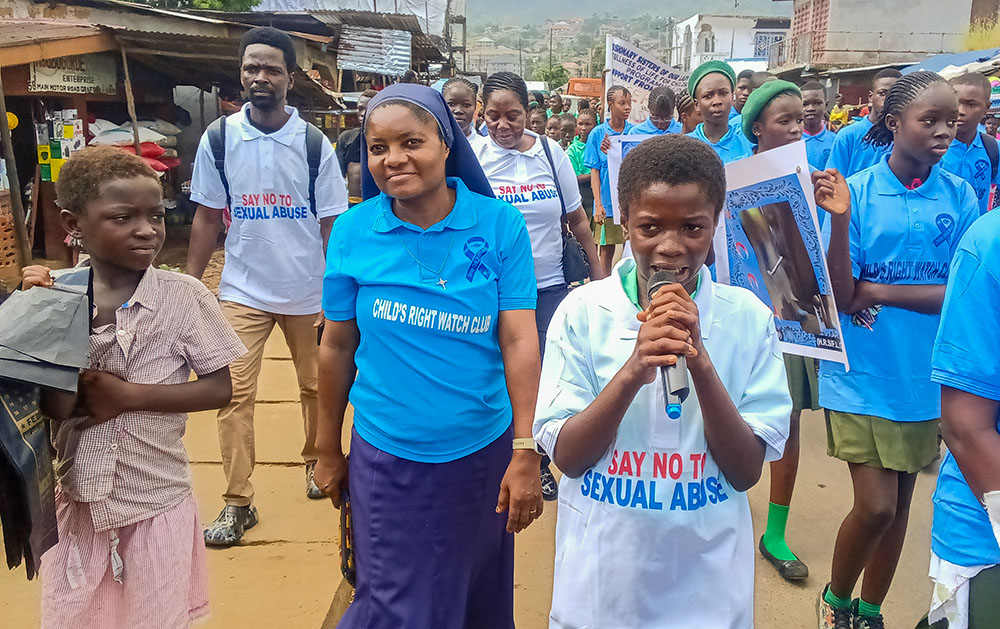
Child Rights Watch Club members and community participants join a campaign march Oct. 29, 2025, in Grafton Community, Freetown, Sierra Leone, to raise awareness on teenage pregnancy, early marriage, gender-based violence and drug abuse. (Courtesy of Misean Cara Ireland/NLW Germany)
by Sr. Onyinyechukwu Bernadette Ezejesi
Toward the end of 2012, Sierra Leone was slowly emerging from conflict, but for children, especially girls, the war had never truly ended. Teenage pregnancy was rising sharply. Early child marriage, sexual exploitation, neglect and different forms of abuse had become almost normal. Many children wandered through life without hope, without protection and without a future.
In many communities, children returned to homes broken by war and later strained by Ebola, where caregivers were traumatized, unemployed or struggling to survive. Schools reopened, but hunger, fear and silence followed the children into the classrooms.
Girls were sent to hawk on the streets, selling items to support their families but often returning home pregnant. Boys drifted into street life, petty crime or idle peer groups because there were no jobs, no guidance and no hope. Violence and exploitation became survival strategies.
In overcrowded slums, fishing communities, streets and mining areas, children lived without supervision. Drug use began to spread as an escape from hardship, first through alcohol and marijuana, and then through a far more dangerous substance known as kush. Cheap and widely available, it was falsely seen as relief from stress and trauma. In reality, it is a toxic mixture of chemicals and drugs that damages the mind and body.
Soon, communities began to notice the change. Young boys wandered the streets confused, some stripped naked in public, others collapsed, had seizures or died suddenly. Parents watched helplessly as their children became aggressive strangers, disconnected from reality. What began as an escape soon became an epidemic.
Advertisement
It was in this painful reality that Sr. Rita Ogbusu, a Missionary Sister of Our Lady of the Holy Rosary, felt her heart deeply disturbed. One evening, during prayer, a Scripture passage echoed within her: "I came that they may have life, and have it to the full" (John 10:10). Yet what she saw around her was the opposite, children merely surviving.
That word became a fire in her heart. She could no longer remain silent.
She then reached out to local stakeholders and gathered family heads, traditional and religious leaders, teachers, and the Family Support Unit of the Sierra Leone Police. She spoke honestly about the suffering of children. They listened and embraced the vision.
Together, they committed themselves to protecting children and restoring dignity and hope. Out of that gathering, the Fullness of Life for Children Management Program was born.
Through community sensitization, safeguarding education, engagement with families, networking with rehabilitation centers, schools, police of Sierra Leone, and traditional and religious leaders, the program began restoring what war, Ebola, poverty and drugs had stolen: voice, protection, awareness and hope.
However, despite these efforts, more desks were empty each term. Teachers said children had run away, but as we listened carefully, a different story emerged. Children were leaving school because it had become a place of fear.
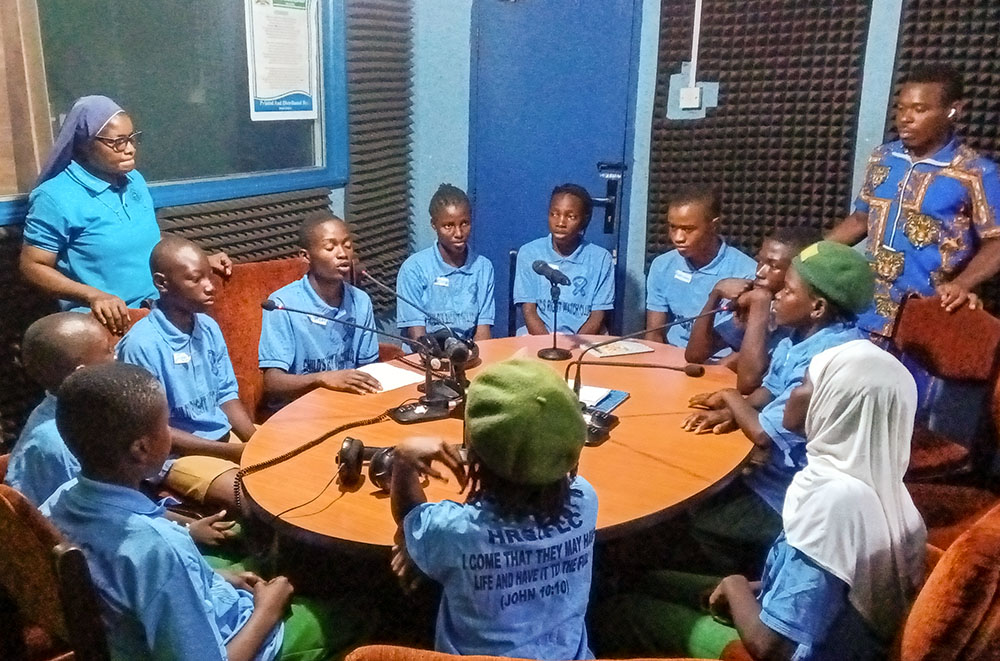
Child Rights Watch Club members of St. Helena's Secondary School, Dockyard Community, and King Fahad Islamic Secondary School, Wellington, both in Freetown, Sierra Leone, take part in a radio discussion on children's issues Nov. 26, 2025. (Courtesy of Misean Cara Ireland/NLW Germany)
Corporal punishment was harsh and frequent, and humiliation, shouting, neglect and in some cases sexual and emotional abuse were hidden behind discipline. Many children chose the streets or early marriage over classrooms that wounded them.
As coordinator of the Fullness of Life for Children Management Program, I realized that protecting children required working with teachers, not against them. Many teachers were themselves products of violent educational systems and had never been trained differently. Punishment was all they knew.
So we began by asking a simple question: What if the classroom became a place of safety, dignity and participation? Training on child-centered learning and safeguarding became essential. Schools were reinforcing trauma from war, Ebola, poverty and broken homes. If education was to heal, its methods had to change.
Working in partnership with the Sierra Leone Teachers Union gave the initiative legitimacy and reach. We designed practical trainings using role plays, case studies, group discussions, and exercises where teachers listened to children's experiences without interruption. We introduced positive discipline, nonviolent classroom management, active learning techniques, and basic child safeguarding principles, including recognizing and reporting abuse.
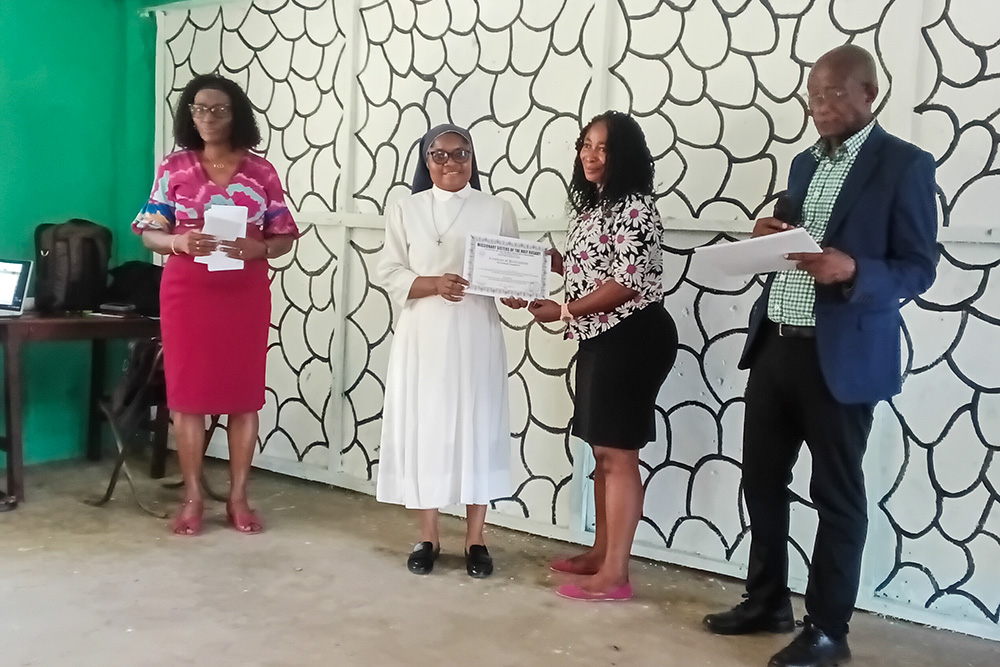
Sr. Onyinyechukwu Bernadette Ezejesi of the Missionary Sisters of Our Lady of the Holy Rosary presents certificates of participation to teachers trained in child-centered learning and child safeguarding Oct. 21, 2025, at St. Helena's Secondary School, Dockyard Community, Freetown, Sierra Leone. (Courtesy of Misean Cara Ireland/NLW Germany)
Teachers were invited to reflect on their own schooling and many admitted they learned through fear. This opened space for transformation. Peer learning helped reinforce new approaches.
Progress has been slow but visible. Corporal punishment has reduced in some schools. Teachers now use group work, storytelling and encouragement. Children who once stayed silent now participate. Attendance has improved, and some who dropped out have returned, saying, "School is different now."
But resistance remains. Some teachers argue that children have become stubborn without punishment. Others feel their authority is threatened. Some parents still believe beating is necessary. At times, we face silent opposition, with teachers attending trainings but returning to old habits.
Change challenges deep beliefs, but every child who stays in school is a victory.
Despite the challenges, the program continues, believing that when teachers change, classrooms change, and when classrooms change, children's futures change. This shift did not remain within teaching practice alone. It extended to the students through the Child Rights Watch Club.
At this club, students learn to recognize and report abuse through role play, discussions and peer learning. Some arrive believing that adults are always right and that silence is safer than speaking. But little by little, they are learning about human dignity, children's rights and to understand that their voice matters.
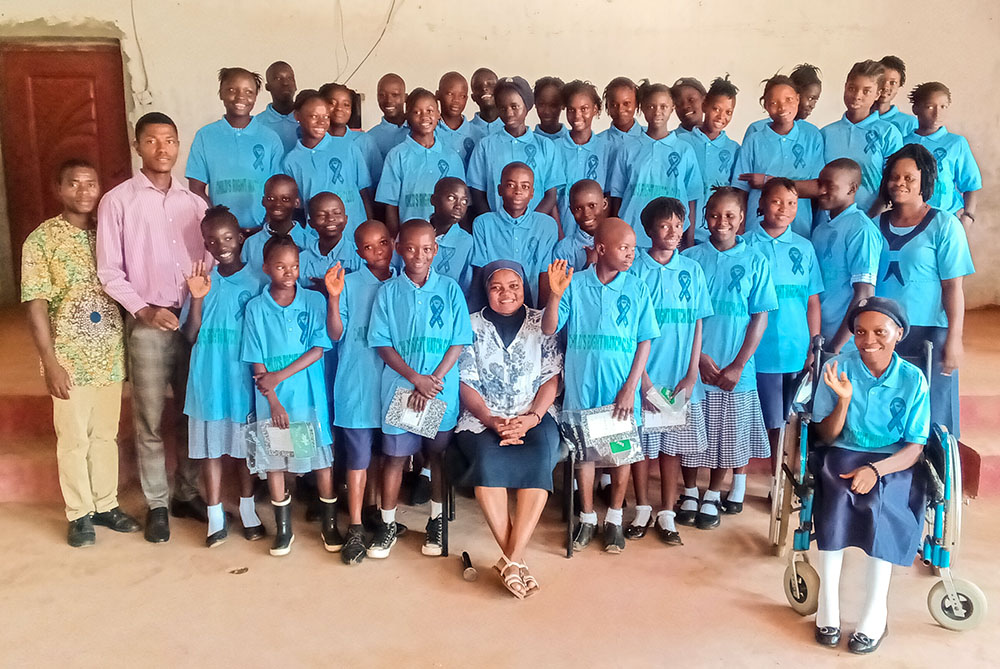
Child Rights Watch Club members of St. Francis Secondary School, Newton, Waterloo, Sierra Leone, pose for a photo with teachers Albert Kamara and Julius Bendu and Sr. Onyinyechukwu Bernadette Ezejesi, on April 22, 2024. (Courtesy of Misean Cara Ireland/NLW Germany)
A defining moment came when a younger pupil confided in an older student about harassment and was not ignored. The student followed the reporting steps and ensured the younger child was protected.
The Child Rights Watch Club has created continuity. Even if the Sisters of the Holy Rosary leave, values remain through the students themselves. The club builds leadership and accountability, giving children the courage to protect their own rights and those of others. The program continues in changed behavior, awakened consciences, and a generation willing to stand for dignity and life.
This growing courage among children is also beginning to challenge deeper patterns within the community itself.
The program has confronted harmful patterns rooted in the legacy of war, asking difficult questions such as: Why must a girl suffer in silence? Why is violence normalized?
At first, resistance came from both communities and some organizations that feared backlash. The turning point came through collaboration with community leaders. Dialogue slowly replaced denial, and others began to join, seeing that protecting girls strengthened the whole community.
Today, many of those patterns are shifting. What was once accepted is now questioned. Silence is giving way to reporting, and fear is being replaced by courage.
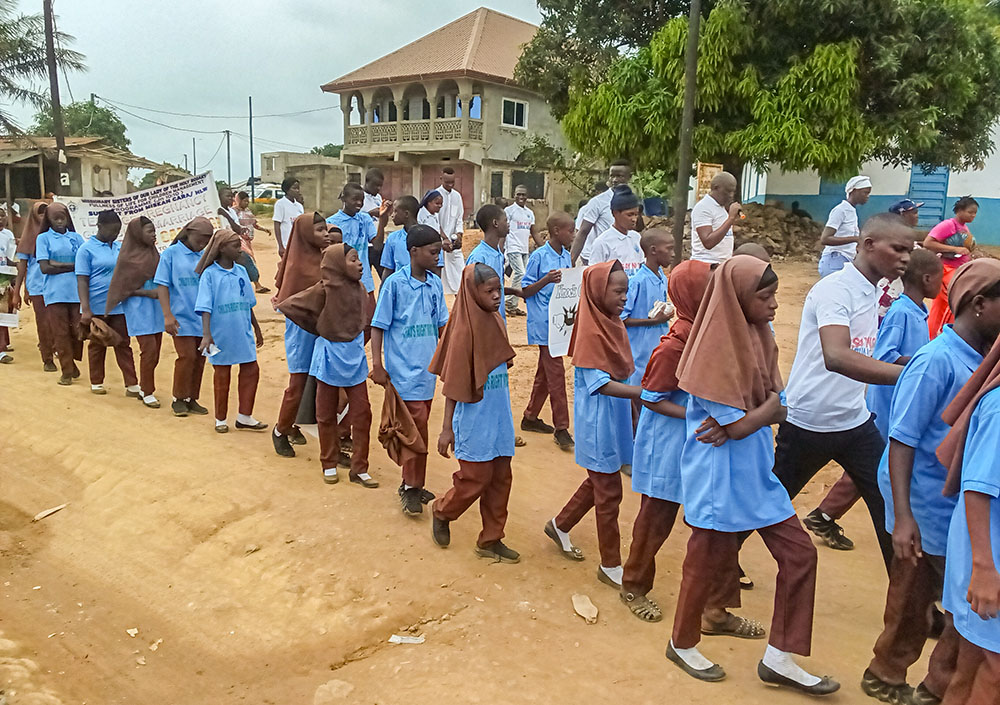
Child Rights Watch Club members and community participants join a campaign march on April 6, 2024, in Rogbangba Community, Sierra Leone, raising awareness on teenage pregnancy, early marriage, gender-based violence and drug abuse, especially "kush." (Courtesy of Misean Cara Ireland/NLW Germany)
As coordinator of the program, my charism as a Missionary Sister of Our Lady of the Holy Rosary has shaped my response: to be present among the vulnerable, to honor the dignity of every human person, and to bring Christ's healing love through simple, faithful service.
One day, we may leave Sierra Leone, but the values we have helped nurture will remain. They live on in changed attitudes, protected children, and communities choosing life. Here, the rosary is prayed through lives restored to dignity and hope.
When I began coordinating the Fullness of Life for Children Management Program, I did not yet understand how deeply it would shape both the communities and my own life. I knew only that the wounds of war were still open and that children, especially girls, were carrying the heaviest burden.
On a personal level, this work has stretched and transformed me. I have faced resistance and moments of discouragement, especially when facing challenges. Yet it has deepened my faith. My training in safeguarding has come alive through the stories of real people who are teaching me patience and humility.
Recently, during a Child Rights Watch Club meeting, a young girl said, "Now I know abuse is not my fault." Her words say more about the program than any report could. The people are no longer passive victims of circumstance. They are becoming protectors of one another. For that, I'm truly grateful.