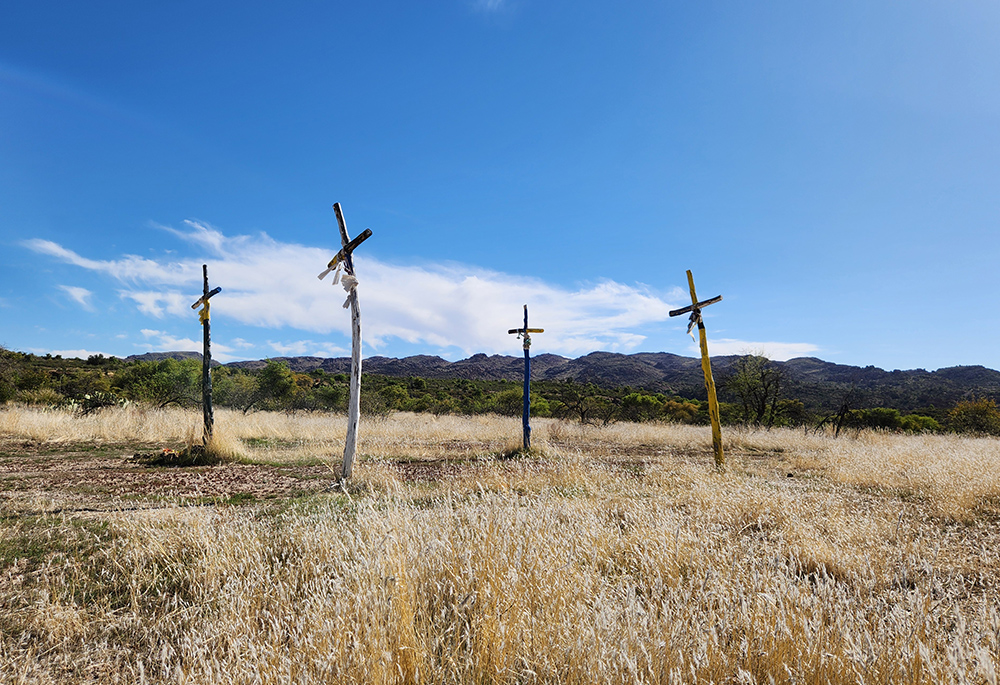
Oak Flat, known as Chi'chil Biłdagoteel among the Apaches, has been at the center of a land struggle for nearly two decades. A campground since the 1950s, the 6.7-acre area in southeastern Arizona has been a sacred space for 1,500 years for Apache and other Native tribes, who view it as a direct corridor to the Creator. (NCR photo/Brian Roewe)

A federal appeals court on Aug. 18 temporarily blocked a land exchange that would have advanced a copper mine on Apache sacred land — a decision that drew praise from Catholic sisters and other opponents.
The 9th U.S. Circuit Court of Appeals issued a temporary restraining order halting the exchange at Oak Flat, a high plateau basin in southeastern Arizona's Tonto National Forest, for 60 days, allowing the court time to review a number of lawsuits challenging the legality of the proposed mining project by Resolution Copper.
Calling herself grateful for the temporary injunction, Sr. Barbara Battista, one of nine Catholic sisters who traveled to Oak Flat for demonstrations in July, told Global Sisters Report she is happy that the court "appears to recognize the complexity of this situation. I continue to educate, advocate and pray for truth to prevail."
"Truth, in this case, would be that the Apache's constitutional rights to religious freedom through honoring the integrity of their sacred lands be honored," said Battista, a member of the Sisters of Providence.
Apache leaders also praised the court ruling.
"This injunction comes in a desperate time of asking for miracles, all over the country and all over the world," Dr. Wendsler Nosie Sr. of the community-based group Apache Stronghold said in a statement shared on social media, the Associated Press reported.
Dominican Sister of Peace Susan Leslie, who was also a member of the recent Oak Flat delegation, agreed, saying the appeals court injunction brought her "tears of joy" and represented a "glimmer of hope."
But, she noted, "this case is far from over."
"The dedication of all those who are committed to guarding the religious freedom of the Apache people through the protection of the sacred land of Oak Flat really are speaking out for the rights of all people everywhere and for Earth herself, and are calling us into the deeper reality of communion with all creation and with all peoples in our common humanity," Leslie told GSR.
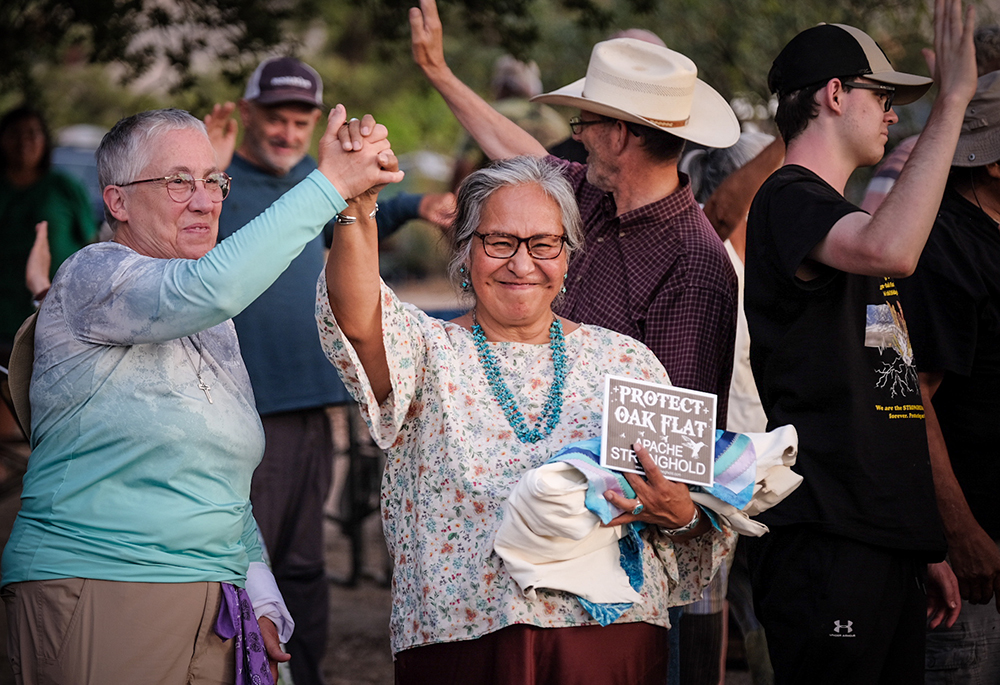
Diné elder and adviser to the delegation, Pat McCabe, center, and Providence Sr. Barbara Battista grab hands in celebration and solidarity at the gathering, held July 18-20, in defense of Oak Flat in southeastern Arizona's Tonto National Forest. (Courtesy of Steve Pavey)
But, she added, "the question remains: Which is more important? Respecting the ageless and undying dignity, rights, beauty and faith of the Apache Nation, or mining copper for financial gain for the proliferation of temporary creature comforts and for the eventual destruction of Mother Earth?"
Battista said she, too, is disheartened by the overall situation facing the Apache. "The fact that the courts have not already settled this in favor of the Apache and religious freedom is shameful," she said.
The appeals court, based in Phoenix, said it was taking "no position on the merits of the motions" filed by mine opponents, including Apache groups. The possible land transfer, backed by the federal government, would permit a joint mining venture to begin work on a massive copper mine that would essentially collapse the Oak Flat site into a crater up to 1,100 feet deep and nearly 2 miles wide.
'The fact that the courts have not already settled this in favor of the Apache and religious freedom is shameful.'
—Sr. Barbara Battista
With hours to spare, the restraining order came just before the end of a 60-day review period for the land exchange, the Arizona Republic reported. The land exchange, the newspaper noted, has survived two decades of legal battles and delays.
It has also galvanized opponents of the project, including Catholic sisters and the sister-affiliated group Land Justice Futures, which in July organized a delegation of 16 people to Oak Flat, including the nine Catholic sisters.
"There has never been as much public dialogue about Oak Flat as there is today. People are waking up to the injustice of the situation, and in the eleventh hour, Oak Flat is gaining more allies," said Brittany Koteles, director of Land Justice Futures, adding that perhaps the U.S. Supreme Court could now review the Oak Flat case on religious freedom grounds. (In May, the court refused to consider the Oak Flat case on such grounds.)
That is crucial, said Sarah Bradley, who headed the Land Justice Futures delegation, saying that the future of Oak Flat and Apache religious freedom are still "on the line."
Bradley told GSR she is frustrated that not enough people know about this case, even in nearby Phoenix, where she said "it's consistently 'brand new' news."
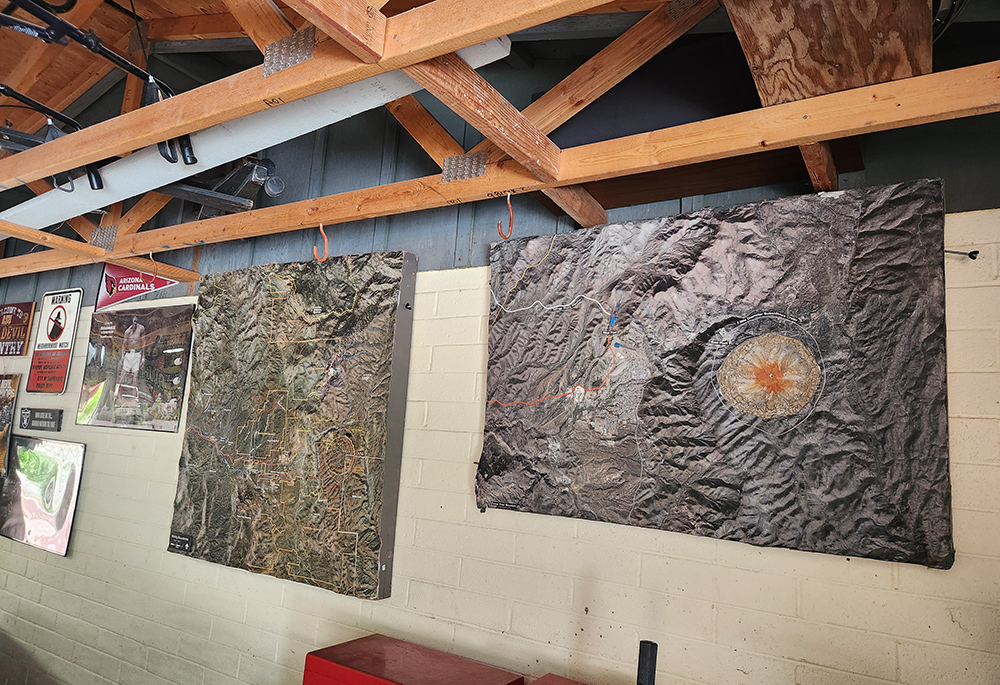
A to-scale model of Oak Flat hangs on the wall of the garage of Henry Muñoz, chairman of the Concerned Citizens and Retired Miners Coalition, in this April 24, 2025, photo. The model, based on the U.S. Forest Service's environmental impact statement, displays how a proposed copper mine would alter the geography around Superior, Arizona, including creating a crater the size of the Eiffel Tower at Oak Flat, a sacred site for Apache and other Native tribes. (NCR photo/Brian Roewe)
"This fight needs to be elevated in the public discourse," Bradley said, "and people need to understand that this case is precedent-setting: in terms of Indigenous religious freedoms and land rights, in terms of public lands being up for grabs with extractive industries, and in terms of the U.S. government turning environmental impact statements into toothless bureaucratic hoops for corporations to jump through rather than warnings to heed in good faith."
She said she and others will "continue to stand with the Apache until Indigenous religious freedoms and sovereignty are treated with the legal rights and respect they deserve and until the Apache can freely maintain their sacred relationship with Oak Flat."
On the day of the appeals court announcement, community-based Apache Stronghold — made up of Apache, Native, and non-Native activists and allies opposed to the mining project — said it would organize a spiritual gathering at the Oak Flat site on Aug. 19.
Advertisement
"We know all of our continued prayers are bringing the protection we need for this holy place. We will prevail in our pursuit to protect Mother Earth," the group said.
Resolution Copper, which is owned by two international companies, Rio Tinto and BHP, defends the mining project as necessary because copper "is a crucial resource for America's energy future, modern infrastructure needs, and national defense."
In a statement, a Resolution spokesman told GSR the Aug. 18 appeals court decision "is merely a temporary pause so that the court of appeals can consider plaintiffs' eleventh hour motions," adding: "We are confident the court will ultimately affirm the district court's well-reasoned orders explaining in detail why the congressionally directed land exchange satisfies all applicable legal requirements."
President Donald Trump weighed in on the appeals court action, saying on Truth Social that opponents of the project are "radical left activists" and "Anti-American." He made the comments the same day, Aug. 19, that he welcomed executives of Rio Tinto and BHP to the White House.
In response, Nosie of Apache Stronghold said in statement distributed by Land Justice Futures, "Our nation cannot survive if we sacrifice what is sacred in pursuit of temporary profits," adding that "this fight is much bigger than politics or profit. This is a fight about our identity as a nation."
Nosie praised those who have joined the Apache in their opposition to the proposed mine: "We've been joined in our struggle by people of many faiths — Catholics, Protestants, Muslims, Jews, and more — and people of every political persuasion. That's because this is not a partisan issue. It is a moral one."
This story was updated August. 20, 2025 with additional comments.