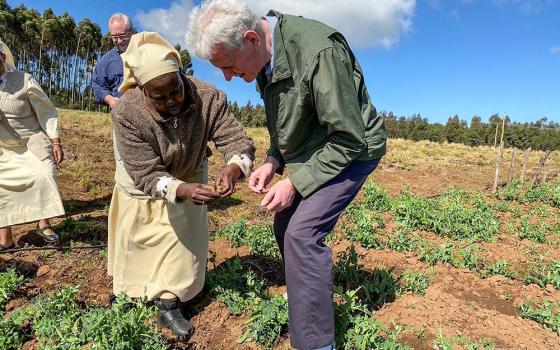
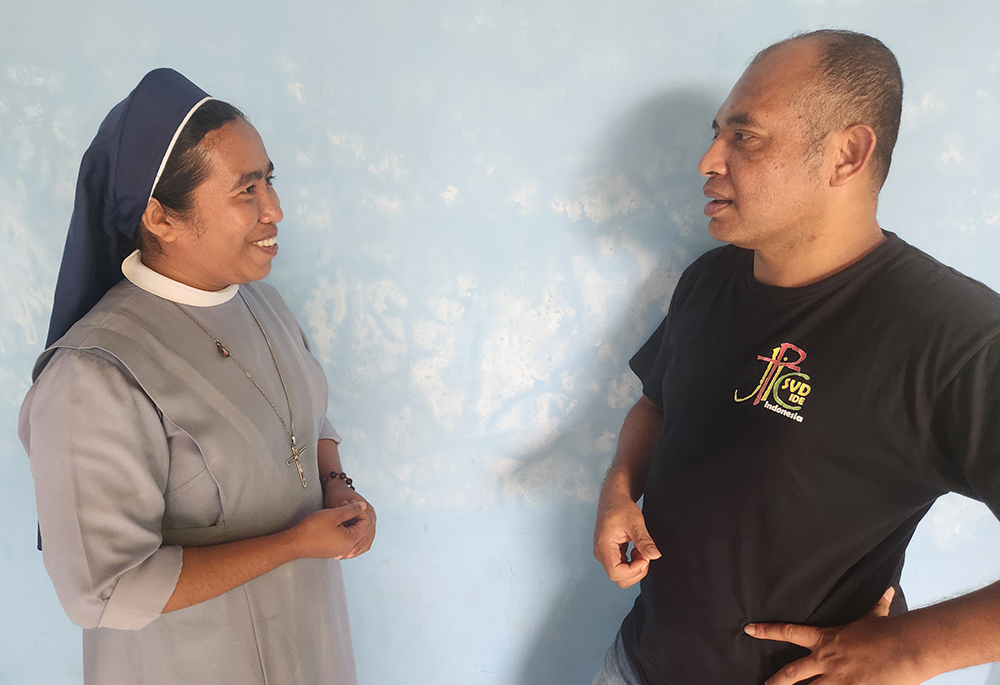
Sr. Fransiska "Ika" Imakulata, left, a Missionary Sister Servant of the Holy Spirit and coordinator of TRUK F, speaks with Divine Word Missionary Fr. Laurens Woda. (GSR/Chris Herlinger)

Editor's note: This story is part of Global Sisters Report's yearlong series, "Out of the Shadows: Confronting Violence Against Women," focused on the ways Catholic sisters are responding to this global phenomenon.

(GSR logo/Olivia Bardo)
It doesn't take long for someone covering the ministries of Catholic sisters to realize that tensions between sisters and male clergy are sometimes all too real.
Most sisters, of course, are discreet and diplomatic about such things. But on my assignments outside the United States and at the United Nations, it is hardly a secret — with an offhanded comment here, an eyeroll there — that sisters feel that many male clerics (not all, but not a few, either) carry with them gender biases.
That might mean "mansplaining," the need to dominate, take control, or perhaps, most sadly, not showing sisters appropriate respect. Such biases reflect societal structures, not to mention patterns, systems and heritages of patriarchy within the church.
So, it was refreshing and affirming to see the exception to that all-too-prevalent dynamic during my assignment to Indonesia earlier this year.
Where I saw it most visibly was in the city of Maumere on the eastern Indonesian island of Flores. There I witnessed the life-enhancing work at a shelter co-founded by the Missionary Sisters Servants of the Holy Spirit and the Divine Word Missionaries, a male religious order.
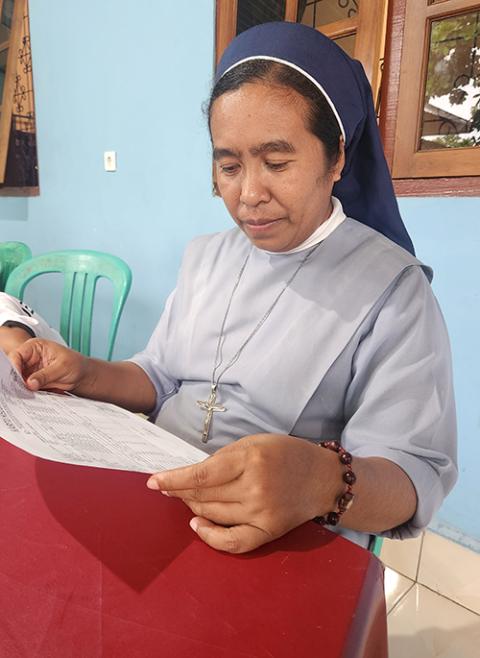
Sr. Fransiska "Ika" Imakulata (GSR/Chris Herlinger)
Nearly three decades ago, the two groups came together form a nongovernmental organization known as TRUK F, or the Flores Humanitarian Volunteer Team, which as I noted in my reporting earlier this year "is the only group in Maumere that focuses solely on empowering women and children who face challenges stemming from domestic, physical and sexual abuse and human trafficking, as well as unwanted pregnancies."
My principal contact during my assignment was Sr. Fransiska "Ika" Imakulata, a Missionary Sister Servant of the Holy Spirit and TRUK F's coordinator.
Sister Ika noted that the important force behind TRUK F was its founder and leader Sr. Eustochia Monika Nata, a Missionary Sister Servant of the Holy Spirit who died in 2021.
'We share the same spirit'
But Sister Ika also praised the relationship between the Sisters Servants of the Holy Spirit and the Divine Word Missionaries, calling it a given.
"We share the same spirit," she told me. "And this collaboration has been going on for a long time. There's nothing out of the ordinary that would cause conflict between us."
And indeed, both Sr. Ika and Divine Word Missionary Fr. Laurens Woda, as well as other sisters and priests, say a good working relationship, even spiritual bond, among the Missionary Sisters Servants of the Holy Spirit and the Divine Word Missionaries is real.
Both share the same founder — Arnold Janssen (1837-1909), a German-Dutch missionary priest who was canonized by Pope John Paul II — as well as "the same spirituality" and similar charisms, Imakulata said.
Both groups champion the concerns of women and children, and work together on preventing abuse and trafficking through advocacy, prevention efforts, victim outreach and recovery, spiritual empowerment and sharing schooling costs for the children of women who have experienced abuse or trafficking.
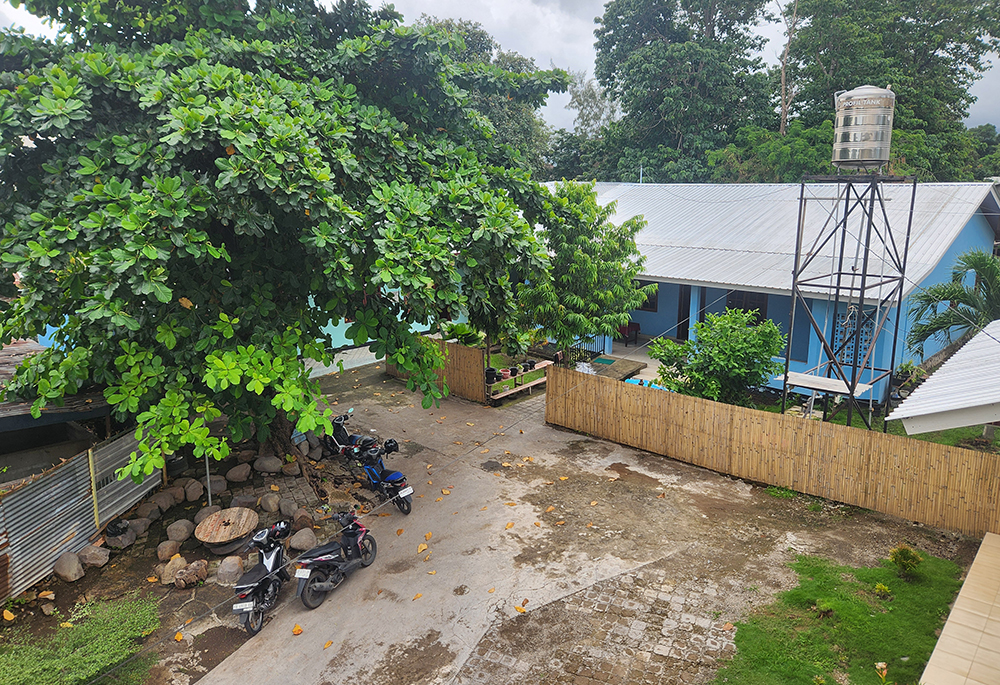
The exterior of the TRUK F shelter co-founded by the Missionary Sisters Servants of the Holy Spirit and the Divine Word Missionaries, a male religious order, in the city of Maumere on the eastern Indonesian island of Flores (GSR/Chris Herlinger)
"TRUK F does not work alone but always receives real support from SVD [Divine Word Missionaries]," Sr. Ika said. "We're connected well."
But in the wider church, challenges still exist, with not all clerics open to such a visible ministry advocating for women.
"I'm sometimes asked, 'Why do you always talk about women and children, women and children," Sister Ika said. "My response is, 'Because there's a problem.' "
"This is what happens in society," Father Laurens told me. "Most of the victims [of abuse] are women. We [in the church] have to pay attention to what is happening around us."
Advertisement
After I returned from my assignment to Indonesia and with those quotes fresh in my notebook, I covered the United Nations' Commission on the Status of Women. During that March event I spoke to Fr. Paul Rahmat, a Divine Word Missionaries priest and the representative at the United Nations for human rights advocacy group Vivat International.
Vivat works in 121 countries as human rights advocates and has a membership of more than 17,000 persons from a dozen Catholic religious congregations.
Tellingly, the two congregations that founded the group in 2000 were the Missionary Sisters Servants of the Holy Spirit and the Divine Word Missionaries, further demonstrating the bonds between the sisters and clerics. (I should add that Father Paul, who is Indonesian, was the one who suggested to me that a good story for our series on gender-based violence, Out of the Shadows, would be the Holy Spirit sisters in Maumere.)
The source of bonds? Jesus' ministry
During an interview at the Church Center for the United Nations as CSW was winding down, I asked Father Paul to what does he attribute the sound bonds between the two groups – and how, from my observation, the men of his congregation seem to take gender equality seriously.
"It comes from our faith," he said — a faith, he stressed, that honors a tradition affirming that "men and women are created equal" and that both men and women are called to be "reconciled in relationship equally."
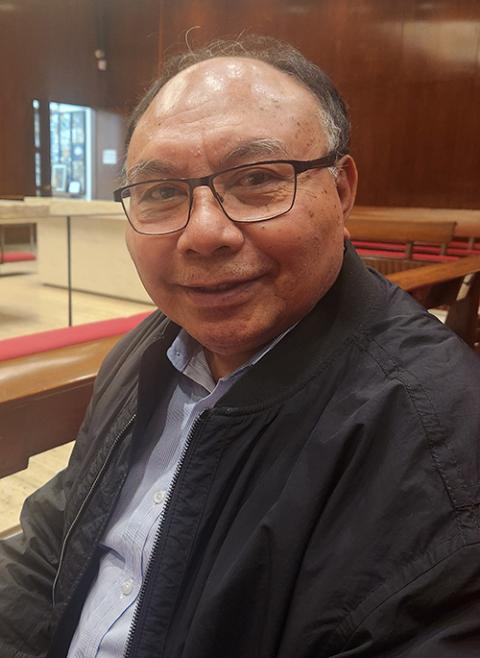
Fr. Paul Rahmat (GSR/Chris Herlinger)
The model, Father Paul said, is the ministry of Jesus, a model that calls Christians "to bring about reconciliation, and justice and dignity for all."
"Jesus came to reconcile unbalanced relationships," he said, and Christians "are called to model what Jesus did."
He said it is wrong and harmful for those who "use the Bible to reinforce patriarchal structures that are used to justify violence [against women]," and that men within the church — clerics and laity both — should not be afraid to call out those who do that.
Like his counterparts in Indonesia, Father Paul acknowledges the historical fact that the church doesn't have a good record on gender equality and that it is up to men within the church to acknowledge and face up to that heritage. "We have to push on that."
He said the ministries I witnessed in Indonesia — like the shelter for women and children I saw in Maumere — are creating safe environments for survivors of the harmful effects of patriarchy, like violence against women.
In Flores, sisters like Sister Ika and priests like Father Laurens are on the front lines "to bring forth the voice of victims to be recognized in the public square," Rahmat said, and their advocacy must be supported. But such advocacy is also needed — by men and women both — in forums like the United Nations.
The model, Father Paul said, is always Jesus' revolutionary egalitarian ministry.
"Jesus fought for the rights of women, and that's still an inspiration for us."