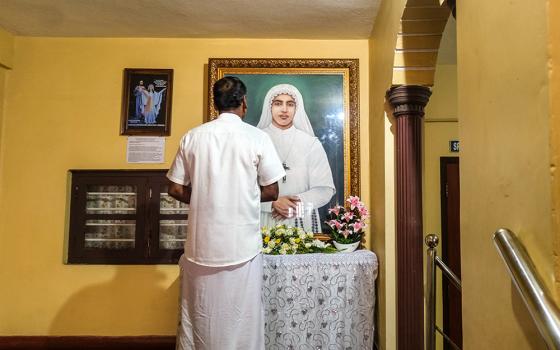
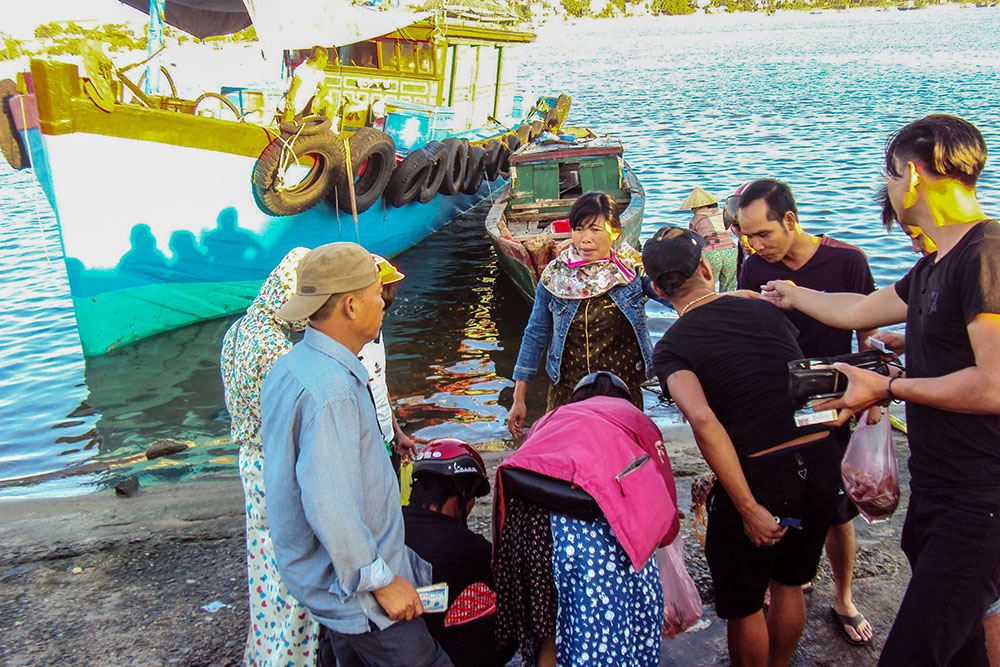
Mary Magdalene Vu Thi Tue (center, in denim jacket) sells fish to customers in Quang Tri, Vietnam, on April 22, 2026. At left is the fishing boat her family recently repaired after years of abandonment following the Formosa disaster. (Reporter in Vietnam)
Every morning before sunrise, 60-year-old Mary Magdalene Vu Thi Tue walks to the seaside market to sell baskets of fish her son caught during the night.
After a decade of hardship, the work feels almost miraculous.
"We are very proud to return to our traditional fishing work after 10 years," Tue said from her coastal village in Quang Tri province. "Now we earn about 250,000 dong [US$10] a day."
For years, the family's fishing boat sat abandoned near the shore — a painful reminder of the 2016 Formosa environmental disaster that devastated Vietnam's central coast and destroyed the livelihoods of thousands of fishing families.
In February, Tue's family finally repaired the boat.
The repairs cost 90 million dong (about US$3,400). Half came from donors connected to the Lovers of the Holy Cross sisters. The rest came from years of savings earned through odd jobs and manual labor.
"Even when we had nothing, we refused to sell the boat my parents gave me as a dowry," said Tue, a mother of three and grandmother of three.
In April 2016, the Taiwanese-owned Formosa Ha Tinh Steel Corporation, a subsidiary of the Formosa Plastics Group, discharged toxic chemicals into the sea across four central provinces. Massive fish deaths devastated local fishing economies and triggered one of Vietnam's worst environmental disasters.
Tue's family received only 20 million dong (about US$760) in compensation.
Like many others, she was forced into unstable work. She carried fruit at markets, swept trash, collected scrap metal and sold lottery tickets while caring for her husband, whose health deteriorated after he turned to construction work following the collapse of the fishing industry.
"I cried so much after he died in 2021, but I still had to keep working to raise my children," Tue said.
Across Quang Tri province, thousands of fishermen lost jobs after the disaster. Catholic sisters working along the coast said the crisis that followed was not only economic, but deeply social and emotional.
"What haunted us most was seeing people waiting outside the convent gates every morning asking for help," said Lovers of the Holy Cross Sr. Mary Caroline Pham Thu Hien.
At first, the sisters distributed rice, food and medicine. Soon, they realized emergency relief alone would not be enough.
"Long-term accompaniment is the most important thing," Hien said. "Helping families stabilize their lives sustainably is our mission."
The sisters began visiting affected families every two weeks, listening to their struggles and identifying those at greatest risk.
Over time, they noticed patterns: Unemployment fueled alcoholism, gambling, domestic violence, debt, migration and family breakdowns.
"One fisherman sold the family's only motorbike to gamble," Hien recalled. "Then he beat his wife and children. His wife came to us bleeding and wanted a divorce."
The sisters treated her injuries, counseled the couple and eventually connected them with jobs at a restaurant.
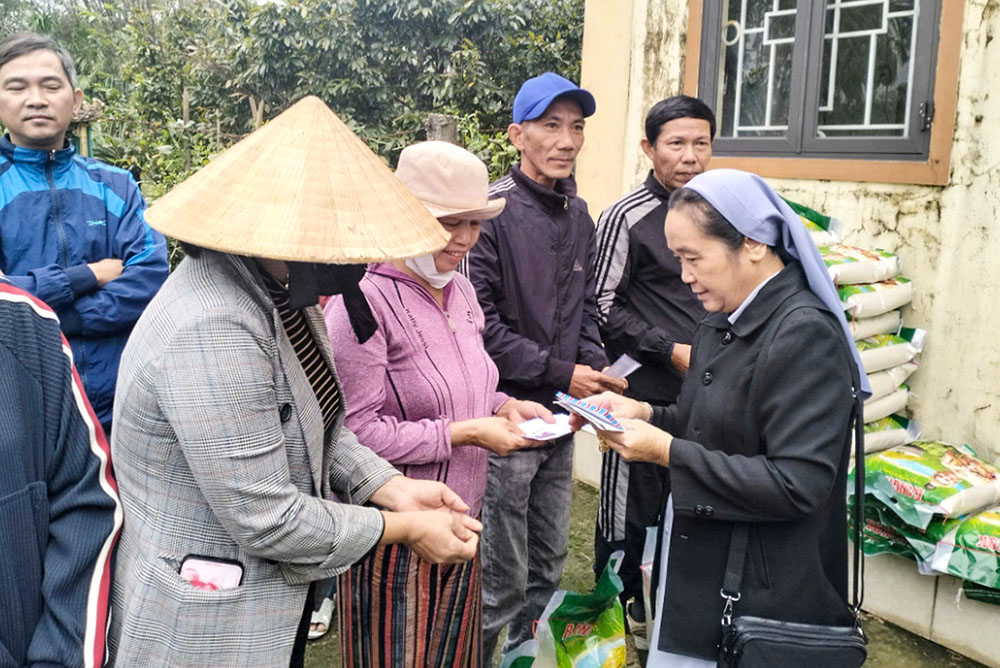
Lovers of the Holy Cross Sr. Mary Caroline Pham Thu Hien distributes rice and cash to poor fishermen in Gio Linh, Quang Tri province, Vietnam, on April 18, 2026. (Reporter in Vietnam)
Experiences like these changed how the sisters approached ministry after Formosa.
Instead of limiting aid to food distribution, they focused on rebuilding livelihoods and emotional stability. They provided microcapital for tiny businesses, helped families restart fishing or farming, distributed chickens and fertilizer, supported school fees and made regular home visits.
"We learned that if families only receive food, the suffering returns very quickly," Hien said. "But if they regain work, confidence and hope, they can rebuild little by little."
Over the past decade, the sisters have assisted about 210 vulnerable families in their area. Today, 38 families still receive regular support.
In Hue, Nguyen Thi Bay, 69, still keeps several clay jars once used to make anchovy fish sauce in the corner of her kitchen.
For generations, her family had produced fish sauce for local markets and restaurants.
After the toxic spill, authorities ordered her to destroy more than 1,000 jars worth over 60 million dong (about US$2,800). She borrowed 40 million dong (about US$1,500) from a bank to repay customers.
"I wanted to kill myself because I panicked so much," Bay recalled.
Daughters of Our Lady of the Visitation sisters began visiting her family soon afterward.
They brought food, money and chicks to help the family survive. They also provided capital for Bay to open a small drink stand near a school.
"The sisters often visited us, comforted us and helped us start earning money again," she said.
Before the disaster, Bay believed Catholic sisters mainly cared for fellow Catholics. But the sisters helped her family despite their different religious backgrounds.
"I realized they serve everyone, especially poor and vulnerable people," she said.
The support helped her children stay in school through scholarships arranged by the sisters. Today, all four have stable jobs, and the family has repaid its debts.
Each morning, Bay now buys chickens from nearby farmers and resells them at a local market.
"I earn about 200,000 to 250,000 dong a day [about US$7.50-9.50]," she said. "It is enough for me and my sick husband."
Daughters of Our Lady of the Visitation Sr. Anna Le Thi Thuy said the sisters quickly discovered that emotional trauma was as dangerous as hunger.
"Many families separated because of debt and unemployment," Thuy said. "Children dropped out of school because their parents could no longer pay fees."
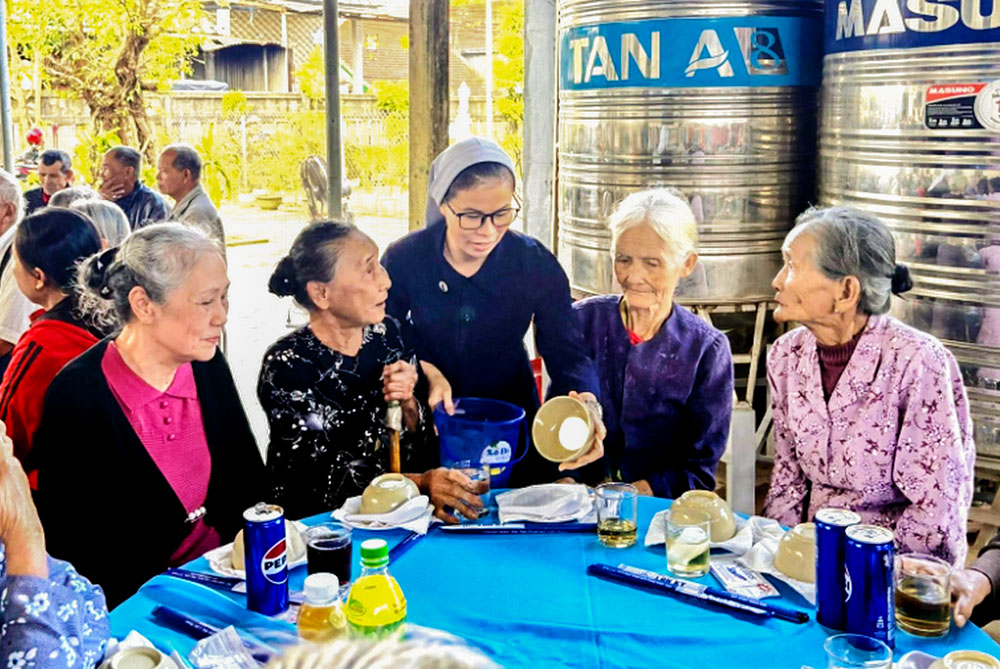
Daughters of Our Lady of the Visitation Sr. Anna Le Thi Thuy serves lunch for elderly people from fishing families at her convent in Hue on April 12, 2026. (Reporter in Vietnam)
The sisters began weekly home visits, listening to families and identifying urgent needs.
"In our ministry, visiting families is most important," she said. "People need to feel they are not abandoned."
Sometimes the desperation shocked them.
Thuy remembers one family preparing to cook a dead chicken they found floating in a river because they feared seafood contamination and had nothing else to eat.
"We told them not to eat it because they could become sick," she said. "Then we gave them food and money to buy pork."
Over the past decade, the sisters have assisted around 400 families affected by the disaster. Fifty-six families still receive support today.
As fish stocks declined and climate disasters continued hitting central Vietnam, sisters also helped families shift away from dependence on the sea.
Daughters of Mary of the Immaculate Conception sisters in Hue distributed chicks and fertilizer to struggling households.
Sr. Mary Theresa Do Thi Lan said the sisters first responded by treating illnesses linked to contaminated seawater. Eventually, they realized many families needed new livelihoods entirely.
"Creating ways for people to survive is the most important thing," Lan said. "Many people left home to find work far away, and families broke apart."
The sisters began helping fishermen transition into farming and animal raising.
One of them was Phan Canh Quang, a former crew member whose family fell into poverty after his wife developed severe spinal disease.
Advertisement
Quang said the sisters first provided his family with 3 million dong, food and 30 chicks.
Today, Quang cultivates crops and works as a motorcycle transporter delivering goods for local shops.
"I no longer live in debt," he said. "Without the sisters, I think my life would have had no way forward."
Another fisherman, Nguyen Ba Trao, 50, lost nearly 45 million dong (about US$1,700) in unpaid wages after his boat owner went bankrupt following the disaster.
His marriage collapsed. He drifted between construction jobs and sleeping on park benches until a volunteer introduced him to the sisters.
Trao said the sisters gave him startup support to return home.
"Now every day I take care of my trees and fish ponds," Trao said. "I sell rice, vegetables, bananas and fish. I am no longer wandering from place to place."
Ten years after Formosa, many coastal families remain fragile. Donor support has declined while requests for help continue to grow.
Yet the sisters say the lesson they learned from the disaster remains clear: Recovery is not only about compensation or emergency aid.
It is about accompaniment.
"We cannot solve everything," Hien said. "But if people know someone is still walking with them, they find strength to continue rebuilding their lives."