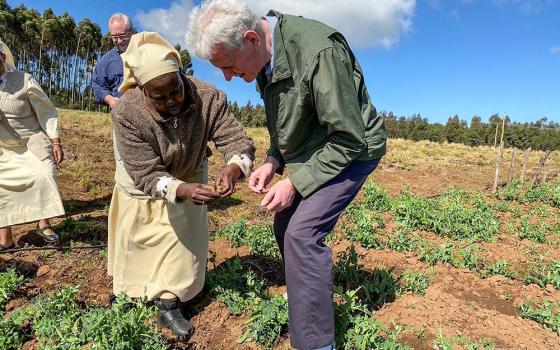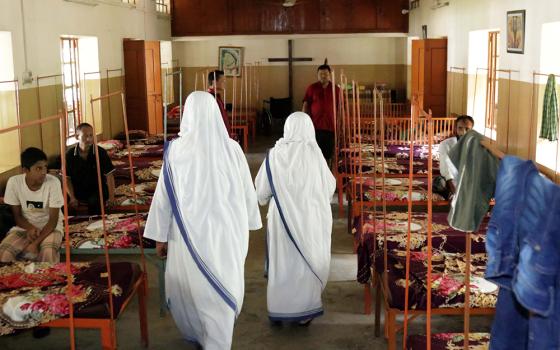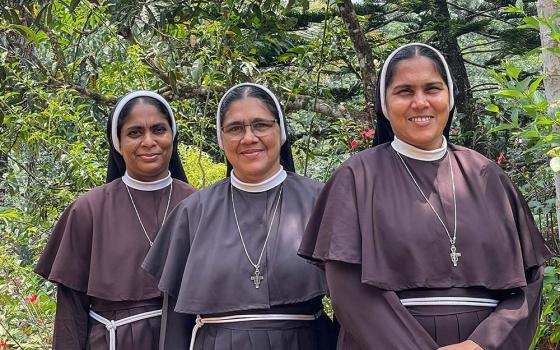
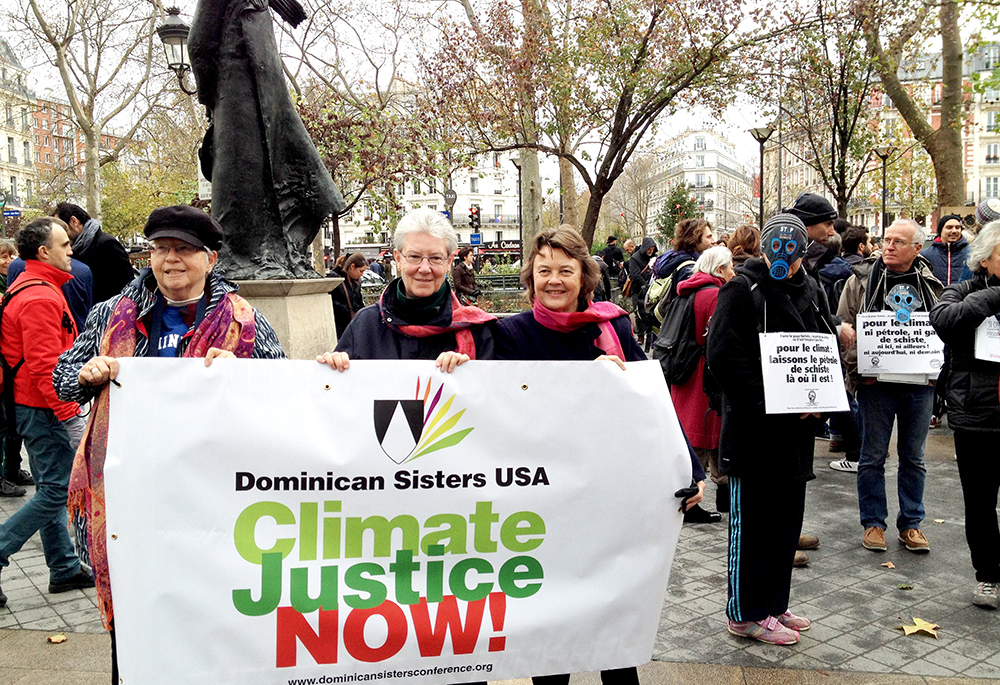
In this 2015 file photo, Adrian Dominican Sr. Patricia Siemen, Amityville Dominican Sr. Margaret Mayce and Adrian Dominican Sr. Elise García demonstrate in Paris for climate justice. (CNS/Global Sisters Report). Editor's note: The sisters in photos are from prior news stories, not of research participants.


There is significant potential for the global Catholic Church to positively impact the climate crisis. Popes have been teaching about climate change for decades, most notably Pope Francis whom Pope Leo XIV has echoed. Alongside these teachings, the Catholic Church also has robust advocacy networks and large amounts of land, buildings and investments that could support changing energy practices.
However, research shows that the top U.S. Catholic leaders, U.S. bishops, have largely approached climate change with ambivalence and denialism, and have largely avoided engaging in significant climate action, despite their power to do so within their local dioceses. This is likely due to their ties to Republican individuals and organizations.
In contrast, Catholic sisters, who have little formal power within the U.S. Catholic Church, are leading on environmental issues at many levels of society and within the Catholic Church.

Sr. Mary Lou Buser, a member of the Sisters of St. Joseph of Brentwood, New York, blesses Ellie, a Goldendoodle, during a prayer service marking the Season of Creation at the Sisters of St. Joseph motherhouse Oct. 3, 2021. (CNS/Gregory A. Shemitz)
Why is so much environmental activism within the U.S. Catholic Church coming from sisters, despite their relative lack of institutional power? To answer this question, we engaged in qualitative interviews with U.S. sisters who have been leaders on environmental issues.
Our research finds that 1) key qualities of sisters' avowed religious life facilitate their environmental leadership and 2) bishops and diocesan priests' environmental leadership may be inhibited by their power and money interests, as well as their isolation from community. While our findings should not be considered representative of the views of U.S. Catholic sisters generally, our findings do provide insight from the perspective of U.S. sisters who are involved in environmental activism. (Note that no sisters interviewed in this research are named, following ethical standards in social science research.)
US sisters' religious life facilitates environmental leadership
As previous research would predict, we find that social networks and communal living often pulled Catholic sisters into environmental activism, particularly by other sisters already involved in environmental leadership. Many sisters mentioned specific retreats or workshops run by other sisters, such as EarthConnection, Jubilee Farm and Green Mountain Monastery. Sr. Miriam MacGillis, co-founder of Genesis Farm, was brought up by many sisters we spoke with for helping spark their own ecological conversion.
Sisters discussed community support as important for initially getting involved in environmental activism and for resilience in this work over decades. Most sisters described how their local congregations supported them when they wanted to focus more on environmental leadership. Sisters of Earth was also noted as an important "support network."
Finally, sisters being unmarried and (usually) having no biological children appears to facilitate activism and leadership. This finding parallels other research that "biographical availability," or not having personal constraints like marriage and family responsibilities, gives people more freedom to engage in activism.
US bishops' power and isolation may inhibit environmental leadership
Why, then, are U.S. bishops and diocesan priests less involved in environmental activism? Many of the sisters have worked with bishops and priests for decades in various capacities. They suggested power and money interests and social isolation may be inhibiting activism among clergy in the church.
Many sisters perceived U.S. bishops and diocesan priests as being resistant to environmental activism because they were more focused on maintaining their institutional power. For example, one sister described bishops as "hesitant to move on any area that is controversial."
Here, some sisters discussed bishops and diocesan priests as not wanting to anger conservative financial donors or parishioners. This aligns with findings that political conservatives are more skeptical of climate change. The sisters noted that "money does talk" and some "have outsized influence in some of their dioceses because of the amount of money that the family has." Diocesan priests were described as "trying to please the people and not rile them, and they don't want their money to go down."
Advertisement
Seminary education was seen by many sisters as inhibiting environmental concern. Several sisters described a conservative shift happening in seminaries recently and among younger diocesan priests. This trend is corroborated by recent empirical research showing that newer priests are more politically and theologically conservative than prior cohorts. One sister does not "see these young seminarians being invited to even think critically" and instead "an expectation of respect and honor and 'you listen to me because I have the answers' " — what many Catholics term "clericalism."
Sisters perceived both diocesan priests and bishops as having an isolated and lonely life, which inhibits their ecological awareness. One sister described bishops as getting "used to an isolated life and just dealing with important people at important levels, with the very finest of everything, and kind of forget to be a shepherd." Diocesan priests and bishops were described as "frozen in place" because of their greater social isolation, and that community was essential for sisters' ecological conversion.
While generally critical of bishops' and diocesan priests' lack of engagement with environmental issues, sisters also spoke with empathy and sadness about the isolation of men working in the hierarchical Catholic Church that they saw as driving this ecological avoidance.
Less power, more freedom to lead in activism
Many sisters described their lack of institutional power within the Catholic Church as giving them more freedom to be environmental leaders. One sister explained that "people who are not in power have more freedom and flexibility especially to challenge the status quo, even if it goes nowhere." Diocesan priests and bishops were described as getting "trapped in the institutional expectations" and "having far more restrictions put on them in terms of their behavior" if "they want to climb the career ladder." In contrast, many sisters emphasized "the freedom women religious have."
Despite this perception that sisters have greater freedom in activism because of their lack of power, many sisters still described significant pain in their gender-based exclusion from power. Nearly all sisters brought up unprompted wanting women to be incorporated more into decision-making power or leadership in the church.

A butterfly gathers nectar on bee balm on a natural area of the property of the Dominican Sisters of Adrian, Michigan, June 30, 2015. (CNS/Dennis Sadowski)
Climate action and decision-making power
In the face of decades of papal teachings about the reality and urgency of climate change, U.S. sisters have been leaders on environmental action. In contrast, U.S. bishops have largely not been creation care leaders. Sisters' exclusion from power may give them more freedom to engage in environmental activism. Bishops have significant power to enact sustainability-related action in their dioceses and beyond but are perceived as too ideologically conservative and concerned with protecting their power to act.
This research brings up a challenge for climate action. Addressing climate change will require significant changes to the status quo. Leaders with the power to enact those significant changes are likely particularly resistant to change because they are generally benefitting from the current system of power relations.
Research finds that incorporating women into decision-making power leads groups to more informed decisions on environmental issues and climate change action. If the Catholic Church did more fully incorporate women into decision-making power, it may lead the church to take bolder action that would fulfill its significant potential to impact the climate crisis. Greater diversity in leadership is not simply a goal in itself but helps groups more effectively address urgent and complex social problems.
Editor's note: This essay is adapted from the authors' article, "Community as Catalyst for Change: Factors Contributing to US Catholic Sisters Engaging in Environmental Activism," published in the Journal for the Scientific Study of Religion.