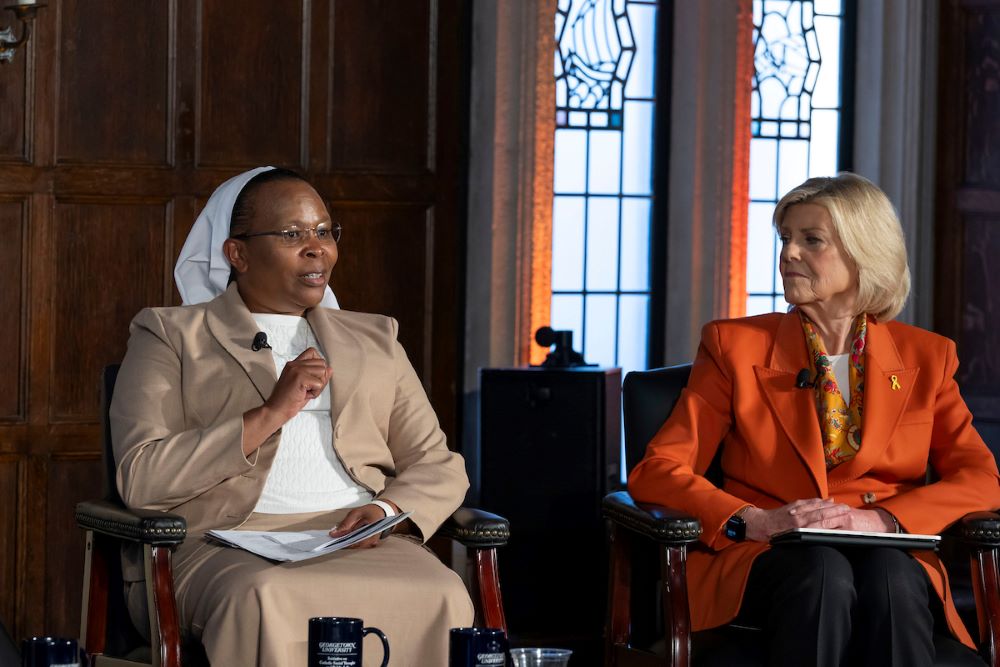
Little Sisters of St. Francis Sr. Jane Wakahiu (left) speaks as NBC News correspondent Anne Thompson listens at the "Catholic Women's Leadership to Advance the Common Good" panel at Georgetown University March 9. (Georgetown University/Lisa Helfert)
by Sr. Christine Schenk
A panel of "four remarkable women leaders" was brought together by Georgetown University's Initiative on Catholic Social Thought and Public Life recently to address the theme "Catholic Women's Leadership to Advance the Common Good." The March 9 presentation was designed to highlight the work of Catholic women "as well as the opportunities ahead to continue to advance women's leadership in the church."
The timing was fortuitous. The very next day the Vatican's Dicastery for the Doctrine of the Faith issued a long-awaited synodal report from study group five, "The Participation of Women in the Life and Leadership of the Church."
Kim Daniels, director of the Georgetown Initiative, skillfully facilitated the dialogue among four women who are exercising luminous leadership within their respective communities. Panelists included Anne Thompson, an award-winning Catholic journalist at NBC who frequently covers church issues; Joanna Arellano-Gonzalez, co-founder of the Coalition for Spiritual and Public Leadership, an organization that describes itself as "merging liberation theology and community organizing"; Cynthia Bailey Manns, the director of Adult Learning at St. Joan of Arc Catholic Community in Minneapolis and a U.S. delegate to the synod on synodality; and Little Sisters of St. Francis Sr. Jane Wakahiu, who oversees the Hilton Foundation's Catholic Sisters' initiative.
Although study group five's report had yet to be published, the panelists' stories and experiences exemplified the key issues, charisms and challenges within it that impact women and men in the church today.
Quoting Pope Francis' recognition that women "continue to encounter obstacles to exercising leadership," Daniels first asked the panel what they saw as the most important obstacles that still exist in the church and the most important opportunities.
'The biggest obstacle is that still we have an unwillingness to admit the fact, the truth that women's baptism is not inferior to men's baptism and that women image Christ in their baptism.'
—Cynthia Bailey Manns
Thompson recounted an experience during the recent conclave when she ran into one of the women Francis had elevated into Vatican leadership. She asked her what she expected from the conclave and immediately noticed a "cloud of concern" that came over the woman's face. "And for me, that was like cold water in my face," Thompson said. "I realized at that moment that for all the efforts that Pope Francis had made to elevate women, how tenuous that was, how fragile that was. And if someone was elected pope who wanted to turn the clock back, there was little that could be done about it."
As for opportunities, Thompson pointed to female leadership appointments made by both Francis and Pope Leo XIV and alluded to a recent The Way Forward conference in Minneapolis where "easily half of the presenters were women. No one raised an issue ... The bishops listened. So I think there is change." While saying she is "more optimistic than I have ever been," Thompson also said, "there is much more work to be done."
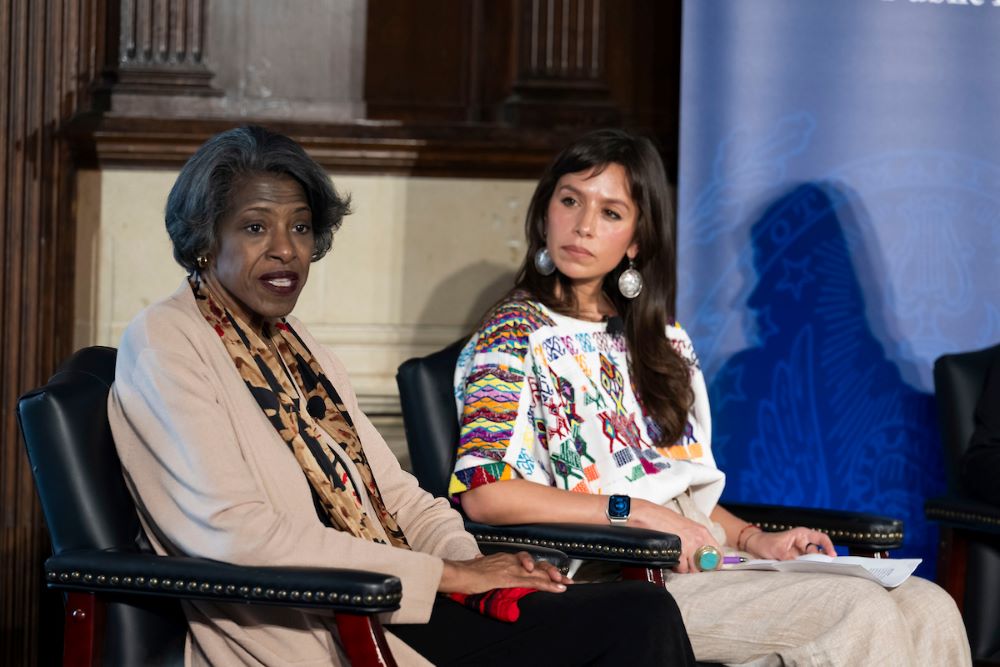
Cynthia Bailey Manns (left), director of Adult Learning at St. Joan of Arc Catholic Community in Minneapolis, speaks at a Georgetown University panel March 9 while Joanna Arellano-Gonzalez, co-founder of the Coalition for Spiritual and Public Leadership, listens. (Georgetown University/Lisa Helfert)
Arellano-Gonzalez' skilled leadership with CPSL helped catalyze a massive Catholic outpouring in support of Chicago migrants suffering from ICE's Operation Midway Blitz. The huge Catholic response was due in no small part, Arellano-Gonzalez observed, to the many female organizers who succeeded because their communities trusted them. Yet looking at women's roles in the church, she said, "The reality is that women make up more than half of the church, but for so long, women's voices and leadership have been unexplored, silenced or 'invisiblelized.' " She said "where the Holy Spirit is moving us is a mass movement of women leading, preaching, organizing where women's work is uplifted, where women's homilies are heard, where women have critical decision-making roles in co-creating the church that they want."
Wakahiu praised the leadership of Catholic sisters on behalf of the common good around the world: "Go to the tea farms in India where no one knows that Catholic sisters are there. Go deeper in Ukraine where conflict is raging. They are there. Go to South Sudan where it's very difficult. They are there." In February Dominican Sr. Lucía Caram organized and led a humanitarian convoy of 21 vehicles carrying medicine, health equipment and other supplies from Barcelona to Ukraine. The convoy also accompanied Ukrainians returning home after receiving medical treatment. "This is the field hospital," Wakahiu said simply.
While inspired by Francis' legacy of appointing women to leadership in the Vatican, Wakahiu also lamented the "many cultural barriers that prevent women from advancing in those positions ... not just at the vertical level, but sometimes in the local diocese." She too acknowledged that "there is so much to be done but we are on the right path."
For Manns "the biggest obstacle is that still we have an unwillingness to admit the fact, the truth that women's baptism is not inferior to men's baptism and that women image Christ in their baptism." As a result, she says, many women experience "a serious, deep spiritual wound because there are systems and processes and beliefs and practices in place where women feel constrained in honoring their gifts and charisms and callings to be a part of the people of God."
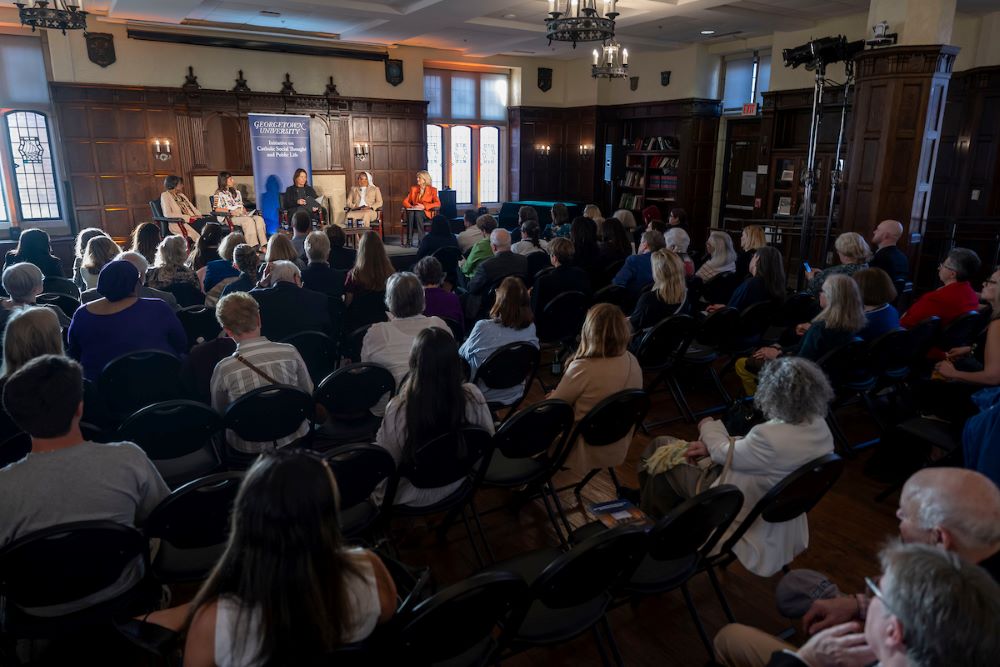
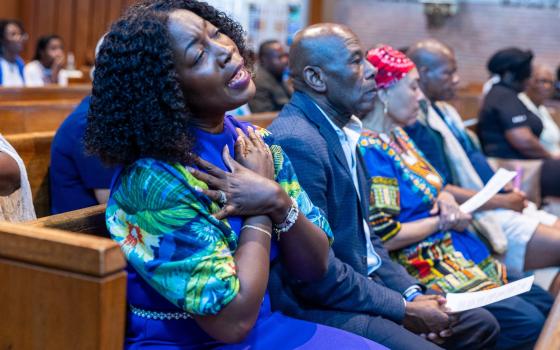
Audience members listen to the panel discussion "Catholic Women's Leadership to Advance the Common Good" at Georgetown University March 9. (Georgetown University/Lisa Helfert)
Manns' St. Joan of Arc community is only two blocks from the site of George Floyd's murder and the murders of Renee Good and Alex Pretti. St. Joan's draws people from over 200 zip codes and is known as "a social justice parish," with many ministries serving people on the margins. The parish has also been part of a Minnesota Council of Churches coalition formed at the time of Floyd's death to "take care of each other." As a result, said Manns, "When ICE came to Minneapolis and St. Paul, we were ready. And so everybody activated their coalitions, their partnerships, ramped up their ministries and got to work."
Manns' role at the parish is to tend to the spiritual foundation of volunteers and staff. "My piece was to make sure that we were always grounded, and as much as possible, centered in our relationship with God ... and to make sure we're serving from that centered place of healing, reconciliation and gratitude and joy." During Lent, she said, the parish starts its Masses "with breath work and silence to bring ourselves together in that spiritual space and then discern together how to go out and serve."
In response to Daniels' closing question "Where is women's leadership going in the coming years and how can women exercise leadership right now?" panelists urged women to be proactive and not to be afraid to do what they are called to do.
"I would say don't wait to be asked," Thompson said. "If you see a need and you think you can help, do it."
Arellano-Gonzalez advised, "If something doesn't exist, go start it with a few friends, speak up, take up space. In 2015 and 2016 when I was sharing this idea of Catholic-rooted organizing and CSPL, several men scoffed at me saying, 'That's not possible.' And now I'm here talking about our work. So yes, you can."
Advertisement
Manns said it is important to encourage young people "to find, discern what is yours to do based upon your gifts and skills and talents ... and go out and do that work with joy."
Wakahiu recalled this sage advice from her mother: "When you find a roadblock, it doesn't mean that you cannot go to where you need to go. It only tells you to take a different direction to get to where you're going or take a detour."
Paragraph 29 of study group five's detailed synthesis report offers a possible way forward: "It is also important that theology and canon law explore new forms of exercising authority grounded in the Sacrament of Baptism and distinct from those deriving from Holy Orders, so that adequate canonical forms may be found to make effective the participation of women in roles of leadership within the Church."
This is all well and good. It is also a clear detour around the "roadblock" of the Vatican's current interpretation of who may and may not be admitted to Holy Orders.
Despite the powerful charisms bestowed upon women leaders like Daniels, Arellano-Gonzalez, Manns, Thompson and Wakahiu, it is no secret that women leaders face significant obstacles in exercising their God-given gifts within the church. Could it be because our governance structure — with rare exceptions — relies exclusively on ordained men? To its credit, the study group 5 report sharply criticized clericalism and male chauvinism.
A recurrent refrain from each woman on the Georgetown panel was "We have a lot of work to do."
Indeed.
And so do our churchmen.