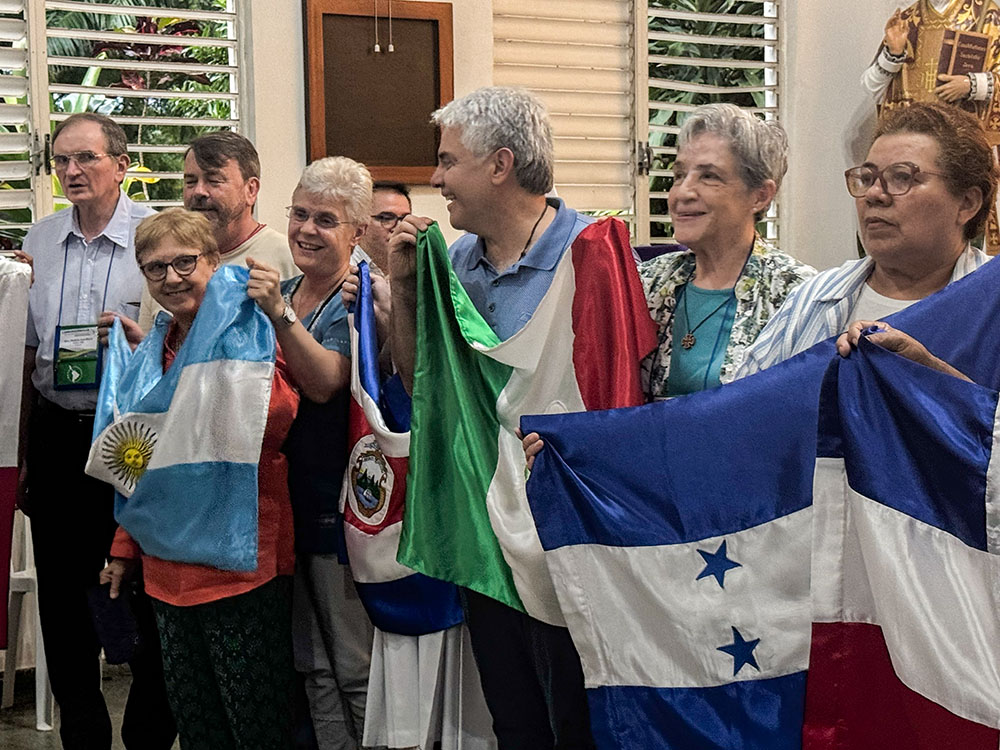
Members of the Confederation of Latin American and Caribbean Religious hold flags from various Latin American countries as they sing in a chapel during a board meeting March 21, 2026, in the Dominican Republic. CLAR affirmed its commitment to the process that Pope Francis called "walking together," or synodality. (GSR photo/Rhina Guidos)
by Rhina Guidos
Leaders of the religious conferences of Latin America and the Caribbean reaffirmed their commitment to the process of listening, discernment, and participation among the laity, religious and prelates to bring to fruition what Pope Francis called "walking together," or synodality.
"We have to rescue it and keep it moving forward, give, as they say, a little push" to the process, said Piarist Fr. Ricardo Alberto Sola, president of the Cuban Conference of Men and Women Religious, speaking about the process of synodality during a meeting of the executive board of the Confederation of Latin American and Caribbean Religious (CLAR). The meeting was formally held March 19-23.
Some CLAR members and presenters who spoke to the group during the gathering in the Dominican Republic voiced concerns that the implementation of synodality is not moving forward — or if it is, its progress is marginal and peripheral.
The gathering of presidents and general secretaries of the 21 conferences that make up CLAR used the process called "Conversations in the Spirit," small groups that listened to a question, entered into moments of silence, then participated in a discussion that, in some cases, yielded discussions about power dynamics, culture and structures in the church.
Such conversations were used at the Vatican during the 2021-24 global synodal consultation process in the hope of promoting synodality throughout the church.
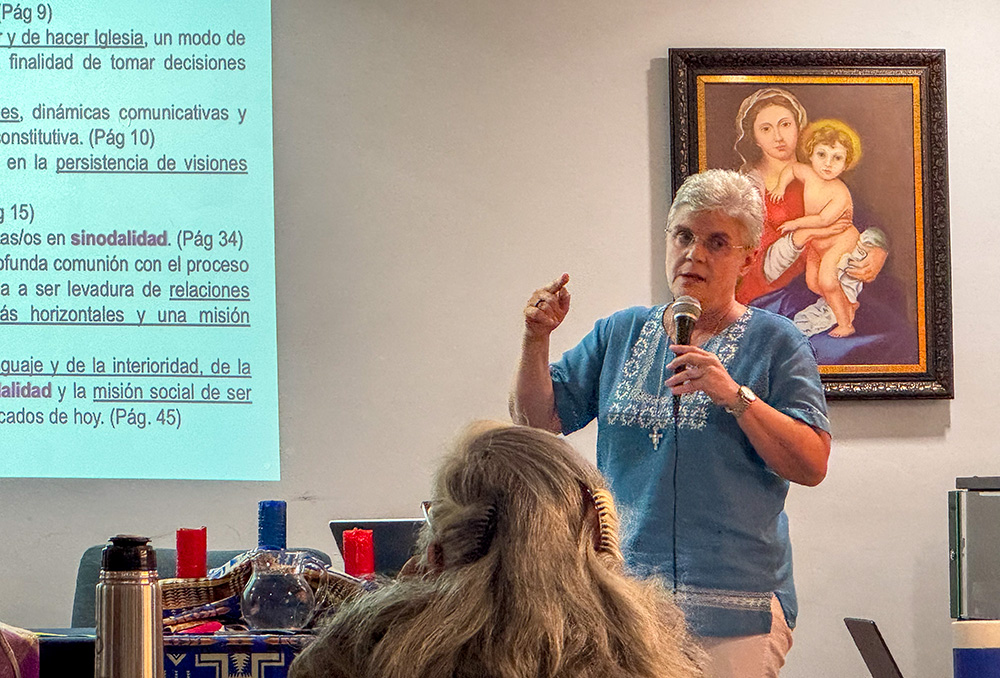
Sr. Daniela Cannavina, a Capuchin Sister of Mother Rubatto, talks about the importance of synodality March 21, 2026, with members of the board of directors of the Confederation of Latin American and Caribbean Religious, gathered in the Dominican Republic. Cannavina said the process of listening, discussion and action inherent in synodality "is the way forward" for the church. (GSR photo/Rhina Guidos)
Although consecrated life in Latin America has participated in the process alongside other groups — such as the Latin American and Caribbean Episcopal Council (CELAM), a body of bishops — "that participation is not enough," said Sr. Daniela Cannavina, a Capuchin Sister of Mother Rubatto from Argentina. As CLAR's general secretary from 2020 to 2024, Cannavina was one of the first women in the history of the church to participate in a global synodal process. Since then, she has become one of the leading advocates for synodality in Latin America.
And she is not the only one.
"The process of synodality within religious life must be CLAR's top priority," said the organization's president, Missionaries of the Holy Spirit Fr. José Luis Loyola, who is also head of the Conference of Major Superiors of Religious in Mexico. "That is where we must place our emphasis and reexamine everything."
For Cannavina, Loyola and other women and men religious committed to synodality, the process of walking together is key to reforming church structures.
In welcoming participants to CLAR's 2023 IV Latin American and Caribbean Congress on Religious Life in Bogotá, Colombia, Company of Mary Sr. Liliana Franco Echeverri, then president of the organization, said that "our structures are in urgent need of renewal," because "there are structures that suffocate and ways of proceeding that deny what is human."
Those structures produce a discouraging sense of failure, and in some cases their power has been used to control and pigeonhole, she added. The need for their renewal is evident due to the "horror of our abuses," she said, which have denied others their dignity and diminished faith and joy.
At that 2023 meeting, Benedictine Sr. Maricarmen Bracamontes offered a reason for why structures need to change, recounting the case of a group of sisters who were tasked with running a listening center for potential victims of abuse in a diocese. As part of their work, they presented three cases of alleged abuse to the bishop.
"There was more care for the perpetrator than for the victim, and since it was among themselves — then that's where it stopped," the Benedictine sister said in 2023 regarding the prelate's lack of action, adding that the sisters ended up resigning from the center.
Loyola, who has followed in Franco's footsteps and whose presidency continues the vision of change, seeks to offer CLAR's 150,000 members a path forward in this process.
Advertisement
In a document titled "Be Born Again," published in late 2025, the organization acknowledged that even among its own members there are those who fear change. But the church must break with traditional patterns, the document says, and proposes listening, participation and action as a way forward.
"This is not a time for fear, nor for indifference," CLAR said in the document. "It is time to assume our historical responsibility, to set out on the journey, to go out to meet others, to embrace just causes, to build bridges of peace, and to sow hope where there seems to be no future."
CLAR's members live in a region struggling with the exploitation of people and resources, environmental degradation, criminal gangs and drug cartels, high unemployment, climate change, autocracies, democracies under attack, and an exodus of people fleeing those conditions.
When asked to write down what was in her heart during the 2026 meeting in Santo Domingo, Sr. Graciela Laino, of the Auxiliary Parish Sisters of Santa María, wrote: "uncertainty and hope."
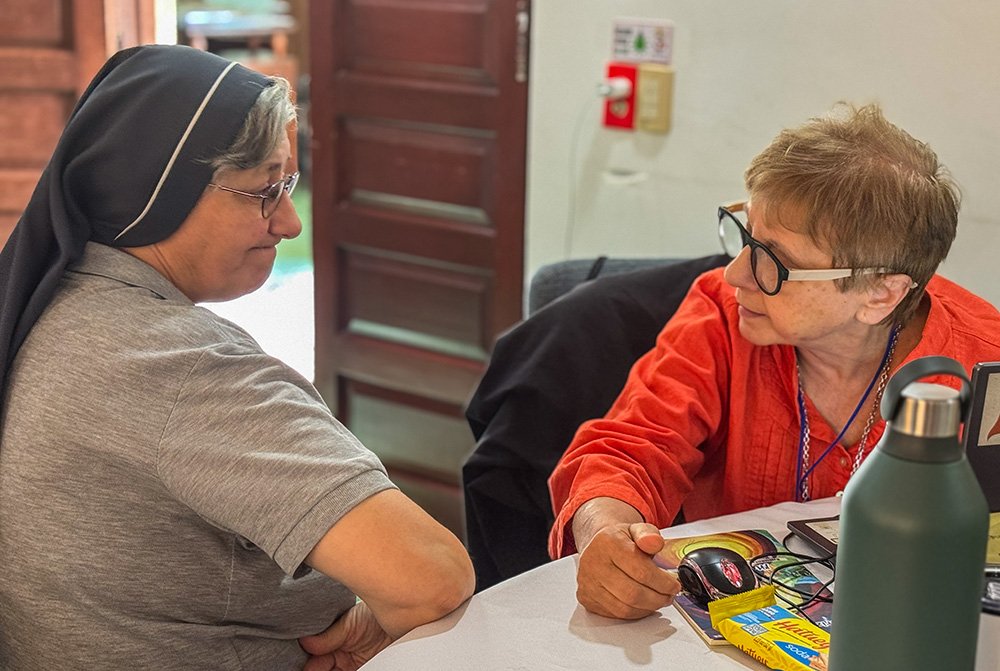
Sr. Graciela Laino, of the Auxiliary Parish Sisters of St. Mary, right, talks with Sr. María Inés Castellaro, general secretary of the Confederation of Latin American and Caribbean Religious and a member of Hermanas de la Virgen Niña, during a meeting in the Dominican Republic March 21, 2026. (GSR photo/Rhina Guidos)
In her 47 years as a sister, Laino said, she has seen many changes and, like a lot of women and men in religious life, rapid adaptation. She told Global Sisters Report that when she began her life as a sister, she never imagined working with congregations other than her own — something she now regularly does to meet common goals — or the rapid and monumental social challenges faced by the communities she serves.
In CLAR's most recent document on religious life, "Be Born Again," which draws on the Biblical figure of Nicodemus, she finds a model to follow.
Nicodemus was a Pharisee, a cultured Jew, who knew a great deal about the law and the prophets, Laino explained, but there came a time when all those things he knew no longer worked, and Nicodemus began to pay attention "to that Jesus of Nazareth."
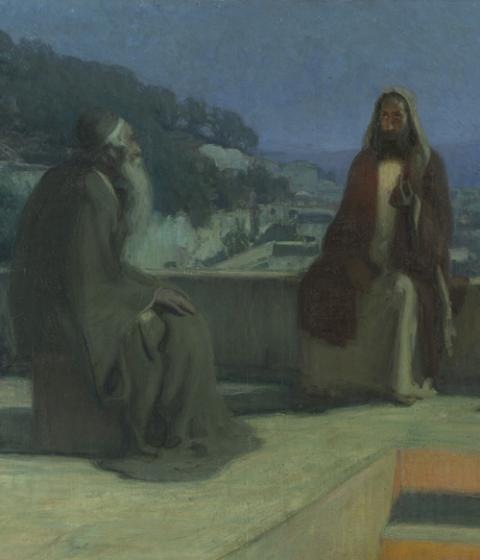
"Nicodemus," detail of an 1899 painting by Henry Ossawa Tanner (Pennsylvania Academy of the Fine Arts)
Just as Nicodemus found himself speaking with Jesus during the night, a moment of darkness, religious men and women, facing various types of nights or moments of darkness — including diminishing numbers of members in their congregations or the difficult social problems facing Latin America — religious life, too, must begin to speak with Jesus, she said.
"As it pertains to us, who are accustomed to walking with Jesus — or at least try to — [in the form of the people they serve], there comes a time when our answers are no longer useful. So, like Nicodemus, during the night we must speak with Jesus, speak with our brothers and sisters and what they face, and seek to be born anew to proclaim the good news," said Laino, executive secretary of the Conference of Religious of Argentina.
Remaining in the dark, remaining in the midst of problems or challenges that religious men and women may not fully understand, is not an easy situation, Loyola admitted during Mass with the group on March 19, the feast of St. Joseph.
Among CLAR's members, some were unable to return to their home countries because the government would not allow them to enter again; others had not attended previous CLAR meetings due to security concerns during travel; still others were facing several and severe crises — lack of food and electricity — in the countries where they serve their missions.
'We, too, are invited — like Joseph — to face the nights we are living through, in our congregations, in our church, in this global landscape that is truly dark and quite chaotic.'
—Holy Spirit Fr. José Luis Loyola
But CLAR is committed to accompanying them, Loyola said, and to continuing to encourage them in their mission.
"Our board of directors is very focused on this process of synodality, which has to do with being born anew, with this invitation from the Spirit that touches us deeply to undergo processes of transformation," Loyola said during his homily. "It seemed to me that Joseph sets a beautiful example for us because Joseph, too, faced a night filled with many uncertainties."
Joseph entertained thoughts of fleeing, of divorcing Mary when she said she was pregnant with Jesus, thinking that God was asking too much, Loyola said.
"He was a good person, a just person, but the Spirit asks him for more, that more that goes beyond mere compliance. What the Spirit asks, in the midst of the night, is for confidence, for space so God's dream can be fulfilled," Loyola said.
"I believe that we, too, are invited — like Joseph — to face the nights we are living through, in our congregations, in our church, in this global landscape that is truly dark and quite chaotic. Like Joseph, let us not flee, but let us stay. And in that sleep, in those deep dreams where God reveals himself, we have the opportunity once again to become guardians of life, guardians of the memory of Jesus."