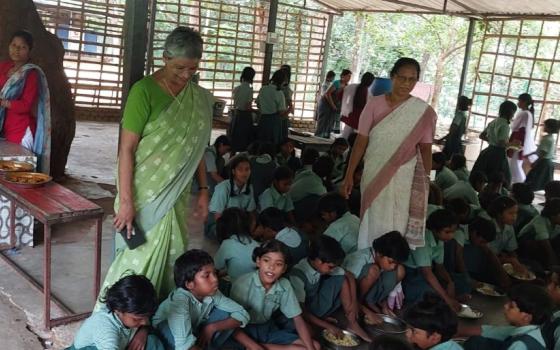
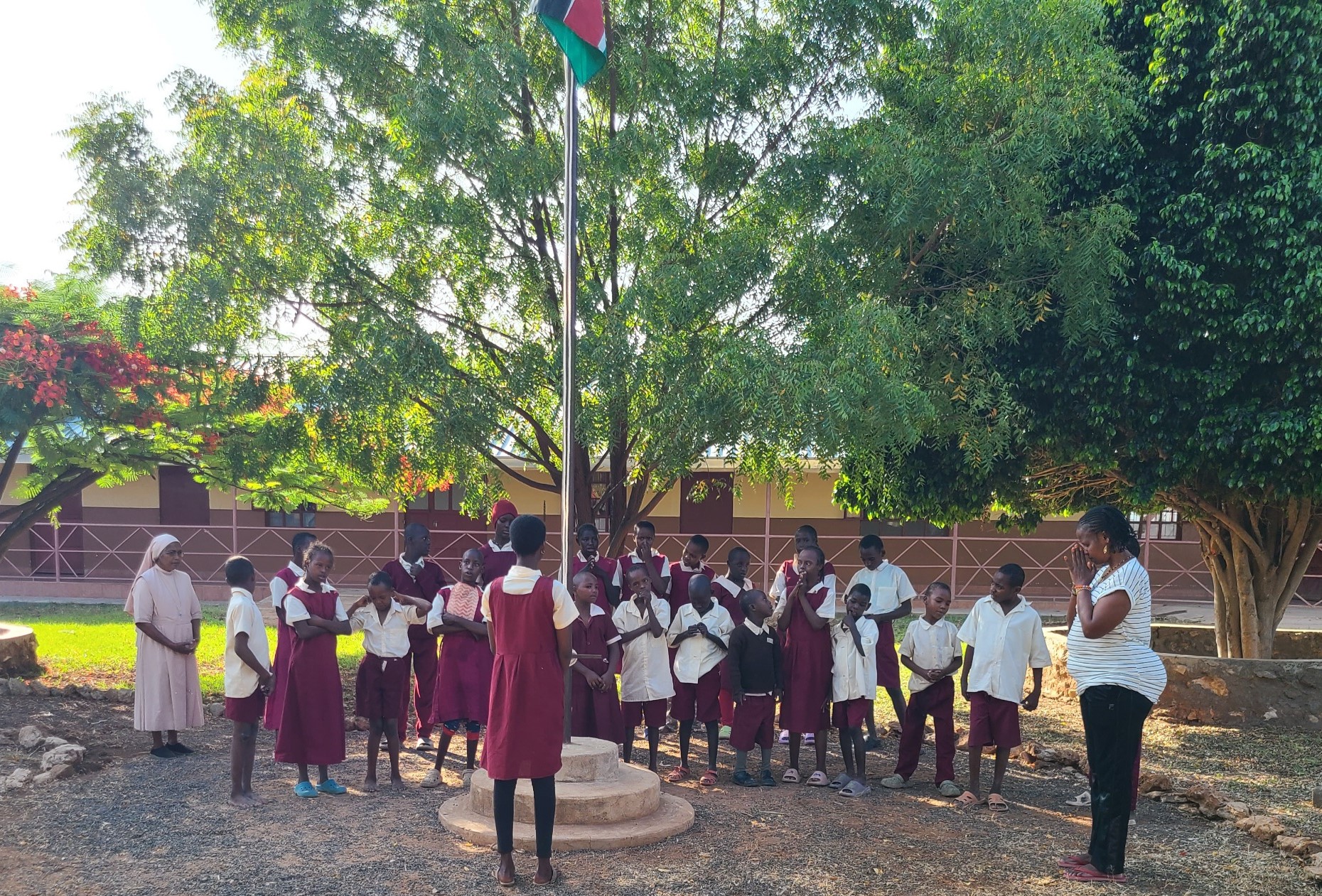
Children of the Divine Providence Home in Isiolo, Kenya, attend an assembly meeting with their teachers. Nirmala Dasi Sisters run the center, which focuses on children with mental disabilities who may also have physical disabilities. (Mourine Achieng)

by Mourine Achieng
Life unfolds slowly but steadily under the scorching sun of Isiolo. Barefoot, lively children guide small herds of goats along the outskirts of the town. Older men sit under trees chattering while playing Mancala. Women, busy with daily chores, are hardly seen.
It's in this pastoral community setting that the Diocese of Isiolo unraveled an unsettling truth about the cruelty towards children with disabilities decades ago. They then invited the Society of Nirmala Dasi Sisters to help with the situation.
In Isiolo, disability is perceived as evidence of divine punishment, ancestral displeasure or wrongdoing by the parents, especially the mother. Children with disabilities are often neglected, hidden and killed as they are seen as a curse in their families and communities.
While attitudes are gradually changing through education and awareness, long-standing beliefs still contribute to stigma against children with disabilities. Sr. Theresa Puthur, the administrator of the Divine Providence Home, told Global Sisters Report of a recent incident where community members tried to convince a mother to kill her disabled newborn. They believe that if a child grows up to their parent's waistline, one of the parents will die. Luckily, the family didn't succumb to the myth.
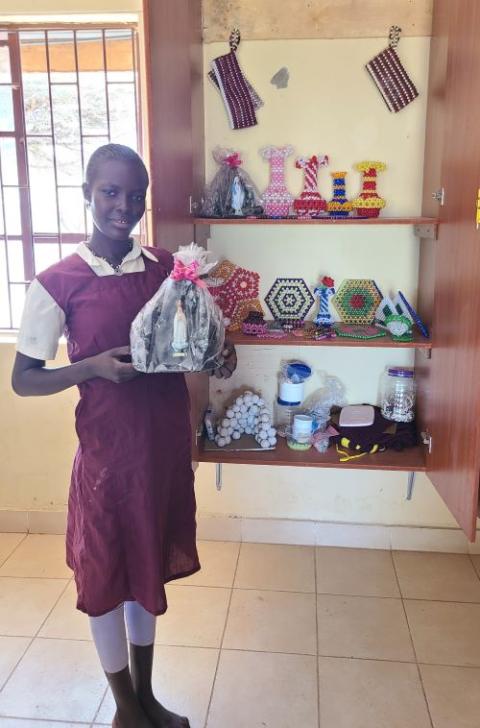
A child holds a miniature grotto of Our Lady of Lourdes that she made at the Divine Providence Home in Isiolo, Kenya. (Mourine Achieng)
Pathur explained that in pastoral communities, children are expected to contribute to household labor, such as herding. Therefore, a child requiring additional care can be considered as bringing hardship rather than support to the family. Some parents refer to children with disabilities as "the useless ones," she said.
According to Pathur, this explains why some parents bring their disabled children to the Divine Providence Home without a uniform or supplies, claiming that they forgot, yet still shopped for their other children's back-to-school supplies. The rehabilitation center also serves as a boarding school, and there have been several instances in which parents "forget" to pick up their children when the school closes.
The center focuses on children with mental disabilities who may also have physical disabilities. Due to negligence at home, many children lack self-care and hygiene skills. Therefore, the sisters train them in buttoning, toileting, dressing, nasal hygiene, eating and bathing. They then move on to cleaning their clothes, utensils and dorms. Social and communication skills are part of their program.
The sisters' efforts are evident. "The children are now helping their parents with house chores over the holidays, and they're elated," Pathur said with a smile.
The rehabilitation center also trains children in beadwork. They learn to make rosaries, table mats, pen holders, flower vases and women's purses. Pathur said that some of the children are very creative. Once they see a model design or a picture, they create the same, if not a better one.
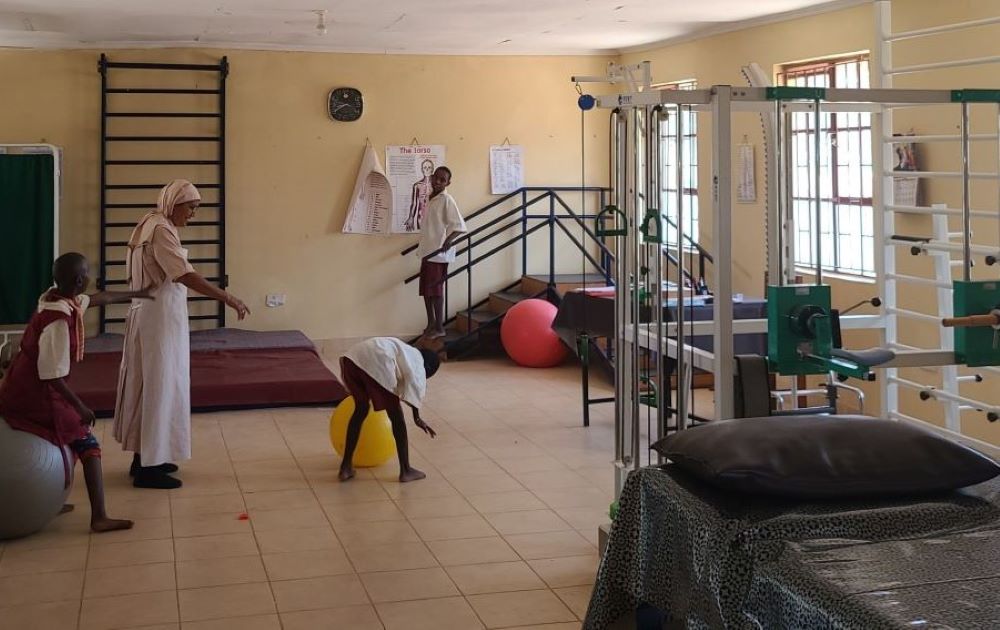
Sr. Roslin Thalakkotture works with children during a physiotherapy session at the Divine Providence Home in Isiolo, Kenya. (Mourine Achieng)
Pathur told GSR that through consistent physiotherapy sessions, three of the children can now walk. However, some parents don't continue these training sessions when their children come home. Therefore, their legs grow weaker, and essentially negate the physiotherapist's work. Furthermore, some parents discontinue the children's medication over the holidays, affecting their progress.
A few miles from the Divine Providence Home is the Alakara Home for Physically Challenged, another center and boarding institution run by the Nirmala Dasi Sisters. (Alakara means "happy" in the Turkana language.)
Children at the Alakara center attend classes at a day school and return to the boarding facility afterward. Sr. Sheeba Maliekal, who is in charge of the home, said that some children come back during break or lunchtime to have their diapers changed.
At the end of the school term, the children go home for the holidays. The center also schedules a visiting day before the end of the term. However, Maliekal noted that some parents neither show up nor call their children. This leaves some children hurt and can often trigger anger, making them prone to fights, she said.
Advertisement
According to Maliekal, children are enrolled in pre-primary one when they are 9 to 11, considerably older than usual, as an 11-year-old would typically be in grade five. This delay is largely due to parents bringing their children to the center well past the standard enrollment age. Despite starting school late, most children at the center go on to complete their studies through high school and attend technical institutes, colleges or universities.
The sisters' center in Alakara has produced several teachers, lab technicians, information technology professionals, artisans and tailors. Notably, one of their children graduated in information and communication technology in 2025 from Kabarak University. Another graduate with cerebral palsy ran for office in Isiolo in the previous general election.
The sisters not only meet the children's educational needs but also support those who need corrective surgery. They provide medical and physiotherapy care for the children. After corrective surgery and regular physiotherapy, some children can use their hands or walk.
Thanks to the sisters in Isiolo, children with disabilities can live with dignity and hope. Children once neglected and hidden away by their families are learning to care for themselves and gradually gaining independence. What once seemed like a bleak future is now illuminated by the promise of education, helping to reshape community perceptions of children with disabilities.