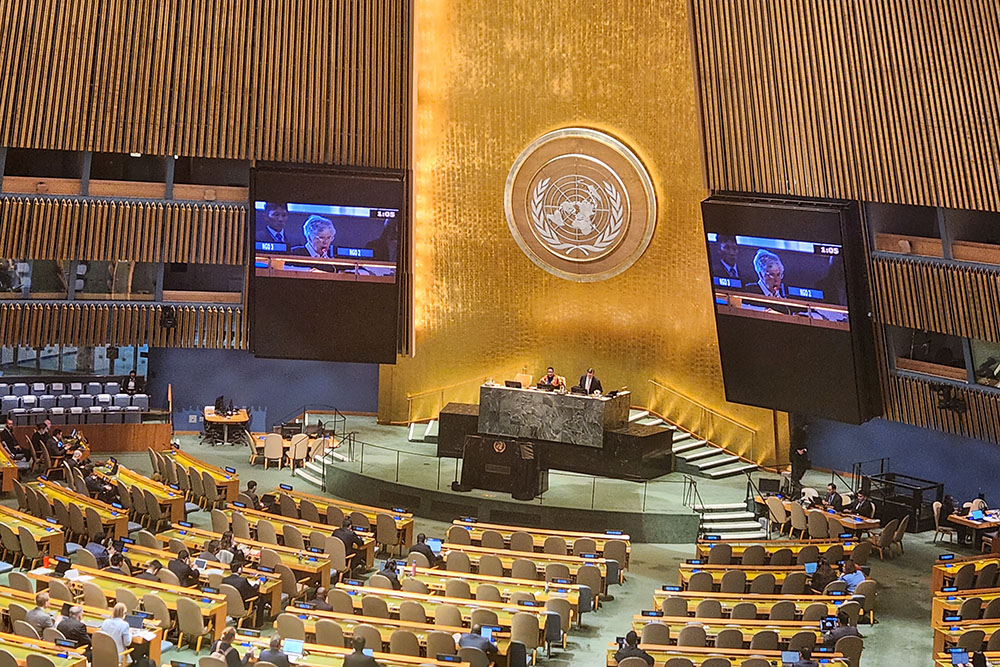
Dominican Sr. Carol Gilbert, longtime anti-nuclear activist, is seen on screens at the United Nations General Assembly Hall on May 1, 2026, delivering prepared remarks on the need to support the 1970 Treaty on the Non-Proliferation of Nuclear Weapons on behalf of 109 religious groups. (GSR photo/Chris Herlinger)

Sister congregations are adding their names to calls at the United Nations for a renewed commitment to curb the spread of nuclear weapons.
In a statement read publicly during the first week of a monthlong review conference of the 1970 Treaty on the Non-Proliferation of Nuclear Weapons, or NPT, 109 faith groups, including more than a dozen sister congregations, called on political leaders "to reaffirm the spirit of the NPT as an urgent and binding commitment."
"Fifty-six years after the entry into force of the NPT, the treaty's most fundamental commitment remains unfulfilled," said Dominican Sr. Carol Gilbert, a longtime anti-nuclear-weapons activist, speaking at the U.N.'s General Assembly Hall in New York May 1 on behalf of the faith groups. The review meetings run from April 27 to May 22.
"We see the NPT unraveling and a proliferation crisis brewing," Gilbert said. "All nuclear-armed states are modernizing their arsenals with new delivery systems and doctrines that lower the threshold for use. The moral authority of the treaty depends upon the credibility of the disarmament commitment. That credibility is now in crisis."
Most of the organizations signing on to the statement are Christian, but across a spectrum of largely Catholic, Protestant and Anglican groups, as well as interfaith organizations. Among the Catholic organizations are global members of Pax Christi and some 20 congregations of women religious, including multiple congregations affiliated with the Dominicans and Sisters of Charity.
The statement read by Gilbert said that those holding "power today do not fully grasp how near we have already come to nuclear war."
The declaration argued that underlying the current situation "is a spiritual crisis rooted in the normalization of violence and war as instruments for resolving conflict between peoples and nations."
The statement said: "When armed force is treated as a first resort, when military spending eclipses investment in human development, when entire populations are taught to accept the threat of annihilation as a condition of their security, our moral imagination has failed.
"We affirm that genuine security is built on justice, on mutual care, on the recognition that no nation's safety can rest on another nation's annihilation."
The United Nations' Office of Disarmament Affairs calls the 1970 Non-Proliferation Treaty "a landmark international treaty" that was designed "to prevent the spread of nuclear weapons, to further the goals of nuclear disarmament and general and complete disarmament, and to promote cooperation in the peaceful uses of nuclear energy."
The treaty, the U.N. said, is "the only binding commitment in a multilateral treaty to the goal of disarmament by the nuclear-weapon states" and is regarded as a cornerstone in efforts to end the proliferation of nuclear weapons.
Advertisement
Acceptance of nuclear use called 'spiritual sickness'
In a longer written statement entered into the proceedings' official record, the faith groups said that the "acceptance of apocalyptic violence as the final arbiter of disputes among nations is not simply a strategic posture. It is a spiritual sickness — one that every faith tradition we represent has named, lamented and called its followers to resist."
In specific actions, the statement calls for nations to recommit to verifiable reductions in nuclear weapons with a moratorium on new warhead development, with a return to negotiations that includes all nuclear-armed states, including the United States, which was one of the first nations to sign and ratify the treaty.
As an example of the continued uncertainty surrounding nuclear weapons and war, Gilbert said in an interview that it is not clear if the United States and Israel have ruled out using a nuclear weapon against Iran. "We don't know with [President Donald] Trump what's on or off the table," she said.
Gilbert noted that according to the Bulletin of the Atomic Scientists, "We are at 85 seconds to midnight," citing the bulletin's "doomsday clock," which the bulletin said is now the closest the clock "has ever been to midnight in its history."
Gilbert told GSR that the present moment "is the closest we have ever been to using nuclear weapons." She noted one looming challenge is the danger artificial intelligence poses to military operations.
Other issues, Gilbert argues, include that "many in powerful positions continue to support the arms industry and all those who make billions on these 'forever wars.' "
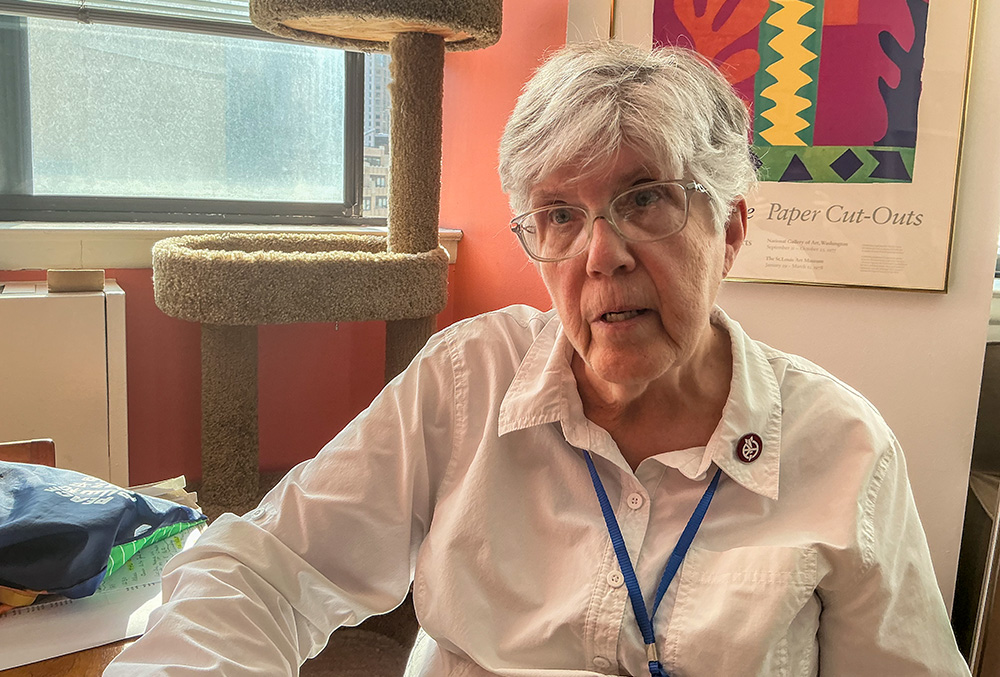
Dominican Sr. Carol Gilbert, longtime anti-nuclear activist, speaks during an interview. (GSR photo/Chris Herlinger)
With U.S. spending on arms significantly higher than any other country in the world, "we continue to rob the poorest around the world as the money is taken from social programs, healthcare, education and childcare," she said.
Responding to the review conference and to the overall state of nuclear weaponry in the world, Mary Yelenick, the main representative of Pax Christi International at the United Nations, told GSR that the "nine nations that presently possess nuclear weapons seem to enjoy holding the planet hostage to their will."
She added: "They seem to view the NPT not as a binding legal document, but as a pesky impediment to their own national policies. They count on obfuscation, and employ responsible-sounding language, such as 'deterrence,' to justify their murderous positions."
Yelenick, who is an American, was particularly critical of the United States, citing the fact that the United States "not only possesses nuclear weapons," but is the sole country that "has actually used them — murdering countless people, and irradiating multiple generations and lands through the development and use of those weapons."
She noted that the United States used two nuclear weapons in Japan at the end of the Second World War and later tested them on U.S. and non-U.S. lands.
Annemarie O'Connor, the representative to the United Nations for Passionists International, attended the May 1 meeting at the U.N. She told GSR that given current global tensions, adhering to the Non-Proliferation Treaty is important for the whole of humanity and the planet.
She also acknowledged that despite the review meetings at the United Nations, the issue of nuclear perils is not high on the global agenda, either for nation states or the media. "But we have to respond to this," she said. "It's urgent, and really important."