(GSR graphic/Olivia Bardo; CNS/Vatican Media)

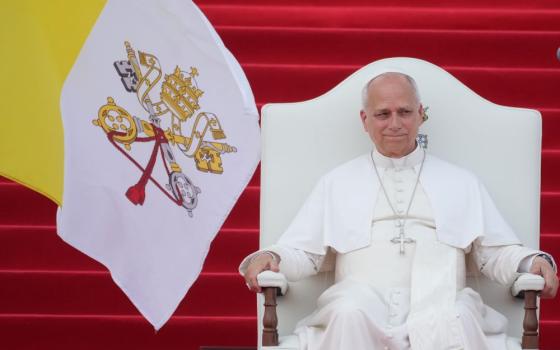
American sisters with long experience as peace and justice advocates say they have an ally in Pope Leo XIV, saying that with one year into his papacy, they feel he supports their hopes, ministries and advocacy.
They told Global Sisters Report that while Leo's public style is more deliberate and more cautious than Pope Francis', Leo has continued his predecessor's commitment to the issues they champion in their ministries, such as war and peace, disarmament and the protection of the environment.
Regarding the pope's declarations on war and weapons, longtime anti-nuclear activist Dominican Sr. Carol Gilbert said "he's terrific. He has said some very powerful things."
In a May 1 statement she read at the United Nations on behalf of 109 religious groups, Gilbert expressed concerns Leo has raised in the last year, including "a spiritual crisis rooted in the normalization of violence and war as instruments for resolving conflict between peoples and nations," said Gilbert, who for 40 years has been in and out of jails protesting war and nuclear weapons.
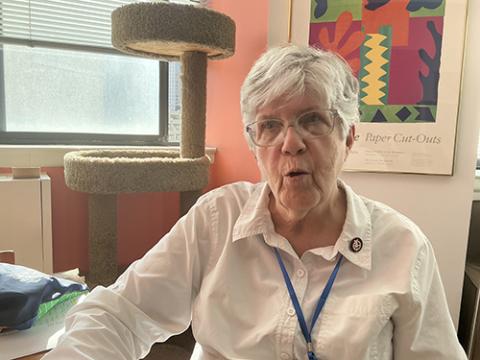
Longtime anti-nuclear activist Dominican Sr. Carol Gilbert (GSR photo/Chris Herlinger)
While recognizing the just war tradition — which was articulated first by St. Augustine, who is the inspiration for Leo's religious order — Gilbert said she believes Leo's consistent message about the U.S.- and Israeli-led war on Iran (that she believes is not morally justified) could likely apply to any war in the future.
She also said that oft-heard arguments about the justification for wars, like World War II, do not apply in the current context, pointing to the possibility of nuclear weapons being used in any conflict in the world now.
"I have great hope that Pope Leo will continue to speak truth to power."
Sr. Eileen Gannon, justice promoter of the Dominican Sisters of Sparkhill, New York, agrees but also has confidence that when speaking about the Augustinian just war heritage, the pope speaks from an appreciation and knowledge of a long tradition.
That sense of continuity extends beyond church history and into the recent papacies, said Sr. Claire Regan, whose activism included participating in peaceful demonstrations against the nuclear arms race in the early 1980s (and who continues protesting today).
"There are so many threads he has continued from Pope Francis," she said.
And in his public statements on the wars in Iran, Gaza, Ukraine, and several African countries, the Sister of Charity of New York said the pope "is speaking directly, clearly and morally on the matters of the day."
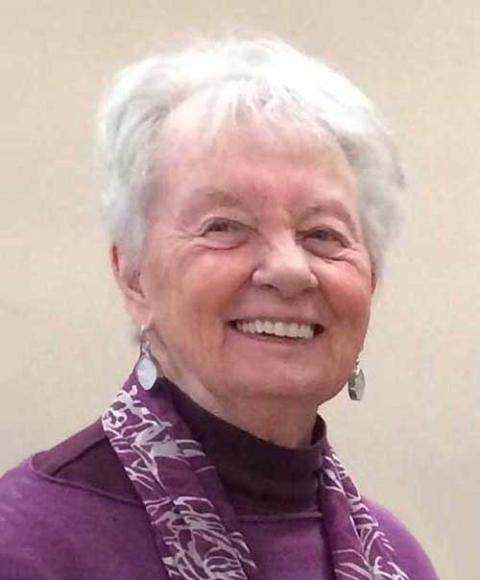
Sr. Eileen Gannon, justice promoter of the Dominican Sisters of Sparkhill, New York (Courtesy of the Dominican Sisters of Sparkhill, New York)
Not partisan, just gospel
None of the sisters interviewed said they felt the pope was being politically partisan in condemning the war on Iran. Rather, they said, he was simply articulating a consistent Gospel-based message.
At the same time, they said they recognize that the gospel is political, and that Leo was speaking of a larger truth than was recognized by Leo's critics — such as President Donald Trump and Vice President JD Vance, who felt the pontiff was taking a partisan political stance in condemning the Iran war.
"Jesus was political," Gannon said, adding that being political "is part of the world we live in" — and was part of the world Jesus lived in. "When I read the Gospel, it's pretty political. It says, 'Feed the hungry. Welcome the stranger.' "
Gilbert, who is currently participating in a United Nations review of the Treaty on the Non-Proliferation of Nuclear Weapons, said she believes that in a world of worsening nuclear threats, Leo has articulated a message that war is no longer viable as a solution to problems.
"War is gone," she said, adding that the pontiff is affirming a belief "that we are a peace church."
"Every time Pope Leo speaks out against the war I think he becomes stronger, and it makes the church stronger," Gilbert said. "He is teaching us how to live the Gospel, which is to love every human being."
In speaking of Leo's critics, Gannon said that the temerity displayed by Vance in criticizing the theological grounding of a pope "who is an Augustinian, who has a doctorate in canon law, was ridiculous."
What is not ridiculous, she said, is that sisters feel supported by Leo on matters of importance to her and her congregation and its Dominican tradition of adherence to truth.
"I feel supported [by him] because this church to which I belong and have for my whole life, the community that I'm a member of, has for many, many years, as long as I can remember, cited justice as our goal and our mission."
Advertisement
A pope who is 'open to dialogue'
Beth Blissman, the Loretto Community's U.N. representative, said Leo's statements on just war theory may be more "centrist" than that of the congregation she represents at the United Nations, which consistently advocates for non-violence. "We need to evolve as a species beyond war," she said.
Still, Blissman said that in contrast to the statements by Trump, Vance and U.S. Defense Secretary Pete Hegseth, the pontiff is offering "a version of masculinity that is not fear-based but Gospel-based."
"He is open to dialogue and is welcoming to all," she said, adding that the pope "stands in sharp contrast to Trump," noting that he "has used the language of human dignity."
Sr. Carol De Angelo, director of the Office of Peace, Justice, and the Integrity of Creation for the Sisters of Charity of New York, said she appreciates how the pontiff has not been shy about "talking about structural sin."
De Angelo, a long-time environmental activist, who believes "it was providential" that Leo was selected as pope, added to that list by praising him for his concern about the challenges and dangers posed by artificial intelligence, saying that that is becoming an issue of increasing concern to members of her congregation.
"He makes you think about the deeper issues; he's taking us to new places," she said of Leo, adding he is "responding to the signs of the times."
"He's holding up what it means 'to be church' right now."