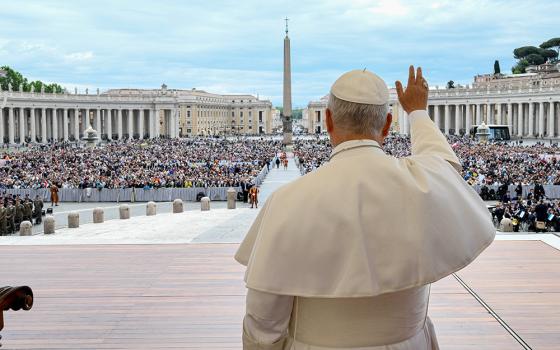
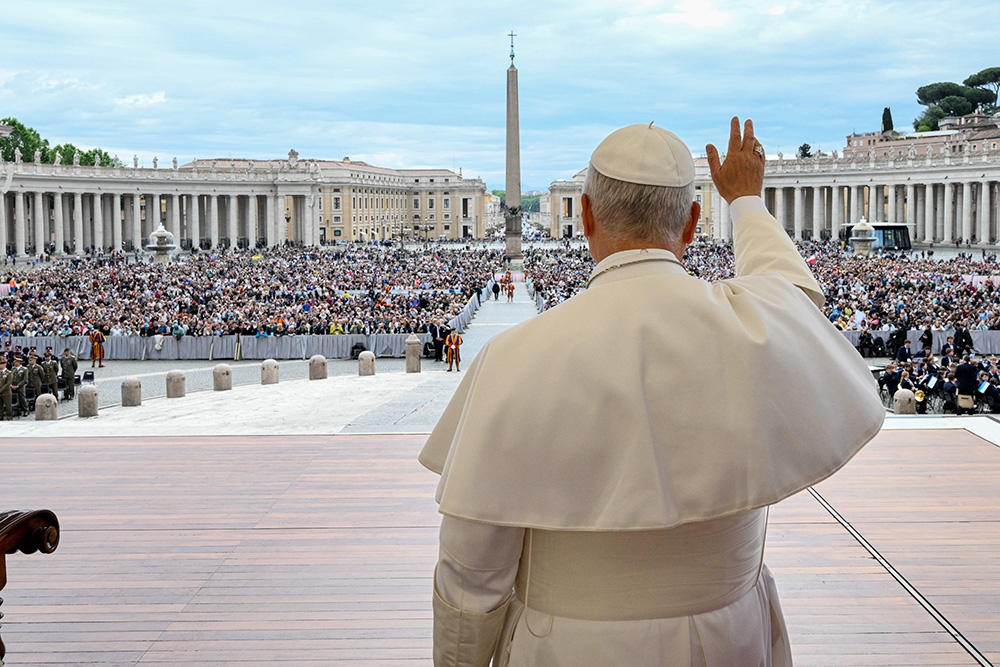
Pope Leo XIV waves to those gathered in St. Peter's Square at the Vatican during his weekly general audience May 6, 2026. (CNS/Vatican Media)

In the last year, Pope Leo XIV has emerged as a towering moral figure offering a message of peace and solidarity that stands in sharp contrast to the language and priorities of many leading political figures, not least the president of the United States.
But in the days, weeks and months following Leo's election on May 8, 2025, it was not immediately clear where his quiet, methodical style of governing would lead the Catholic Church.
Despite the fact that the vast majority of the 133 cardinals who elected Leo were elevated to the College of Cardinals by Pope Francis, it was clear that the electors were not looking for a carbon copy of the late pope. Several cardinal electors told National Catholic Reporter that finding a candidate who could foster unity was a priority in the conclave following Francis' trailblazing, but turbulent, pontificate.
With surprising speed, they set their sights on an Augustinian missionary from Chicago to take the reins of the world's largest church. But in keeping with his mild-mannered character, Leo did not begin his pontificate with bold rhetoric or dramatic gestures.
Even among his closest collaborators, Leo kept many holdovers from the Francis era in place rather than quickly assembling a new circle of trusted advisers who might signal the direction of his pontificate.
Many of the curial changes expected to come early in Leo's pontificate still have yet to materialize: Several dicastery prefects, including Cardinals Michael Czerny of the Dicastery for Promoting Integral Human Development, Marcello Semeraro of the Dicastery for the Causes of Saints, and Kevin Farrell of the Dicastery for the Laity, Family and Life, have long passed the traditional retirement age of 75.
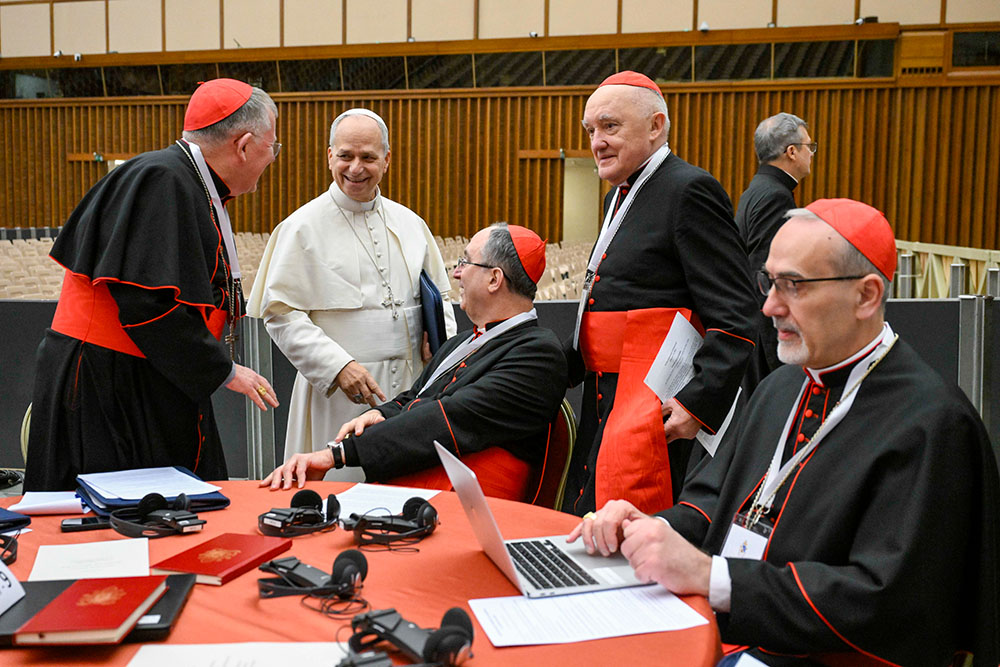
Pope Leo XIV shares a light moment with cardinals Jan. 8, 2026, during a consistory at the Vatican Jan.7-8. (OSV News/Vatican Media/Simone Risoluti)
Leo has not yet created any new cardinals, nor has he published an original major teaching document laying out the theological and pastoral priorities of his pontificate — his apostolic exhortation Dilexi Te ("I Have Loved You") was already being prepared by Francis before his death.
Several issues Leo was expected to address swiftly after his election also remain unresolved. An early meeting with the prelate of Opus Dei, for example, suggested that Leo might act quickly on new norms for the church's sole personal prelature, but a more recent meeting with a critic of the group suggested that the consultation process in determining the organization's statutes is still underway.
In moving slowly and consulting broadly, however, Leo has avoided ostracizing any segment of the church, particularly those that felt on the outs during the Francis pontificate.
"For Francis, it was about breaking new ground," said Massimo Faggioli, a professor of ecclesiology at Trinity College Dublin. "For Pope Leo, it's about keeping that ground walkable."
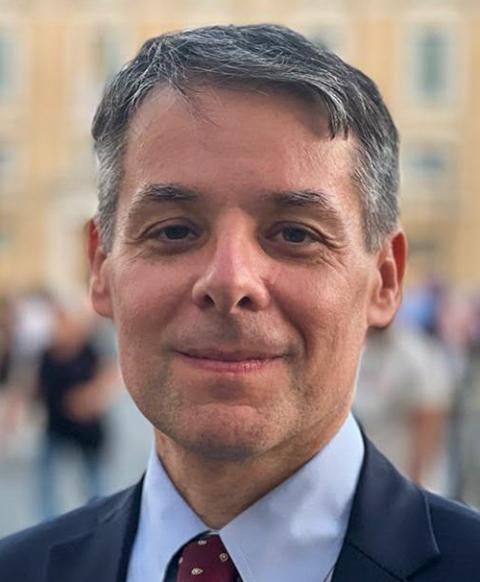
Massimo Faggioli, professor of ecclesiology at Trinity College Dublin (Courtesy of Massimo Faggioli)
Signs gradually emerged showing Leo's pastoral sensibility to be very much in line with that of his predecessor: He called for conversion for those who ignore climate change, encouraged LGBTQ inclusion advocate Jesuit Fr. Jim Martin, and has spoken out against the "inhuman treatment of immigrants in the United States."
At the same time, he has not taken a clear public position on some of the most debated issues within the church, including the fuller inclusion of LGBTQ Catholics, women's ordination to the diaconate or priesthood, and restrictions around celebrating the pre-Vatican II Latin Mass.
That balancing act was evident on Leo's return flight from Africa on April 23, when he was asked about priestly blessings for same-sex couples. Leo said that going beyond the general, informal blessings that were permitted in a 2023 Vatican declaration approved by Francis "can cause more disunity than unity," and added that he would rather focus on "more important issues" within the church, such as justice, equality and human freedom.
On more controversial questions such as women's role in church leadership and inclusion of LGBTQ Catholics, Faggioli explained that Leo's approach has been: "Let's make sure that what has been gained by Pope Francis becomes understood by more people and better, rather than making promises that we cannot keep."
While Leo has avoided reopening some of the church's most polarizing internal debates, his quieter efforts to build a more collaborative culture within the church have begun to take hold.
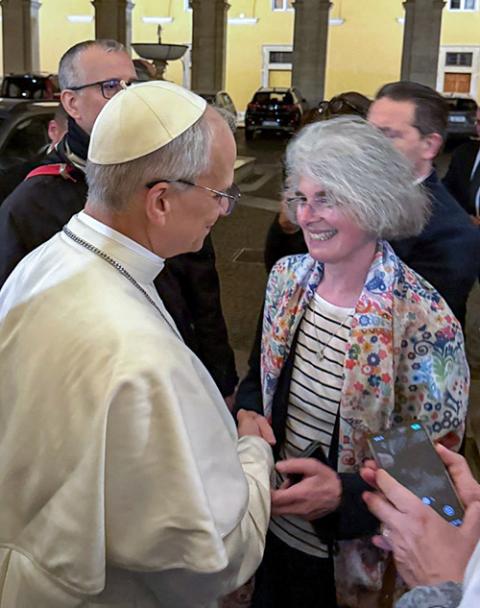
Xavière Sr. Nathalie Becquart greets the newly elected Pope Leo XIV in Palazzo Santo Ufficio, Vatican City, May 8, 2025. (OSV News/Courtesy of Nathalie Becquart)
Xavière Sr. Nathalie Becquart, undersecretary of the Synod of Bishops, said Leo has affirmed the importance of synodality, the catchall term for creating a more listening and participatory church among all its members, "not only in his speeches, but also in his way to lead."
Leo, who participated in the 2021-24 global synodal process both as a diocesan bishop in Peru and as a curial official in Rome, has worked to implement that style of listening and dialogue within the Vatican machinery.
In January, Leo convened the world's cardinals in Rome to discuss priorities for the church's future, seating them at roundtables for discussion in addition to the standard conference hall arrangement, and he announced that he would call yearly meetings of the College of Cardinals.
As a result, the "C9," a small group of cardinal advisers relied on by Francis to discuss key church questions, has been left by the wayside.
Beyond the cardinals, Leo has also called for the heads of the world's bishops' conferences to meet in Rome in October for a meeting on the family.
"He's trying to foster more dialogue among not only the cardinals, but also at the Curia level," Becquart said. "We see that he wants to have more meetings with the head of dicasteries. ... He is taking what has been opened by Francis and is doing it with his own way and style."
Leo's message of unity has also extended to relations with other Christians. His first international trip as pope, planned for his predecessor, fittingly emphasized Christian unity by commemorating the 1,700th anniversary of the Council of Nicaea, which produced the creed still professed by most of the world's Christians.
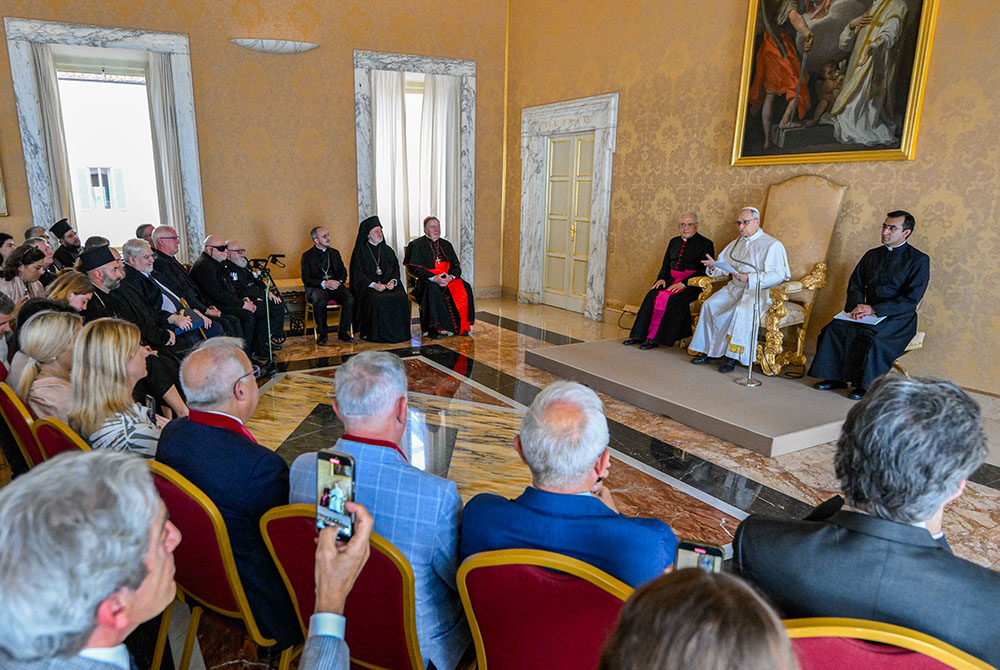
Pope Leo XIV meets with U.S. visitors at the papal villa in Castel Gandolfo, Italy, July 17, 2025. The group, led by Cardinal Joseph Tobin of Newark, New Jersey, and Greek Orthodox Archbishop Elpidophoros of America, was on an ecumenical pilgrimage to Rome, Istanbul and Iznik, Turkey, site of the ancient city of Nicaea. The journey commemorated both the Holy Year dedicated to hope and the 1,700th anniversary of the Council of Nicaea. (CNS/Vatican Media)
And, meeting with Archbishop Sarah Mullally of Canterbury, the first woman to lead the Church of England, Leo stressed the importance of ecumenical dialogue amid the challenges confronting the whole human family.
While Leo has not been openly confrontational with politicians from the pulpit, he has instead quietly supported local church leaders as they have spoken on issues relevant to their own contexts.
In the United States, that has been visible in the increased force with which bishops have spoken out against practices and policies of the Trump administration, including through a rare special pastoral message on immigration issued in November.
"In the hierarchy, there's been an acceptance and gratitude" for the pope's teachings, Cardinal Joseph Tobin of Newark, New Jersey, told NCR. "They understand what Pope Leo says and it can't be dismissed as easily as some people unfortunately dismissed Pope Francis."
The poignancy of Leo's message for the American church was underscored by the direct attack launched against him by President Donald Trump on April 12, shortly after Tobin and two other leading U.S. cardinals appeared in a "60 Minutes" interview criticizing elements of the administration's agenda and citing the pope's messages.
Advertisement
Though Leo had not directly rebuked Trump or his administration, his criticism of the U.S.-Israeli war with Iran brought his peace message into sharper political focus. At the close of his first year, Leo's appeals, which had previously taken on a more general form, had become a concrete challenge to the decisions of political leaders.
"There are central values that I think are propelling him, and the evolution is how he applied these values in concrete situations," Tobin said. "Not only his value for peace, but his understanding of being a peacemaker is one that is certainly manifest."
Despite the increased engagement by Leo in condemning the Iran war, the cardinal stressed that Leo "is not going to react to every issue or question that is put before him."
"He is a pastor before he is a pundit," Tobin said. "He doesn't want to engage in running debates with people."
Beyond the U.S. context, the pope's appeals for peace and solidarity took on particular force during his 11-day tour through Africa, where he was immersed in countries facing deep social, political and economic challenges and issued some of his strongest rhetoric yet on the church's social teaching.
The trip, coming near the close of Leo's first year and under heightened scrutiny after Trump's digital broadside against him, offered insight into how the pope understands the moral role of the papacy. In Africa, Leo largely avoided internal church flashpoints — he did not mention polygamy or wade into debates over liturgical inculturation, two questions that have stirred debate in the church throughout sub-Saharan Africa. Instead, he presented the church as a force for unity capable of pressing governments and ordinary believers to reckon with war, corruption, inequality and the wounds left by colonialism and exploitation.
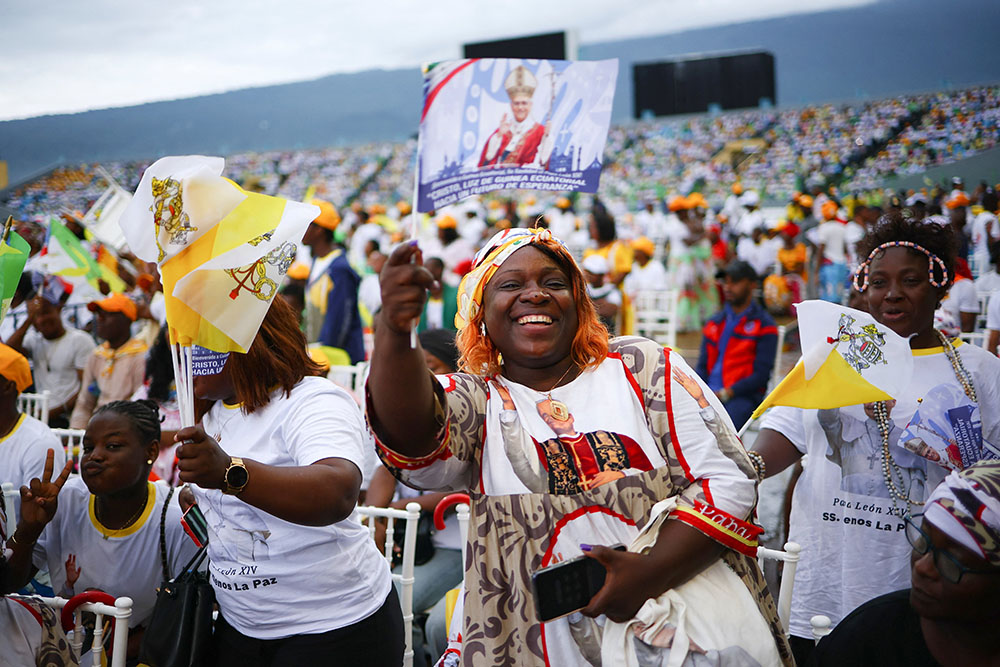
A woman waves a flag with an image of Pope Leo XIV ahead of the pontiff's arrival to celebrate the final Mass of his apostolic journey to Africa at Malabo Stadium in Equatorial Guinea April 23, 2026. (OSV News/Reuters/Guglielmo Mangiapane)
Globally, Leo has made the church's priority mission "to seek peace, to build peace, to foster peace," Becquart said. "And for that you need to start [with] unity, communion, synodality."
Entering the second year of his pontificate, the pope will have no shortage of occasions to advance his prophetic message of unity.
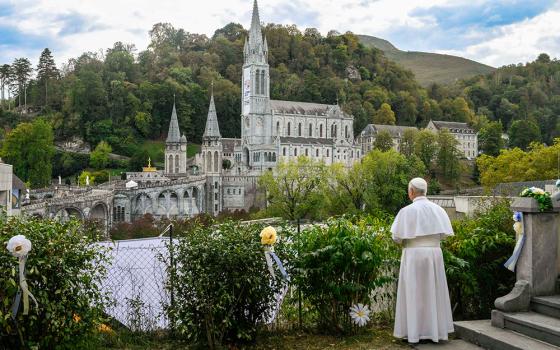
His next international trip, to Spain June 6-12, is expected to touch on polarization within the country's church. Later, Leo is expected to travel to France, where rising conversion rates have often been linked to more traditional forms of Catholic worship.
Shortly thereafter, bishops from around the world will come to Rome to discuss the reception of two of Francis' hallmark initiatives: synodality and Evangelii Gaudium, the document widely seen as the late pope's pastoral vision for the church.
Those public events will unfold alongside quieter but no less consequential decisions within the walls of the Vatican.
Leo has named only two dicastery prefects so far, both relatively low-profile prelates. And after Cardinal Juan José Omella of Barcelona turned 80 on April 21, the College of Cardinals fell below its cap of 120 eligible electors for the first time in years, giving Leo a clear opening to name new cardinals.
For a pope who has opted to keep his cards close to his chest in his first 12 months, the people he taps as his closest advisers may offer a clear indication of where he intends to steer the church in the years to come.
The National Catholic Reporter's Rome Bureau is made possible in part by the generosity of Joan and Bob McGrath.