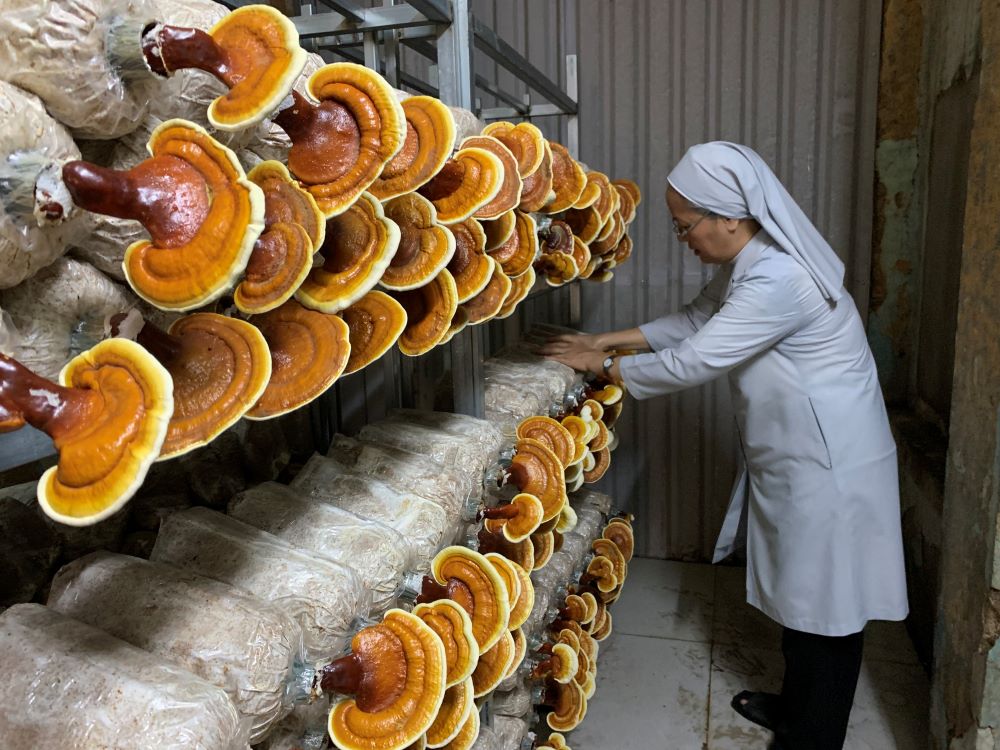
Sr. Marie Nguyen Thi Minh Hoa checks the reishi mushrooms in the growing house she and Sr. Agathe Tran Thi Mong Huyen operate at their St. Paul de Chartres convent in Ho Chi Minh City, Vietnam. This mushroom variety needs six months to grow before harvest. (Mary Nguyen)
Before the heat settles over Ho Chi Minh City, Sr. Agathe Tran Thi Mong Huyen steps quietly into a small mushroom-growing house behind her convent, plastic sandals brushing the damp concrete floor.
Inside the 328-square-foot structure, some 4,000 mushroom-growing bags line iron shelves arranged in neat rows. Fine mist hangs in the air. Next to Huyen, Sr. Marie Nguyen Thi Minh Hoa checks humidity gauges and the date labels tied to each shelf.
Each day, both St. Paul de Chartres nuns spend about three hours tending to the mushrooms, watering them four to five times during hot weather and less when the days are cooler or rainy.
"It's become part of our daily rhythm," Huyen said. "We watch the weather closely. The mushrooms respond immediately."
The sisters began mushroom cultivation in August after a benefactor introduced them to a local company supplying organic mushroom-growing bags. The company provides both materials and technical training.
The sisters cultivate five varieties of organic mushrooms, including abalone and reishi. The project promotes organic farming, which they teach to community members. Mushroom sales also raise money to support scholarships.
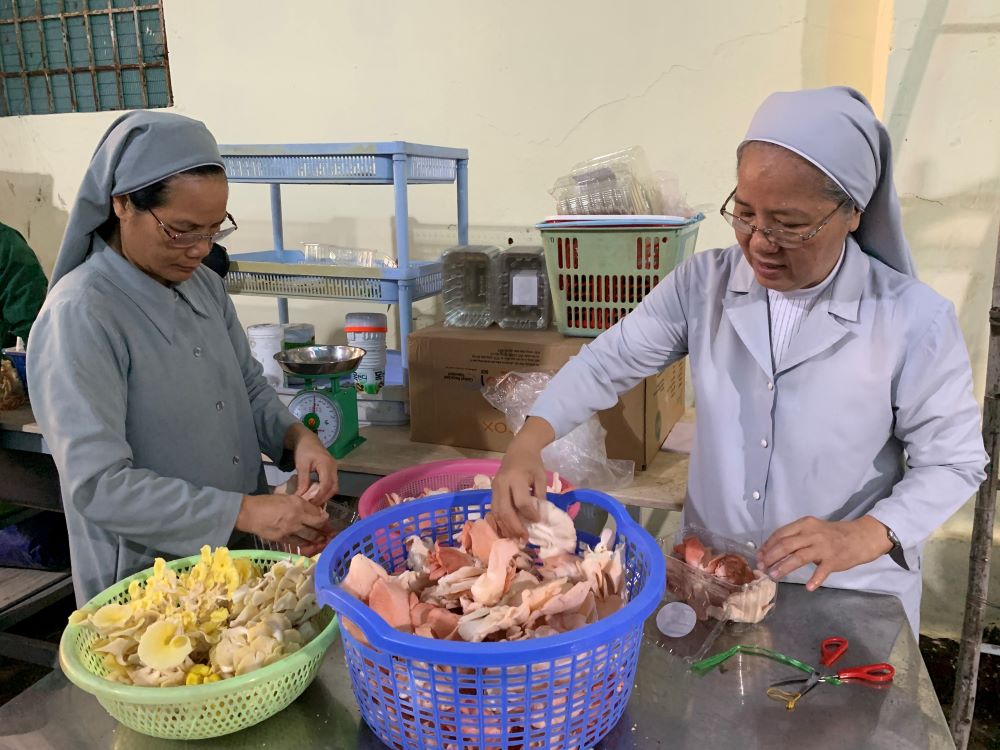
St. Paul de Chartres Srs. Marie Nguyen Thi Minh Hoa (left) and Agathe Tran Thi Mong Huyen pack mushrooms in boxes to deliver to customers. They grow five varieties of organic mushrooms, including abalone and reishi. (Mary Nguyen)
Inside the growing house, shelves are marked with the dates the mushrooms began growing, allowing the sisters to track each stage carefully.
"Every type requires a different technique and a lot of patience," Hoa said. "Light and humidity are especially important."
She said too much light fades the color of golden and pink mushrooms; the right amount produces deeper hues and higher nutritional value. To preserve quality, the sisters rely entirely on natural light.
The mushroom-growing house is designed to support organic cultivation. Its insulated ceiling reduces heat, while misting systems help maintain proper humidity. The structure has no surrounding walls, allowing continuous airflow. Trees and vegetables planted nearby help cool the space and improve air quality.
Water quality is equally essential. The sisters draw water from a purified filtration system at the neighboring St. Martin's Parish, ensuring a balanced pH level — a key requirement for organic mushroom farming.
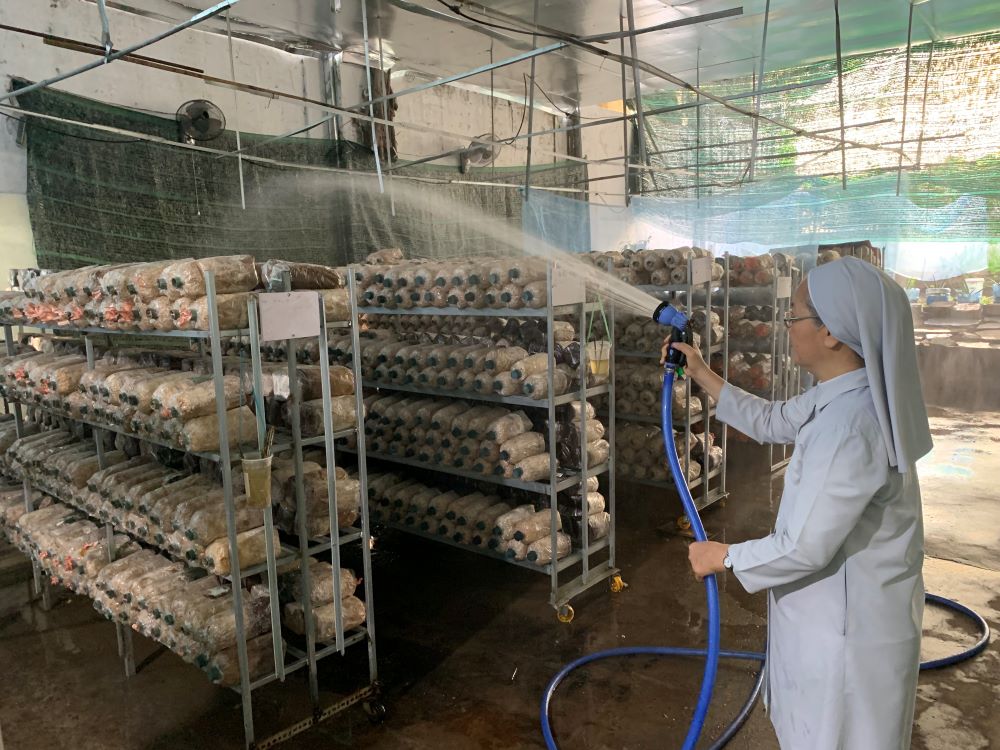
Sr. Agathe Tran Thi Mong Huyen waters mushroom growing bags on shelves arranged in neat rows in the sisters' mushroom-growing house in Ho Chi Minh City, Vietnam. The sisters started growing mushrooms in August. (Mary Nguyen)
The work did not come easily at first. "In the beginning, we lost many growing bags," Hoa recalled. "If the watering method [was] wrong, mushrooms would rot or stop growing because they lacked oxygen."
Over time, the sisters found the most effective approach. "Hand-watering works best," Hoa said. "But we water the walkways between shelves, not directly on the bags. Spraying on the bags can cause waterlogging."
The bags are produced by mixing sawdust, bean husks and essential nutrients, adjusting moisture levels, sealing the mixture in plastic bags, and sterilizing them at 100 degrees Celsius (212 degrees Fahrenheit) before inoculation. Mushroom spores then spread throughout the bag, and mushrooms emerge from the opening at the top.
Hoa said they invested about 100 million dong (about $3,850) to begin cultivating the mushrooms. Each harvest yields about 25 to 30 kilograms (882-1,058 ounces). To date, they have completed seven harvest cycles.
During harvest, the sisters gently pick clusters shaped like flowers, trim away sawdust, weigh the mushrooms and pack them into transparent boxes. Each box is labeled at 250 grams (9 ounces)0, but Huyen adds extra.
"I usually pack closer to 300 grams," she said. "Mushrooms lose moisture easily. It's better to give more than to give less."
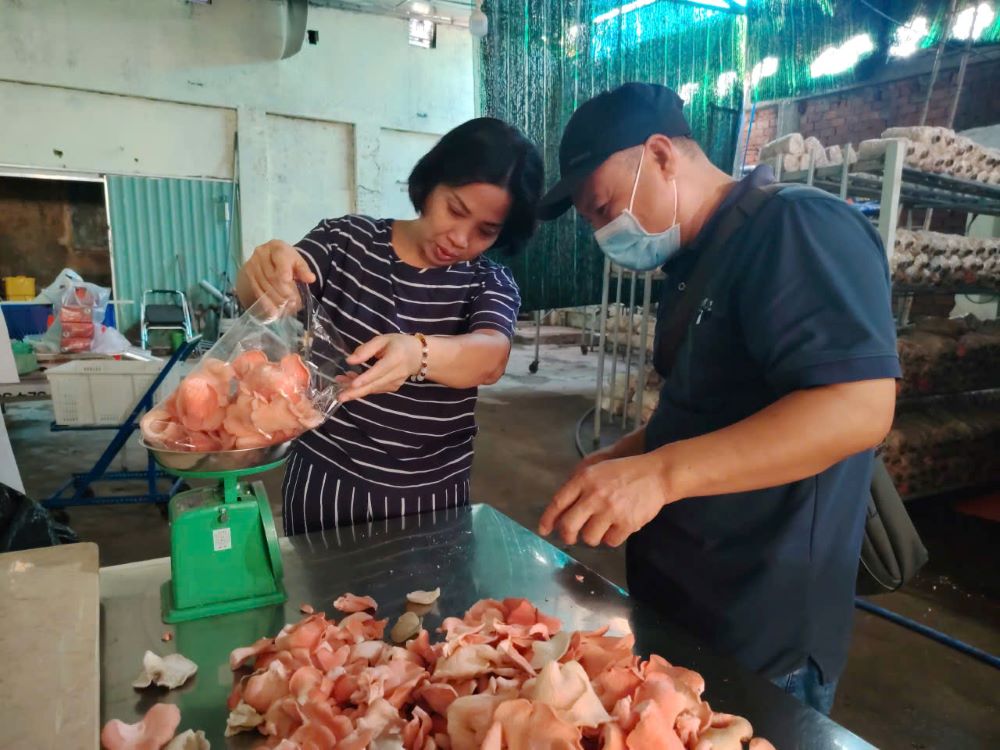
Maria Kieu Thi Thu Ha (left) and another customer buy mushrooms from the St. Paul de Chartres nuns in Ho Chi Minh City, Vietnam. Sales support scholarships for students preschool through university in five dioceses. (Mary Nguyen)
The sisters follow a strictly organic process, using no chemical fertilizers or pesticides. Waste is reused: Old growing bags and mushroom stems are composted and used to fertilize plants in the convent garden. Damaged mushrooms are dried and ground into seasoning powder.
"This is a closed circle," Huyen said. "Nothing harmful is thrown away."
She sees the project as a concrete response to Pope Francis' encyclical Laudato Si'. "We protect the environment, protect human health and provide clean food for families," she said. "That's why we chose this work."
For the two nuns, mushroom cultivation has become a new form of ministry. Huyen spent more than 30 years working in early childhood education, while Hoa devoted decades to pastoral care for hospital patients.
"Now this is our new mission," Huyen said. "It keeps us attentive and joyful."
The sisters supply mushrooms to other religious communities, kindergartens, and centers serving children with physical disabilities under their congregation's care.
Dr. Duong Ngoc Tram Anh, a nutritionist who works at a local hospital, said she supports the project by analyzing the mushrooms' nutritional benefits and promoting them to local residents.
Gradually, the mushrooms have become known by a familiar name: nấm bà sơ — "the sisters' mushrooms."
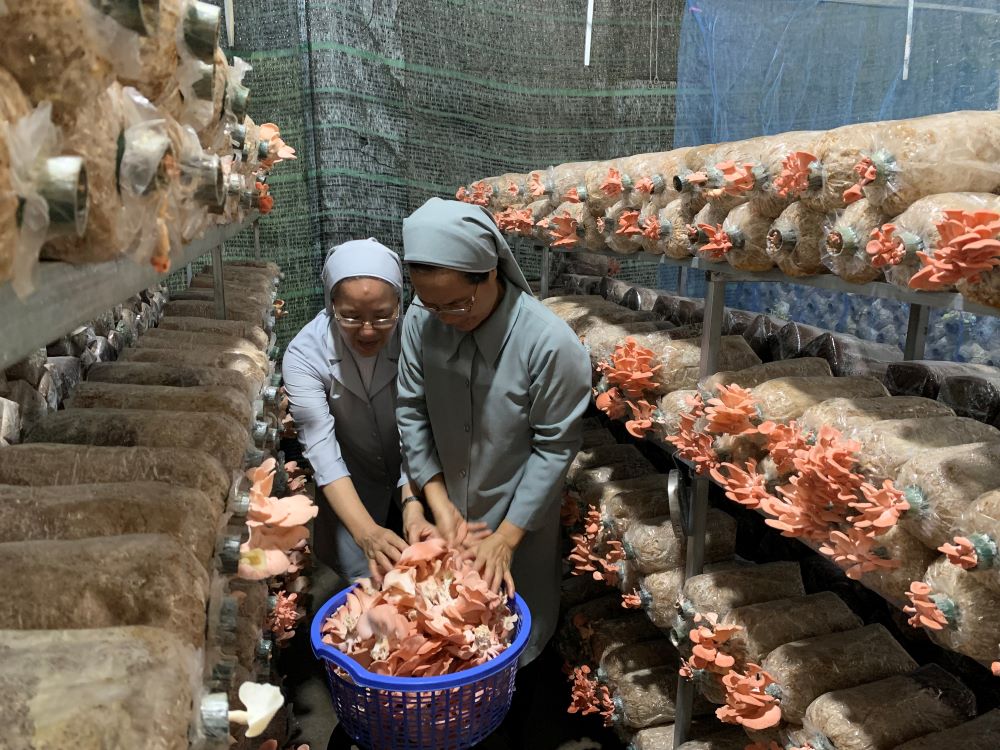
St. Paul de Chartres Srs. Agathe Tran Thi Mong Huyen (left) and Marie Nguyen Thi Minh Hoa harvest mushrooms in their mushroom-growing house in Ho Chi Minh City, Vietnam. (Mary Nguyen)
Anthony Tran Trinh Duy from Bui Mon Parish has visited the mushroom garden and closely watched the sisters work. "I was very happy when the sisters agreed to teach me how to grow mushrooms for free," he said.
The 47-year-old father of two hoped to replicate the model in the southern An Giang province, where his elderly father still farms rice.
"I want my father to have something meaningful to do every day," he said. "And I don't want him exposed to toxic chemicals anymore."
Other customers say they are drawn by both the quality of the mushrooms and the purpose behind them.
Maria Kieu Thi Thu Ha from Bac Ai Parish said she was struck by the appearance of the mushrooms. "They're soft, fresh and beautifully colored," she said. "I never imagined mushrooms could look like this."
"What matters most to me is not just the food," she added. "It's the scholarship fund behind this garden. That purpose makes it truly valuable."
Nguyen Thi Huong, an office worker, recently bought 3 kilograms of mushrooms to serve guests. "Everyone praised them," she said. "They were exceptionally delicious."
She said she buys the mushrooms primarily to support the sisters' education fund.
That fund lies at the heart of the project. Huyen oversees scholarships for 200 students from preschool through university, across five dioceses in the country.
Advertisement
Many students come from families devastated by COVID-19, terminal illness, poverty or divorce.
"We cannot turn our backs on these children," Huyen said. "But we also cannot rely on benefactors forever. We need a stable, long-term source of support."
"This is another way we help children stay in school," she said. "It's love added to their journey."
This is the first mushroom garden run by the St. Paul de Chartres nuns. They hope to expand the model and offer others an opportunity to cultivate mushrooms for public health and environmental protection.
As the morning warms, Hoa checks the last shelf and turns to leave the growing house. "This isn't just about mushrooms," she said. "It's about helping children move forward."
This story has been updated to correct the photo credits.