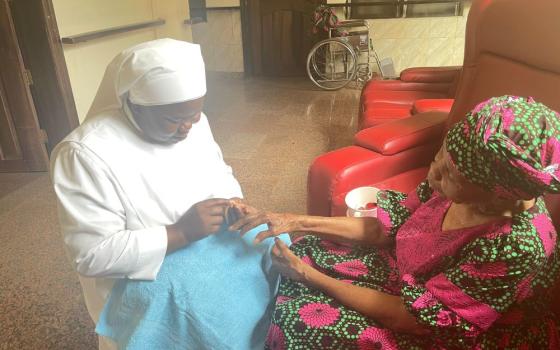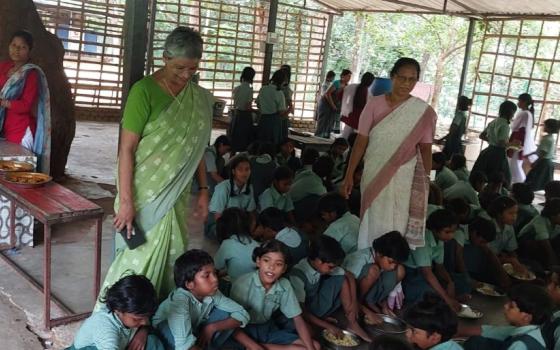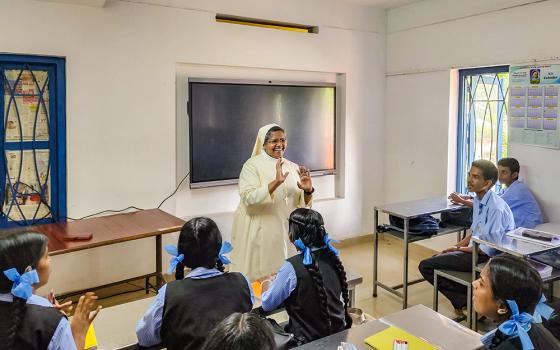
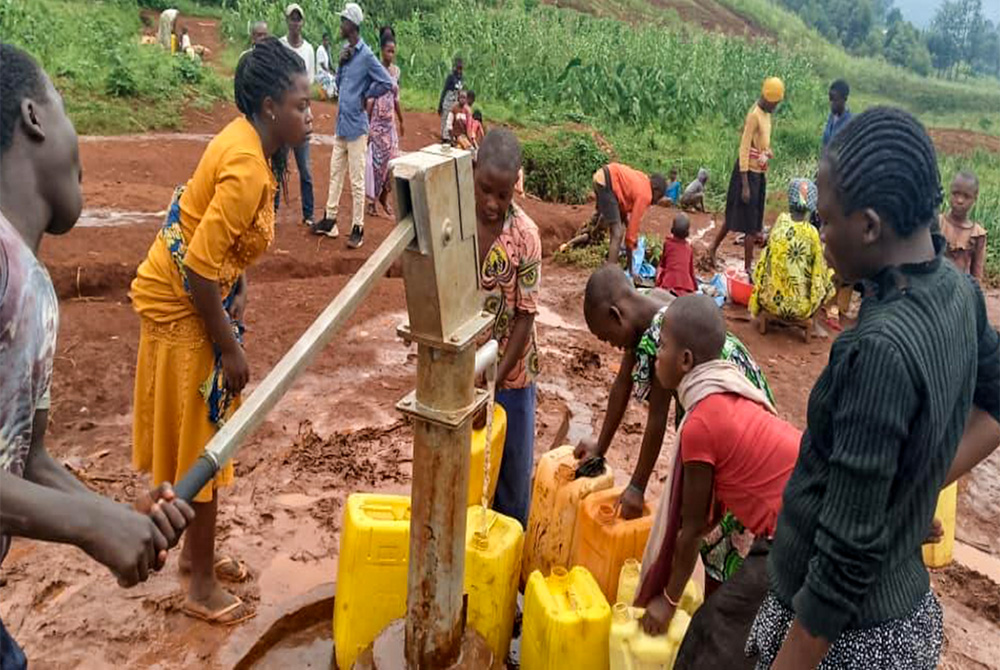
When improving access to water, local leadership is essential. Communities in Walungu Territory in South Kivu Province, Democratic Republic of Congo, form water committees to manage and maintain sources. Women play central roles — because they understand water needs best. (Courtesy of Rose Namulisa Balaluka)
by Sr. Rose Namulisa Balaluka
I remember one morning in Walungu Territory when I followed a group of women walking before sunrise. Each of them carried an empty yellow jerrican. Their pace was steady, but their faces were already tired.
We walked nearly two hours before eventually reaching a small, unprotected spring. As I watched them kneel in the mud to fill their containers, I thought, "Water is life — yet here, it is also suffering."
My ministry in Walungu Territory in South Kivu Province, Democratic Republic of Congo, has brought me close to many forms of poverty. But nothing reveals the daily burden carried by women and children more clearly than the search for clean water.
Water shapes health, dignity, education and opportunity. When it is scarce, everything else becomes fragile.
In most villages where I serve, water collection is the responsibility of women and girls. I have walked these paths with them — steep hills, slippery trails and long distances under rain or burning sun.
Since water points are often several kilometers away, women spend hours each day fetching water. This time could otherwise be used for farming, small businesses, prayer groups or rest. Instead, it is spent carrying 20-liter containers uphill.
I have seen young girls miss school because they must help their mothers. I have met women whose backs are permanently bent from years of carrying water. Their strength inspires me, but also grieves me because the search for water should not cost a child her education or a woman her health.
Advertisement
One of the hardest moments in my ministry is visiting families when children are ill from waterborne diseases. Most households rely on rivers, shallow wells or unprotected springs. These sources are easily contaminated. During the rainy season, runoff carries waste into the water. During the dry season, the remaining water becomes stagnant.
Diarrhea, cholera and typhoid are common. Unsafe water remains a major cause of child mortality, particularly in rural regions lacking sanitation infrastructure.
I remember holding a mother's hand as her child lay weak from dehydration. She told me, "Sister, we know the water is bad. But what choice do we have?"
Her question has stayed with me ever since.
Water scarcity is not only about disease. It is also about dignity and safety. Women often travel alone or in small groups to distant water sources. Some routes pass through isolated areas, and stories of harassment and violence are not uncommon.
Even personal hygiene becomes difficult when water is scarce. For women and adolescent girls, managing menstruation without adequate water or sanitation is deeply distressing. It affects confidence, school attendance and social participation.
Clean water protects not only health — it protects dignity.
When a child no longer drinks contaminated water, that is dignity restored. When a girl returns to school instead of walking for hours, that is justice.
I have observed how water scarcity traps families in poverty. When children are sick, parents spend what little money they have on medical treatment. When women spend hours collecting water, they lose time that could be used on farming or trading.
Development experts have long noted the link between water access and economic productivity. In Walungu, this link is visible every day. Water poverty becomes income poverty.
Yet amid these struggles, I see hope. Through the Association Internationale Tujenge (ASSIT), the faith-based organization I coordinate, we work alongside communities to improve access to water. We partner with local women's savings groups, churches and international supporters. Together, we protect springs, rehabilitate wells and introduce crucial hygiene education.
I remember the day we inaugurated a protected water source in one village. Women sang. Children danced. One elder said, "Today, our daughters get their future back."
Moments like this remind me why this work is sacred.
Local leadership is essential. Communities form water committees to manage and maintain sources. Women play central roles — because they understand water needs best.
We also promote simple sanitation solutions, including Arborloo latrines, which improve hygiene while enriching soil for agriculture. Education is equally important. Teaching handwashing, safe storage and sanitation reduces disease dramatically.
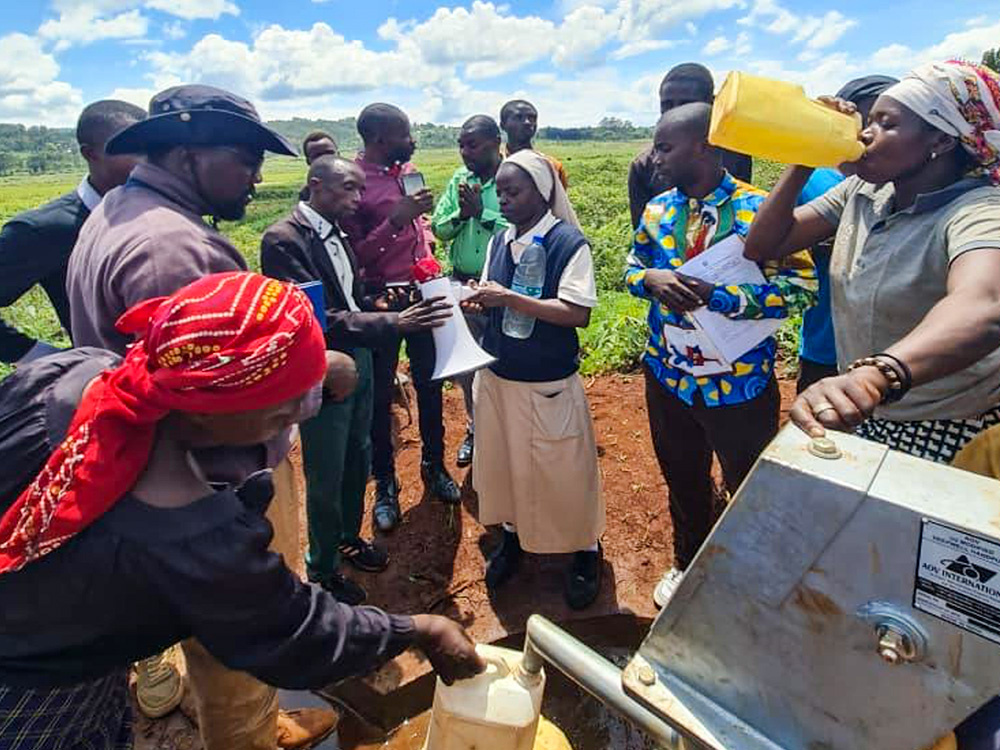
Dorothée de Cemmo Sr. Rose Namulisa Balaluka works alongside communities in Walungu Territory in South Kivu Province, Democratic Republic of Congo, to improve access to water, protect springs, rehabilitate wells and introduce crucial hygiene education. (Courtesy of Rose Namulisa Balaluka)
Change happens when infrastructure and behavior grow together.
My experiences in Walungu have transformed how I understand my mission. In the past, I thought ministry was primarily spiritual accompaniment — prayer, pastoral care and presence.
Now I see that ensuring access to water is also a ministry. When a child no longer drinks contaminated water, that is dignity restored. When a girl returns to school instead of walking for hours, that is justice. When women lead water committees, that is empowerment. Water work is women's work, children's work and, therefore, church work.
The effects of water scarcity on women and children in Walungu are profound. Women carry physical burdens, face safety risks and lose economic opportunity. Children suffer from disease, malnutrition and interrupted education.
Yet I remain hopeful.
I have seen what happens when communities gain access to clean water. Illness declines, school attendance rises, women start businesses, and families regain time and dignity.
Sustainable solutions require collaboration: communities, faith organizations, governments and partners working together. But transformation begins locally. It begins with listening to women. It begins with walking the water path ourselves. Every time I see clean water flowing from a protected source, I am reminded that hope, like water, must be brought close to the people.
And when it is, life flourishes.