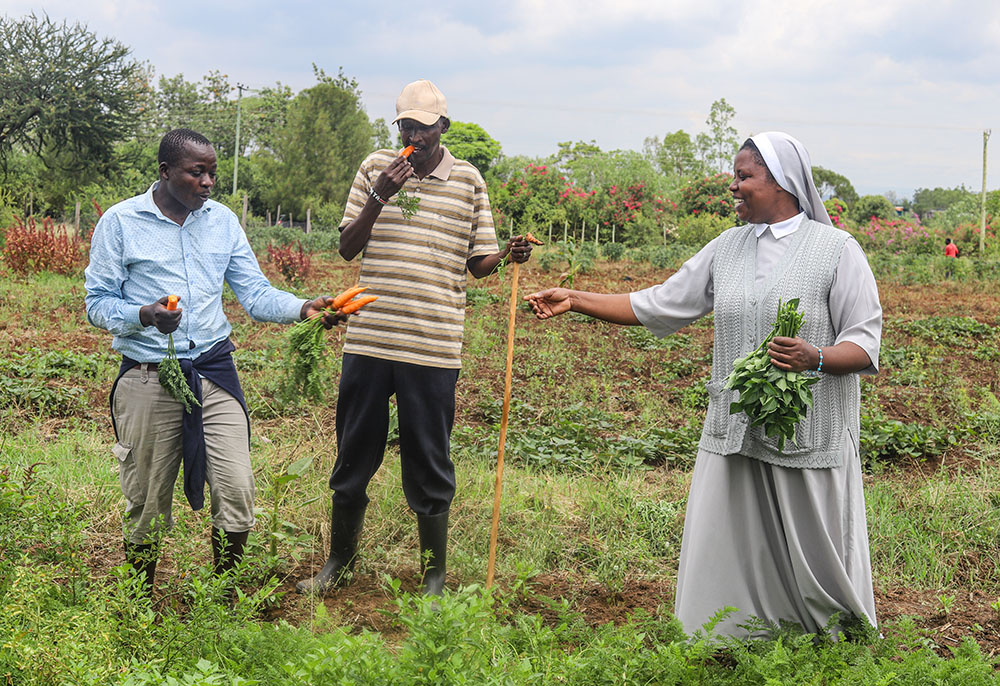
Moses Kelaino (center) and Sr. Stella Cherobon (right) harvest vegetables with another farmer at a demonstration farm in Tuala, Kenya. The project teaches Maasai families climate-resilient farming as drought continues to reshape pastoral life across Kenya’s dry lands. (GSR photo/Doreen Ajiambo)

by Doreen Ajiambo
At sunrise on the dry plains south of Nairobi, Moses Kelaino kneels in a field that should not exist.
Cassava plants rise nearly to his waist, their broad green leaves trembling in the early morning breeze. Beneath the soil, thick roots are forming — food that will sustain his family long after the rains disappear again.
For most of his 62 years, Kelaino never imagined himself farming.
Among the Maasai people, cattle have always defined life. Livestock meant milk for children, wealth for families and dignity for elders. For generations, herders followed the rhythm of the sky: When the rains came, grass grew and cattle thrived across the open plains.
But over the past decade, the sky has begun to forget its promises.
On this patch of land in Tuala, a small settlement about 24 miles south of Nairobi, an entire way of life is changing.
"The Catholic sisters have educated and motivated us not to depend on livestock alone," Kelaino said as he brushed a cassava leaf between his fingers. "Now we are able to plant crops and still have food even when the land is dry."
Just beyond the edge of his field, the landscape shifts. The soil turns pale and dusty, and a few cows wander slowly across brittle grass that struggles to grow under the harsh sun.
Kelaino watches the cattle for a moment, remembering how animals like these once defined everything about his future. Today, however, that future is also growing quietly beneath the soil of his cassava field.
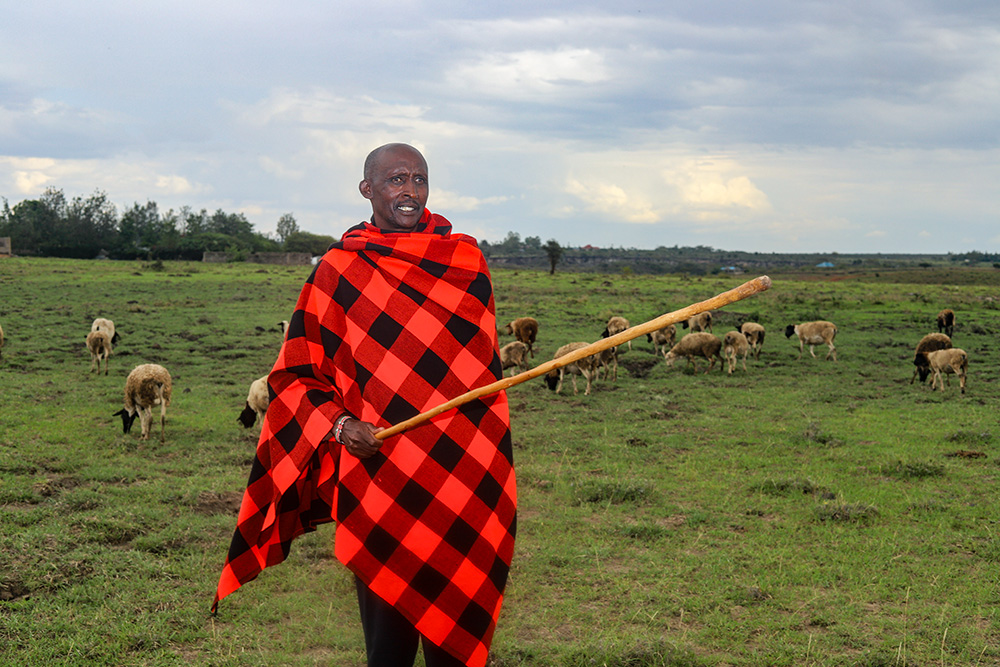
Moses Kelaino, a Maasai pastoralist in Tuala, Kenya, stands near his livestock. After years of drought that killed many animals across the region, Kelaino began growing drought-resistant crops through training provided by Catholic sisters. (GSR photo/Doreen Ajiambo)
In the dry lands of southern Kenya, where pastoralist life has revolved around cattle for centuries, climate change is forcing a profound transformation.
In communities like Tuala, Maasai farmers and Catholic sisters are experimenting with a different future — combining water access, drought-resistant crops and local training to help pastoralists adapt.
Longer droughts, unpredictable rains and rising temperatures are killing livestock and pushing pastoralist families toward hunger across East Africa's arid lands.
Kenya's arid and semiarid lands cover more than 80% of the country and support millions of pastoralists who depend on livestock for survival, according to government and development agencies. Climate scientists say these regions are warming faster than the global average, intensifying drought cycles and threatening livelihoods that have sustained communities for generations.
As global leaders prepare to debate climate finance and adaptation strategies at the COP31 climate summit in Antalya, Turkey, in November 2026, the partnership unfolding here offers a glimpse of what climate resilience on Africa's front lines can look like.
When the cattle started dying
For centuries, Maasai pastoralists survived by following seasonal rains across vast grazing lands. Their culture depended on a delicate balance between cattle, grass and water.
That balance is now unraveling.
Humanitarian agencies say the Horn of Africa experienced five consecutive failed rainy seasons between 2020 and 2023, the region's worst drought in more than 40 years.
During that period, more than 9 million livestock died across Kenya, Ethiopia and Somalia, devastating pastoralist families whose survival depends on them.
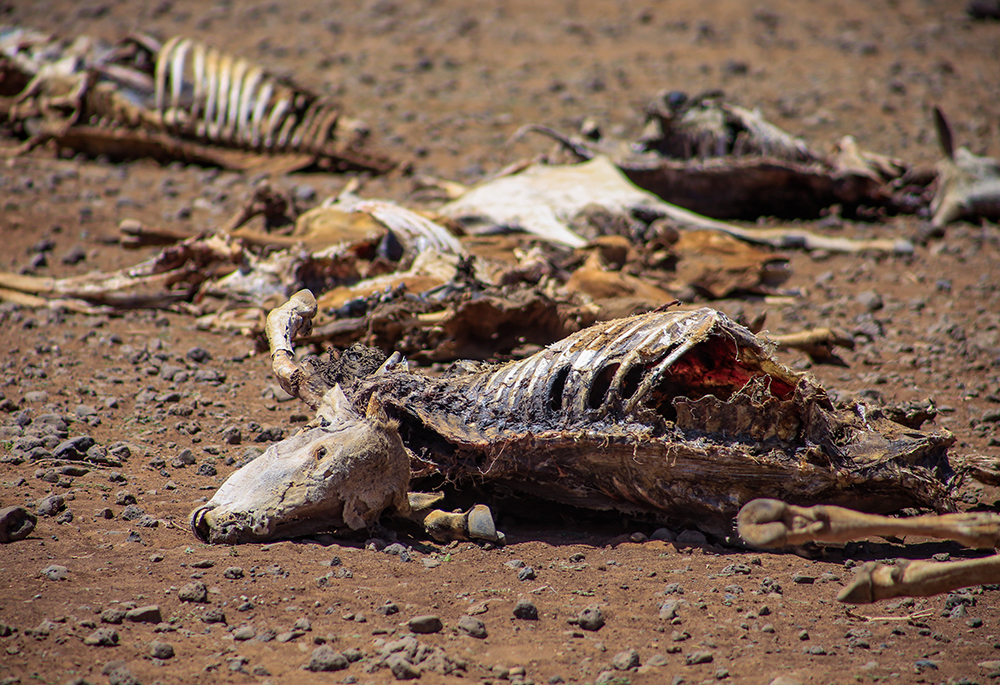
The skeletal remains of livestock lie scattered across the dry ground in Marsabit County, northern Kenya. Repeated droughts linked to climate change have wiped out herds across the region. (Pius Artbeat)
Kenya itself is facing a growing food insecurity crisis. A 2026 humanitarian situation update published on ReliefWeb warns that worsening drought in the country's arid and semiarid lands is driving malnutrition and acute food shortages, leaving millions of people in need of urgent food assistance.
"The region's climate system is becoming more volatile," said Kenyan climate activist Jackline Wanjiku. "Pastoralist communities historically relied on predictable rainfall patterns, but climate change is disrupting those cycles and making droughts longer and rainfall more erratic."
Kelaino understands that disruption in deeply personal terms.
Two years ago, he walked out to check his cattle before sunrise after months of relentless drought. The grass had long disappeared, leaving only dust and scattered thorn bushes across the plains.
One of his oldest cows was lying on the ground.
At first, he thought the animal was resting. But as he moved closer, he noticed its breathing had become shallow and uneven.
He tried to lift it, hoping it might stand. It did not move.
Within hours, the cow was gone.
"My children grew up drinking milk from that cow," Kelaino said. "When the cows die, it is like losing a bank account, a kitchen and a family member all at once."
That morning, he buried the animal beneath an acacia tree and stood beside the mound of soil, wondering for the first time whether the sky itself had changed.
Advertisement
The sisters arrive
Several years earlier, a small group of Catholic sisters working in the area had begun noticing the same troubling pattern.
Members of the Handmaids of the Holy Child Jesus, an international Catholic congregation known for its work in education, health and social development, had come to Tuala primarily for pastoral ministry.
But as drought intensified, the sisters witnessed families struggling to survive.
Livestock were dying. Women walked long distances searching for water. Food became scarce during prolonged dry seasons.
"Climate change is one of the biggest problems we are facing, not only as a country but across the entire continent," said Sr. Stella Cherobon, one of the sisters working in the community.
"Many communities are experiencing very erratic weather patterns. When the rains come, they are often too heavy, and when drought comes, it lasts much longer than before."
The region around Tuala lies in Kenya's semiarid lands, where rainfall has always been unpredictable.
But in recent years, the cycles have become more extreme.
Seasonal rivers that once flowed during rainy months now dry up completely during prolonged droughts. Families who depended on those water sources find themselves traveling farther each year to survive.
The sisters realized that charity alone would not solve the problem and began searching for something more sustainable.
The initiative that later became the Handmaids Social Enterprise project began almost unexpectedly.
"We realized people were struggling with both food and water," said Sr. Mary Taabu Simiyu, who oversees the project.
"Instead of just giving food, we asked ourselves how we could help the community grow their own."
The project began informally around 2018 and became fully operational in 2019, supported by a $25,000 grant from the Conrad N. Hilton Foundation, which also funds Global Sisters Report.
The sisters began experimenting with crops suited to the region's dry conditions — cassava, sweet potatoes, groundnuts, passion fruits and vegetables.
"These are crops that can still grow even when rainfall is low," Simiyu said. "They help families have food even during difficult seasons."
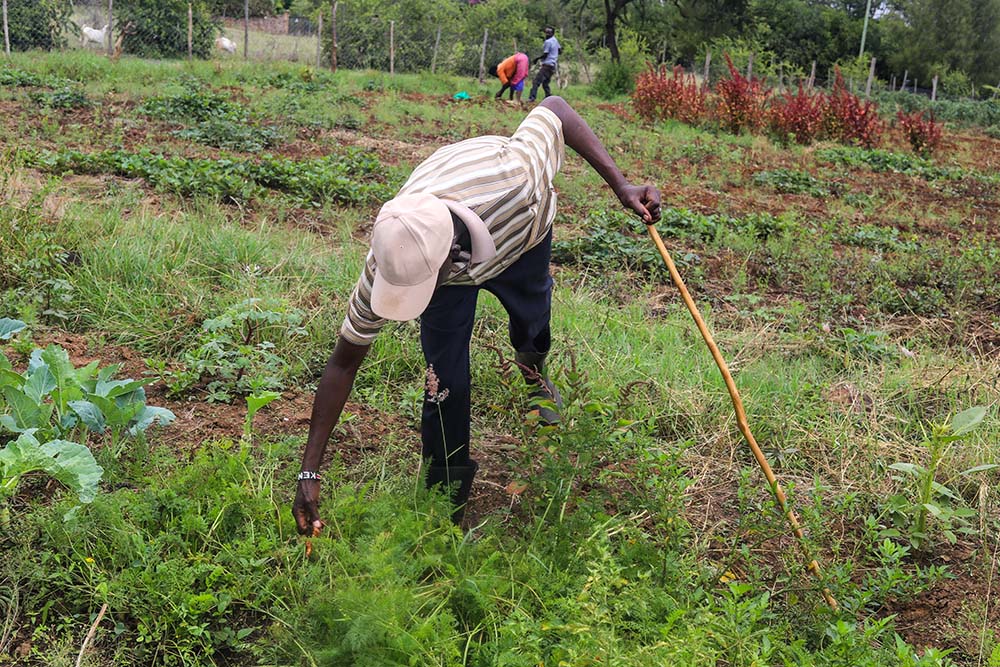
Moses Kelaino works in his vegetable garden in Tuala, Kenya. Through training from Catholic sisters, he has begun growing crops such as cassava and vegetables to help his family survive recurring droughts. (GSR photo/Doreen Ajiambo)
For several years, humanitarian organizations occasionally delivered food aid to the community during severe droughts. But around 2021, the food support stopped, forcing the sisters and local residents to look for longer-term solutions.
Water quickly emerged as the most urgent need.
Water from beneath the dust
With support from the Hilton Foundation, the sisters secured funding to drill a borehole.
Villagers in Tuala recall that when the drilling truck first arrived, people gathered beneath nearby acacia trees to watch. The ground here is stubborn, hardened by decades of sun and long dry seasons.
The machine roared as its metal drill pushed slowly into the earth. For hours, villagers recall, nothing happened.
Dust rose into the air as the drill forced its way deeper underground. Some villagers began drifting away, convinced the effort would fail.
But the sisters remained beside the rig, praying quietly.
Then, late in the afternoon, the drill struck softer ground. Muddy water burst upward through the pipe and spilled across the dry soil, forming small streams in the dust.
Villagers recalled children running forward and shouting, while women clapped their hands in disbelief. For the first time in years, water was rising from beneath the land instead of disappearing from it.
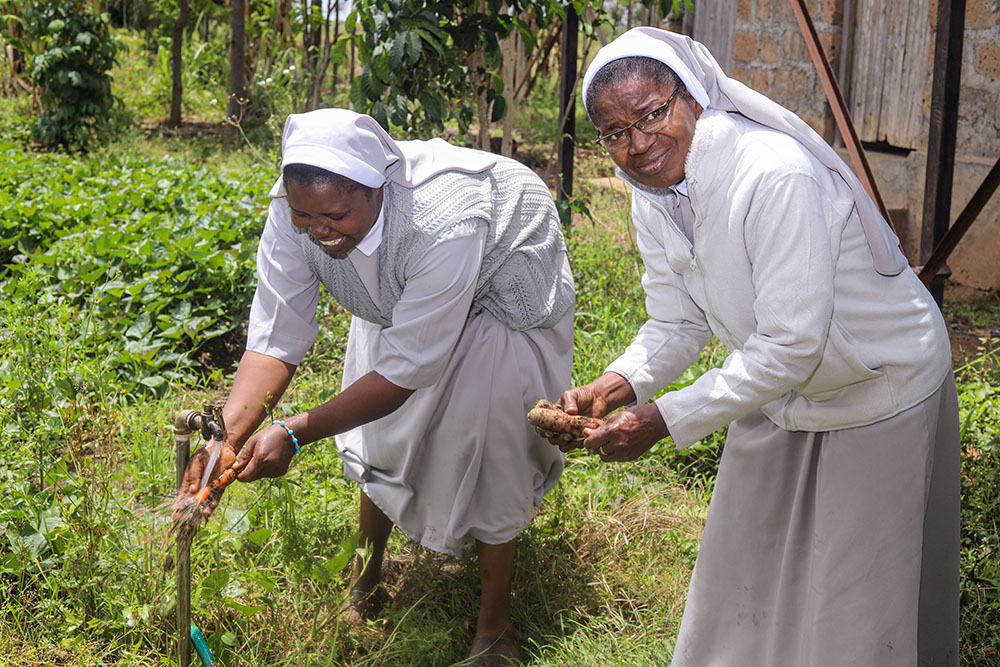
Srs. Stella Cherobon, left, and Justina Umeh wash freshly harvested vegetables at the Handmaids Social Enterprise project in Tuala, Kenya, where Catholic sisters are helping local families adopt climate-resilient farming practices. (GSR photo/Doreen Ajiambo)
Later, an additional 9,000-euro grant from a European Catholic organization helped install a water tank, solar panels and a solar-powered pump.
The sisters decided the water system should serve not only their compound. Pipes were extended so nearby households could also access clean water.
Families now pay a small fee for water. Most of the money goes toward maintaining the pump, repairing pipes and paying technicians when equipment breaks.
"It is not meant to make profit," Simiyu said. "The goal is simply to keep the system running for the community."
Farming where pastoralists once roamed
Today, the farm covers more than 5 acres, and about 50 families have received training.
Kelaino was among the first. He still keeps cattle, about 60 cows, but now also grows cassava and vegetables.
"Cassava does not require a lot of rain," he said. "My family now has food even when the rains fail."
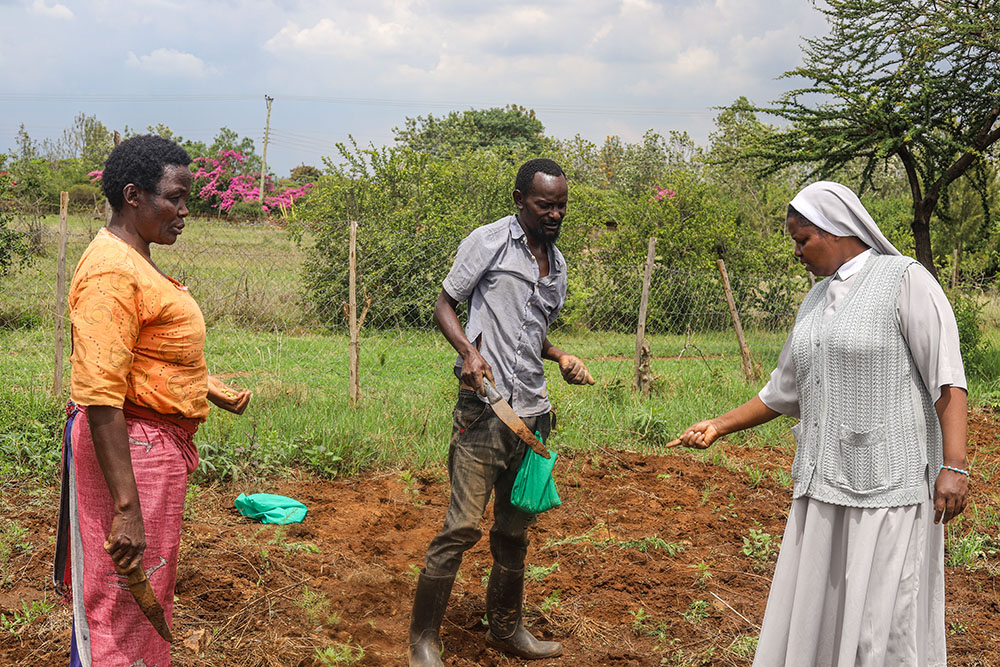
Mary Ledama, left, and Sr. Stella Cherobon plant crops at the Handmaids Social Enterprise farm in Tuala, Kenya. Catholic sisters working with Maasai communities are promoting drought-resistant farming as climate change threatens traditional pastoral livelihoods. (GSR photo/Doreen Ajiambo)
For Mary Ledama, a mother of six, the project has transformed daily life. Before the borehole was drilled, she walked nearly 10 km each day to fetch water.
Now she grows vegetables near her home.
"My children have food," she said. "And I have gained respect in my home."
As evening settles over the plains of Tuala, Kelaino walks slowly through his cassava field while the wind carries the distant sound of cowbells across the dry grasslands that once sustained entire herds.
Beyond the rows of crops, the land stretches outward in dusty shades of brown and gold, a reminder of how fragile life has become in a place where the seasons no longer follow the patterns elders once trusted.
Kelaino bends down and pulls a cassava root from the soil, brushing away the dirt as he studies the thick white tuber that will soon feed his family.
"For a long time, we believed our lives would always depend on livestock alone," he said. "But the weather has changed, and now we must change with it."