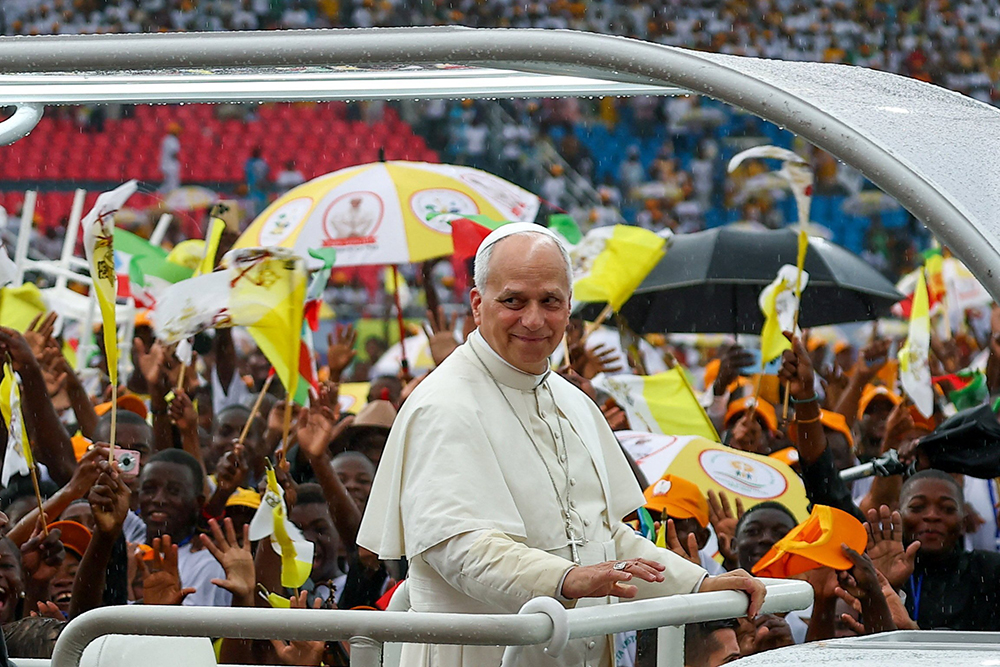
Pope Leo XIV smiles as he arrives at Bata Stadium in Equatorial Guinea, April 22, 2026, for a meeting with young people and families. (OSV News/Reuters/Kevin Thoma)

by Doreen Ajiambo
On the wide stone steps of St. Joseph's Cathedral, where Pope Leo XIV stood days earlier addressing thousands in Bamenda, Cameroon, Sr. Felicitas Lukong lifted her hands slightly, as if still holding onto the moment.
Behind her, the cathedral's mosaic façade shimmered under a shifting sky. The space that had recently overflowed with worshippers had returned to a quiet calm, but for Lukong, the moment had not passed.
"He has shown himself to be a shepherd who truly cares for his people," she said of his April 13-23 African papal visit. "We are deeply touched, not just by his presence, but by his message of peace."
Standing at the exact spot where the pope spoke, Lukong, a member of the Sisters of St. Thérèse of the Child Jesus of Buea, Cameroon, said the visit continues to echo across this conflict-affected region of northwestern Cameroon — in conversations, in parish gatherings and in a renewed sense of responsibility among communities.
As the Catholic Church celebrates the first anniversary of Leo's election May 8, religious sisters and lay Catholics across Africa are reflecting on what many describe as one of the defining gestures of his first year: bringing his message directly to the continent early in his papacy.
Advertisement
For many sisters, the visit felt close.
In Nigeria, Sr. Elizabeth Titilayo Aduloju, a communication scholar and member of the Sisters of St. Michael the Archangel, described the papal visit as "a quiet yet unmistakable act of conversion of gaze."
"Rome turning its eyes, early and intentionally, toward a continent that has long sustained the church," she said.
Rather than presenting Africa as a place to be managed, she said, the visit suggested a partnership rooted in dialogue and mutual contribution.
"In our communities, it felt like reassurance," Aduloju added. "That we are seen, that our struggles matter and that our contributions are valued."
For many across Africa, the visit carried weight beyond symbolism. It signaled recognition of a continent often defined by its challenges but increasingly central to the life and future of the global church. It also affirmed the role of religious sisters and local leaders who sustain communities through conflict, poverty and social instability.
Through interviews with sisters in Cameroon, Kenya, Nigeria and Malawi, a consistent message emerges: the visit was not only about presence, but also about affirmation, responsibility and a renewed call to action.
"Africa is not only receiving the faith. It is also offering something to the universal church."
—Sr. Elizabeth Titilayo Aduloju
Why the visit matters to Africa
Africa is home to one of the fastest-growing Catholic populations in the world, a reality that many sisters say is reshaping the global church.
For religious leaders, the pope's early visit was important because it acknowledged that growth and placed African realities more firmly within the global Catholic conversation.
"Africa is the church's youth and its future," Aduloju said.
She noted that the visit aligned with a broader shift toward listening to communities on the margins and recognizing their role in shaping the church's direction.
"Africa is not only receiving the faith," she said. "It is also offering something to the universal church."
Sr. Eneless Chimbali, of the Servants of the Blessed Virgin Mary in Malawi, said the visit reinforced a growing awareness of Africa's role.
"As Africa's influence grows, there is a rising awareness that we represent a significant hope for both the world and the church," she said. "Africa has a treasure to share."
Sr. Florence Nwaonuma, of the Sisters of the Sacred Heart of Jesus in Nigeria, connected the moment to a longer history of African contribution to Christianity.
"The Holy Father's gesture shows that the universal church recognizes what Africa has given and continues to give," she said.
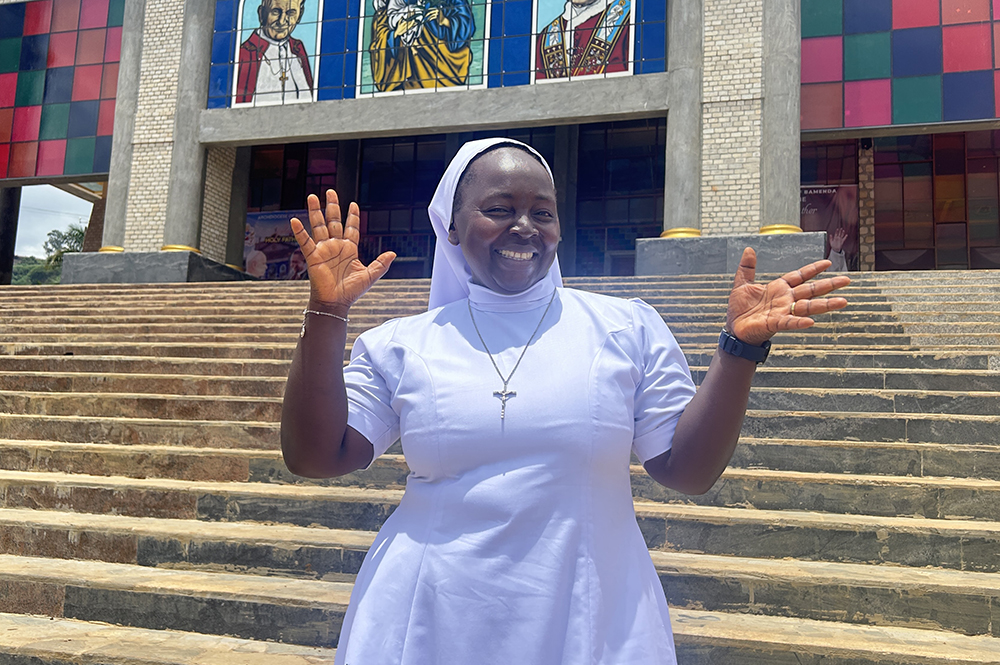
Sr. Felicitas Lukong stands at the spot where Pope Leo XIV addressed the faithful in Bamenda, Cameroon, reflecting on the impact of his visit one year later. (GSR photo/Doreen Ajiambo)
For many sisters, this recognition helps explain why the pope is being celebrated one year into his papacy. His visit was not simply an event, but a signal that Africa's voice matters.
Sr. Jane Wakahiu, a member of the Institute of the Little Sisters of St. Francis in Kenya and director of the Catholic Sisters Program at the Conrad N. Hilton Foundation, said the pope's decision to visit Africa within his first year demonstrated "exemplary moral leadership." (Hilton is a major funder of GSR.)
"His visit reflects a commitment to accompanying the faithful and fostering a culture of encounter and attentive listening," she said.
By addressing violence in countries such as Cameroon, South Sudan and the Democratic Republic of Congo, along with broader issues of poverty and corruption, she said the pope "proclaimed peace, reconciliation and hope."
The visit, Wakahiu added, reinforced confidence in Africa's future.
"It has inspired hope that Africa is a continent full of promise and contributes to the life of the church," she said. "Despite the many challenges — conflict, environmental strain linked to mining, poverty and healthcare pressures — it is possible to overcome them. He challenged leaders to address these realities within their countries."
From message to action
In Bamenda, Lukong said the most visible impact of the April 15-18 visit has been a shift in how people think about peace; she said it created a rare moment of unity in the English-speaking northwest region of Cameroon, which has for years been at the heart of a separatist conflict that has displaced communities and strained social cohesion.
"Many are beginning to understand that peace is something we must work for ourselves," she said. "People heard him, and they are repeating his message."
She described how communities have begun organizing meetings to reflect on the pope's message and apply it to daily life.
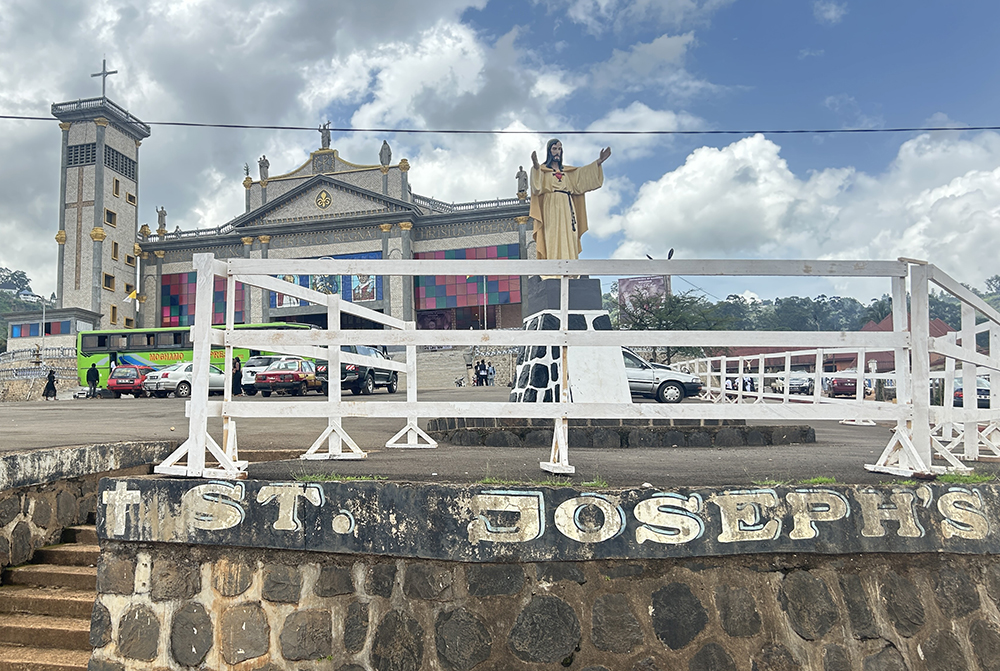
St. Joseph’s Cathedral in Bamenda, Cameroon, where Pope Leo XIV addressed thousands during his visit, continues to draw reflection one year into his papacy. (GSR photo/Doreen Ajiambo)
Beyond its spiritual impact, she pointed to tangible improvements linked to preparations for the visit, including road repairs and the reopening of an airport that had been closed during the conflict.
Still, many sisters cautioned that deeper transformation will take time.
Sr. Solange Lomessoas of the Dominican Sisters of Blessed Imelda in Cameroon said the pope's message on peace and justice resonated strongly, but structural challenges remain.
"We cannot yet speak of real change," she said.
However, Lomessoas noted growing signs of understanding and cooperation, even within communities historically divided.
"In our community, there is more tolerance," she said, pointing to collaboration between Anglophone and Francophone sisters supporting vulnerable children.
Others urged caution about how much a single visit can achieve.
"Symbolic visits alone cannot resolve entrenched conflicts," said Joseph Nfor, a catechist and religious scholar in Bamenda. "They can inspire, but real change depends on sustained commitment from leaders and communities alike."
Across Africa, similar patterns are emerging. The visit has not transformed realities overnight, but it has shifted attitudes, strengthened morale and encouraged communities to act.
As Catholics mark the pope's first anniversary, many sisters describe his engagement with Africa as something worth celebrating.
"What stands out is not only that he came, but how he came," said Aduloju, pointing to Leo's approach of listening and engaging communities as a sign of a church increasingly shaped by dialogue.
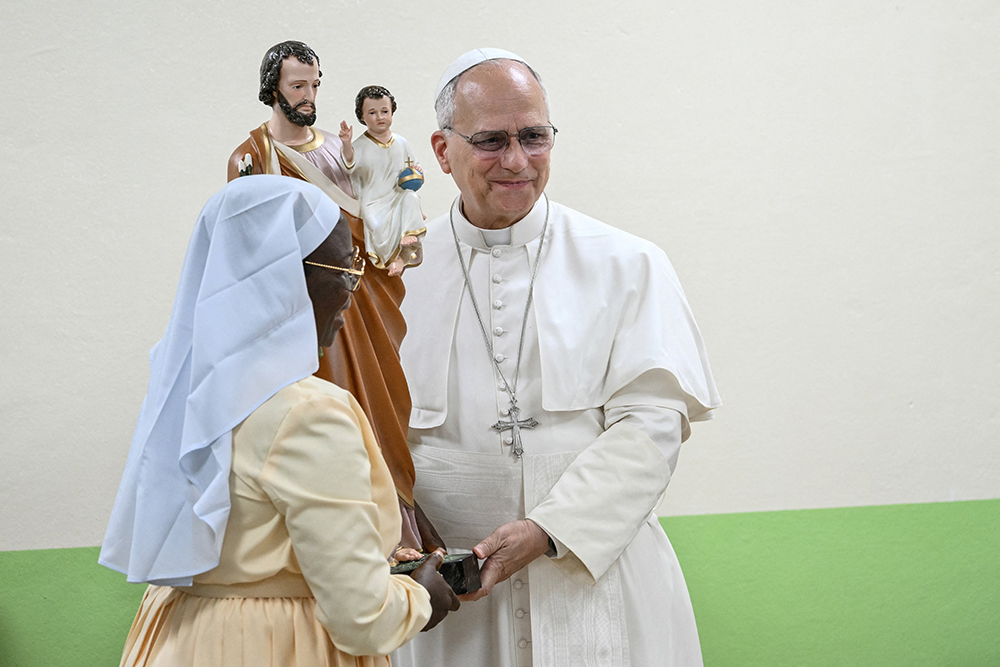
A nun presents Pope Leo XIV with a statue of St. Joseph and the Christ Child during his visit to the Ngul Zamba Orphanage in Yaoundé, Cameroon, April 15, 2026. (OSV News pool via Reuters/Alberto Pizzoli)
Chimbali said the visit offered hope, especially for communities facing hardship.
"It encourages us to recognize the value within our own communities," she said.
Wakahiu emphasized the pope's willingness to address difficult issues such as conflict, poverty and governance.
"His message offers a path forward," she said.
Yet alongside celebration, expectations are rising.
Many sisters called for greater representation of Africans, including women religious, in church leadership. Others emphasized the need for continued engagement on peace, governance and social justice.
"If this visit is to bear lasting fruit, it must lead to deeper collaboration," Aduloju said.
Back on the steps of St. Joseph's Cathedral, the crowds may be gone, but the message remains.
For Lukong, the visit was not an end, but a beginning.
"He did not bring peace in a basket," she said. "He gave us words. Now it is up to us to make them real."